


Blog
GHK-Cu copper peptide benefits for skin: what research shows

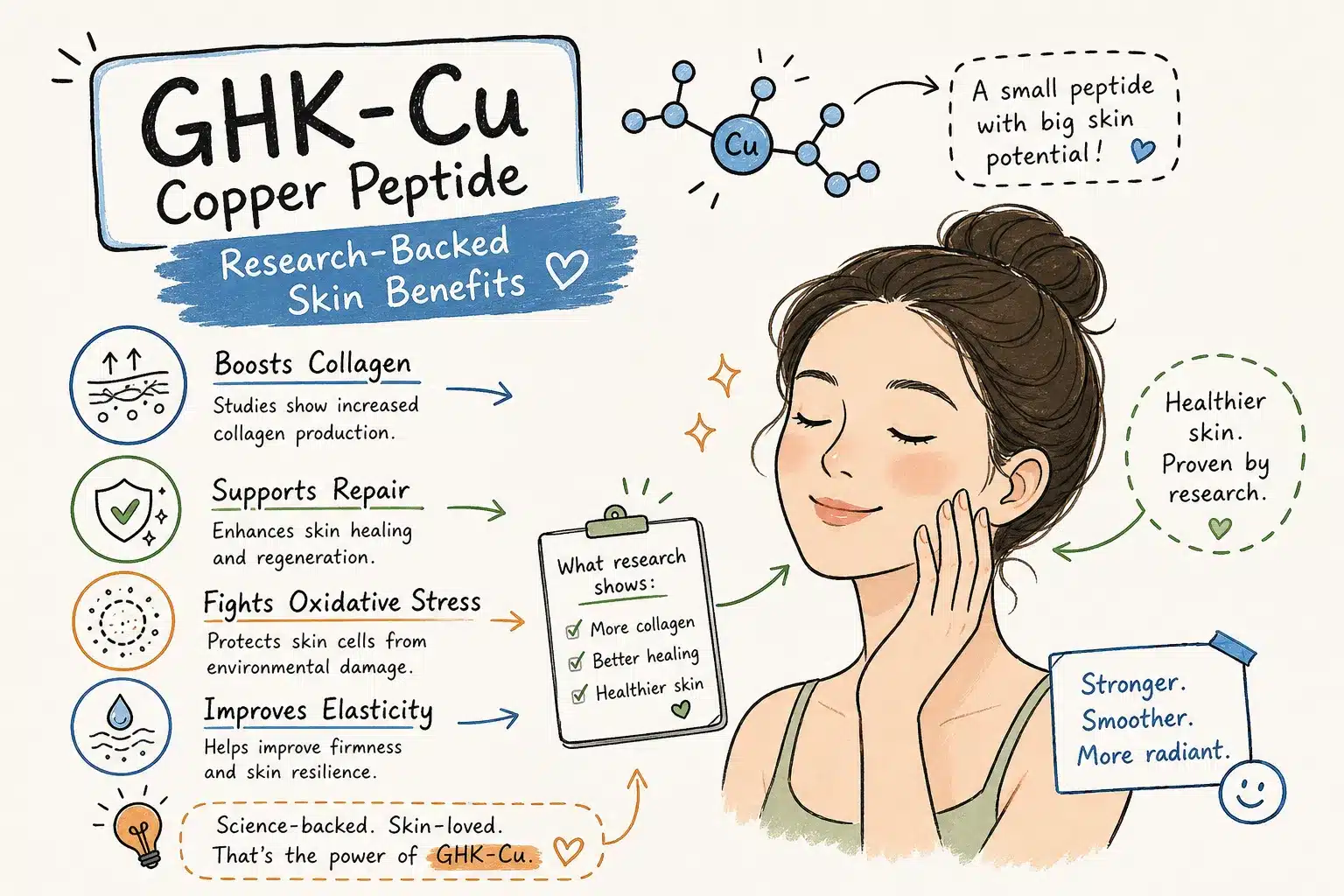
GHK-Cu, also listed on ingredient decks as copper tripeptide-1, is one of the most-researched copper-binding peptides in cosmetic and pre-clinical skin science. This research-first review examines GHK-Cu copper peptide benefits for skin research, covering cellular mechanisms, human trial outcomes, comparative data, formulation specifics, and safety signals. The problem is that marketing often overstates the breadth of evidence compared with published trials. Read the product copy and GHK-Cu sounds like a near-complete solution for photoaged skin. Read the clinical trials and you find small but real human studies, strong mechanistic evidence, and a compound that genuinely earns its reputation in specific areas while leaving other claims undersubstantiated.
GHK-Cu appears in everything from solo topical products to multi-peptide research blends. Suppliers like R-Peptide Supply carry it as part of combinations such as the GLOW stack, making it more accessible for pre-clinical and independent study. The goal here is to separate what the documented findings say from what researchers have extrapolated beyond them.
GHK-Cu copper peptide benefits for skin research: cellular mechanisms
Collagen synthesis and extracellular matrix signaling
The foundational finding behind GHK-Cu’s reputation is straightforward: it stimulates collagen production and glycosaminoglycan assembly at low, non-toxic concentrations in human dermal fibroblast cultures. The classic reference is Maquart et al. (1993), and more recent work by Schwartz et al. (2018) confirmed collagen production increases in human adult dermal fibroblasts (HDFa) at concentrations of 0.01, 1, and 100 nM. In plain terms, GHK-Cu signals fibroblasts to upregulate collagen I and related structural proteins, which is precisely why it keeps appearing in copper peptide clinical studies on skin repair.
What makes the Schwartz data particularly useful for researchers is the dose pattern: collagen and elastin production increased across tested concentrations, but the response showed an inverse dose-dependent curve at the 96-hour mark. That kind of nuanced result is exactly what distinguishes lab-grade sourcing from consumer marketing, where dose complexity gets flattened into “more is better.”
MMP and TIMP regulation: controlling matrix breakdown
GHK-Cu does not just build extracellular matrix; it also regulates how fast the matrix breaks down. Matrix metalloproteinases (MMPs) are enzymes that degrade structural proteins like collagen; tissue inhibitors of metalloproteinases (TIMPs) counterbalance them. Peer-reviewed reviews specifically cite TIMP-1 and TIMP-2 modulation as part of GHK-Cu’s mechanism, and the fibroblast data supports this: TIMP-1 mRNA increased at all tested concentrations, with the increase exceeding the rise in MMP-1, suggesting a net reduction in collagenolytic activity. TIMP-2, however, showed mixed results depending on dose and cell type, which means the research picture is more granular than a simple “GHK-Cu inhibits matrix degradation.”
This dual action on both synthesis and regulated breakdown is why GHK-Cu shows up consistently in wound remodeling and photoaged skin studies. It operates across multiple repair levers simultaneously, which distinguishes it mechanistically from single-pathway compounds and helps explain its recurring presence in skin aging research protocols.
Anti-inflammatory pathways linked to GHK-Cu activity
Beyond matrix signaling, GHK-Cu has been studied for its effects on inflammatory pathways relevant to chronic skin aging. Experimental models report suppression of NF-κB and p38 MAPK signaling, with downstream reductions in TNF-α and IL-6. For photoaged skin, chronic low-grade inflammation is a central driver of ongoing matrix degradation, so a compound that addresses both the structural and inflammatory axes is a plausible candidate for long-term repair protocols, though large human trial confirmation is still absent. The important caveat is that this evidence comes primarily from experimental models, not large human trials.
What the human clinical trials actually found
The three photoaging studies: outcomes and sample sizes
Three published topical studies in women with photoaged or photodamaged skin form the core of the human evidence base for copper peptide skin benefits. In a 71-woman placebo-controlled facial cream trial lasting 12 weeks, researchers documented improvements in skin density, thickness, laxity, clarity, fine lines, and wrinkle depth. A separate 67-woman placebo-controlled study in women aged 50 to 59 showed improved laxity, clarity, firmness, and appearance, along with reductions in coarse wrinkles and mottled pigmentation, applied twice daily over 12 weeks. A pilot study of topical copper tripeptide complexes in aged skin reported increased epidermal and dermal thickness, improved hydration and elasticity, and increased collagen I production, though the sample size was not specified in the available records.
These outcomes are consistent across studies, which matters. The limitation is equally consistent: all trials are small, all endpoints are at 12 weeks, and none constitutes large-scale Phase 3 validation. Small but reproducible signals are not the same as no signal at all, but researchers sourcing GHK-Cu should understand what “human evidence” means in this context.
Eye cream versus placebo and vitamin K: what stood out
One of the more useful published studies is a 41-woman periocular trial where a 0.4% copper peptide cream was compared against both placebo and vitamin K cream after 12 weeks. GHK-Cu outperformed both comparators for reducing periocular lines and wrinkles, improving overall appearance, and increasing skin density and thickness. The fact that this study included an active comparator arm rather than just a placebo comparison gives it more interpretive value than the other trials. The modest scale remains the constraint, but the directional consistency with the larger facial studies is notable.
How GHK-Cu compares to other anti-aging compounds
Head-to-head data: retinoic acid and vitamin C
Direct comparative data is sparse but exists. In one 12-week thigh-skin study summarized in published review literature, 70% of GHK-Cu subjects showed increased collagen production compared to 50% with vitamin C cream and 40% with retinoic acid. That result deserves direct acknowledgment, so does its limitation: this is a study-within-a-study summary reported through a review, not a registered Phase 2 comparative trial. The sample sizes and randomization details are not fully published in the available records, so it should be read as a directional signal rather than definitive superiority data.
What the comparison does suggest is that GHK-Cu’s collagen-stimulating mechanism operates through pathways distinct from both retinoid signaling and antioxidant activity, which may explain why the response rates differed. For researchers designing multi-compound protocols, mechanistic distinctiveness is often more actionable than a ranking of single-agent efficacy.
GHK-Cu versus Matrixyl 3000 on wrinkle volume
Matrixyl 3000 is a palmitoyl pentapeptide-based compound broadly used in commercial anti-aging formulations and represents a useful point of comparison. Published review data reports that GHK-Cu reduced wrinkle volume by 31.6% compared with Matrixyl 3000, and by 55.8% versus control serum, with a corresponding 32.8% reduction in wrinkle depth. These figures come from review-reported summaries rather than independently registered head-to-head trials, so they should be interpreted accordingly. Comparative data against retinoids as procedural comparators, or against chemical peels, does not exist in the current literature. The existing comparisons are all topical-versus-topical, which limits how broadly these findings can be applied to clinical decision-making beyond the research context.
Formulations and concentrations that appear in the research
Clinical study concentrations versus commercial ranges
The concentration data from published trials is specific enough to be useful. The 12-week photoaging trials used a 0.4% copper peptide cream. The nano-lipid carrier formulation was applied twice daily for 8 weeks, though the exact weight-percent in that carrier system is not reported in available records. Research-based topical guidance references 0.5 to 1.0 mg/mL as a practical dosing range based on formulation literature. OTC commercial products typically fall between 0.01% and 1%, while prescription-compounded formulations start at 1% and run higher. Note that these percentages may refer to the peptide salt, the copper complex, or finished-product weight-by-volume depending on the source, so direct comparisons across product categories require clarification of the measurement basis.
The ranges look similar on paper but represent meaningfully different formulation realities. A research-grade compound at 0.4% in a stable cream base is not equivalent to a commercial product at 0.4% in a formulation with incompatible excipients or poor stability controls. For labs sourcing GHK-Cu, purity documentation and formulation conditions matter as much as the concentration figure on the label.
Why formulation vehicle matters more than concentration alone
GHK-Cu bioavailability is not simply a function of how much peptide is in the product. The carrier system governs penetration depth, stability over time, and how intact the copper-peptide complex remains at the site of application. The nano-lipid carrier studied in published trials represents an advanced delivery approach compared to standard cream bases, and the outcomes from that study reflect that design choice. For researchers evaluating formulation variables, the vehicle is a confounding factor that concentration figures alone cannot account for.
Side effects, stability issues, and who should avoid it
Commonly reported adverse reactions in human use
The adverse reaction profile for topical GHK-Cu is generally mild. The most commonly documented reactions are skin redness, tingling, temporary sensitivity, and breakouts in acne-prone users. Rare cases of hives or swelling have been reported in individuals with sensitivities. Reports of “copper uglies”, described as a worsening of skin appearance during initial use, circulate in community forums as anecdotal accounts, but no clinical study has confirmed this as a documented mechanism. Occasional blue-green skin discoloration has been reported with some copper peptide products, likely tied to formulation quality and copper concentration rather than GHK-Cu chemistry itself.
Contraindications and formulation incompatibilities
Specific populations should approach topical GHK-Cu with caution or avoid it entirely. Wilson’s disease and other copper metabolism disorders are clear contraindications given the compound’s copper-delivery mechanism. Known copper or metal sensitivities warrant patch testing before full application. Active skin infections at the application site are noted in supplier safety documentation and cosmetic formulation references as contraindications, and pregnancy, breastfeeding, and pediatric use lack sufficient human safety data to support routine use.
The most practically important formulation incompatibility is ascorbic acid. L-ascorbic acid formulations operate at low pH, which can disrupt the copper-peptide coordination complex and potentially release free copper ions. Free copper then catalyzes oxidative degradation of the ascorbic acid, reducing the effectiveness of both compounds. The concern is specific to free-acid vitamin C formulations at low pH; some stable vitamin C derivatives may be less problematic, but the compatibility of copper peptides and vitamin C should be evaluated carefully at the formulation stage rather than assumed compatible.
How researchers are pairing GHK-Cu with other peptides
The rationale for multi-peptide research combinations
GHK-Cu addresses one axis of skin and tissue research: ECM remodeling and anti-inflammatory signaling. Independent researchers have increasingly explored it alongside peptides with complementary mechanisms, particularly for wound healing and tissue repair protocols. The logic is that targeting multiple repair pathways simultaneously produces more complete experimental coverage than any single-compound model. This reflects a broader shift in pre-clinical peptide research toward combination designs rather than isolated single-agent testing.
The GLOW stack: a purpose-built research blend from R-Peptide Supply
GLOW Stack Peptide Blend: Skin and Recovery Research, Research Peptides Supply pairs GHK-Cu with BPC-157 and TB-500 in a purpose-built research combination. BPC-157 contributes angiogenic activity to the combination, supporting new vessel formation in wound and tissue repair models. TB-500 (thymosin beta-4) is studied for its role in actin binding and cell migration, both relevant to wound healing at the cellular level. Together, the three compounds address ECM remodeling, vascular support, and cell motility, mechanisms that frequently appear together in peer-reviewed wound healing research.
The GLOW stack is available through R-Peptide Supply with verified Certificates of Analysis, as documented on the supplier’s product page: Buy GHK-Cu in 2026: Purity, COAs, Formats, Pricing, Research Peptides Supply, making it accessible for labs running pre-clinical skin repair or wound healing studies where purity documentation is a design requirement. For researchers who need individual compounds for dose-ranging experiments, GHK-Cu is also available as a standalone vial.
Where GHK-Cu research stands and what comes next
An honest summary of GHK-Cu copper peptide benefits for skin research looks like this: strong pre-clinical and mechanistic data, a handful of small but consistent human topical trials showing real outcomes for photoaged skin, and no large-scale clinical validation yet. The compound’s most credible benefits center on collagen stimulation through fibroblast signaling, TIMP-1-driven regulation of matrix breakdown, and suppression of inflammatory signaling pathways. The human trials are modest in scale but directionally consistent, a stronger foundation than marketing language alone provides.
For researchers sourcing GHK-Cu for pre-clinical use, compound purity and COA documentation are fundamental requirements. A well-designed protocol built around impure or unstable material produces unreliable data. Sourcing lot-traceable, HPLC-verified material from a supplier like R-Peptide Supply is a basic methodological standard rather than a premium option; see What Is GHK-Cu Peptide? Structure, Science & Research Use, Research Peptides Supply for detailed structure and research-use information.
The ongoing CuHeal trial (NCT07437586) is a Phase 2, randomized, double-blind, vehicle-controlled study using a split-wound model in 60 healthy adults, with a primary completion estimate of February 2027. Based on the trial registry and available reviews of prior wound healing studies, including recent press about a topical GHK-Cu gel for acute skin wound healing, it is positioned as one of the first adequately powered human trials measuring time to re-epithelialization as a primary endpoint. Those results will either extend GHK-Cu’s credibility into the wound healing domain or clarify where the current extrapolation from skin aging data breaks down. Either outcome advances the evidence base for a compound that has already earned its place in serious pre-clinical research.