


Blog
How to Buy COA-Verified Peptide Blends From Trusted Vendors

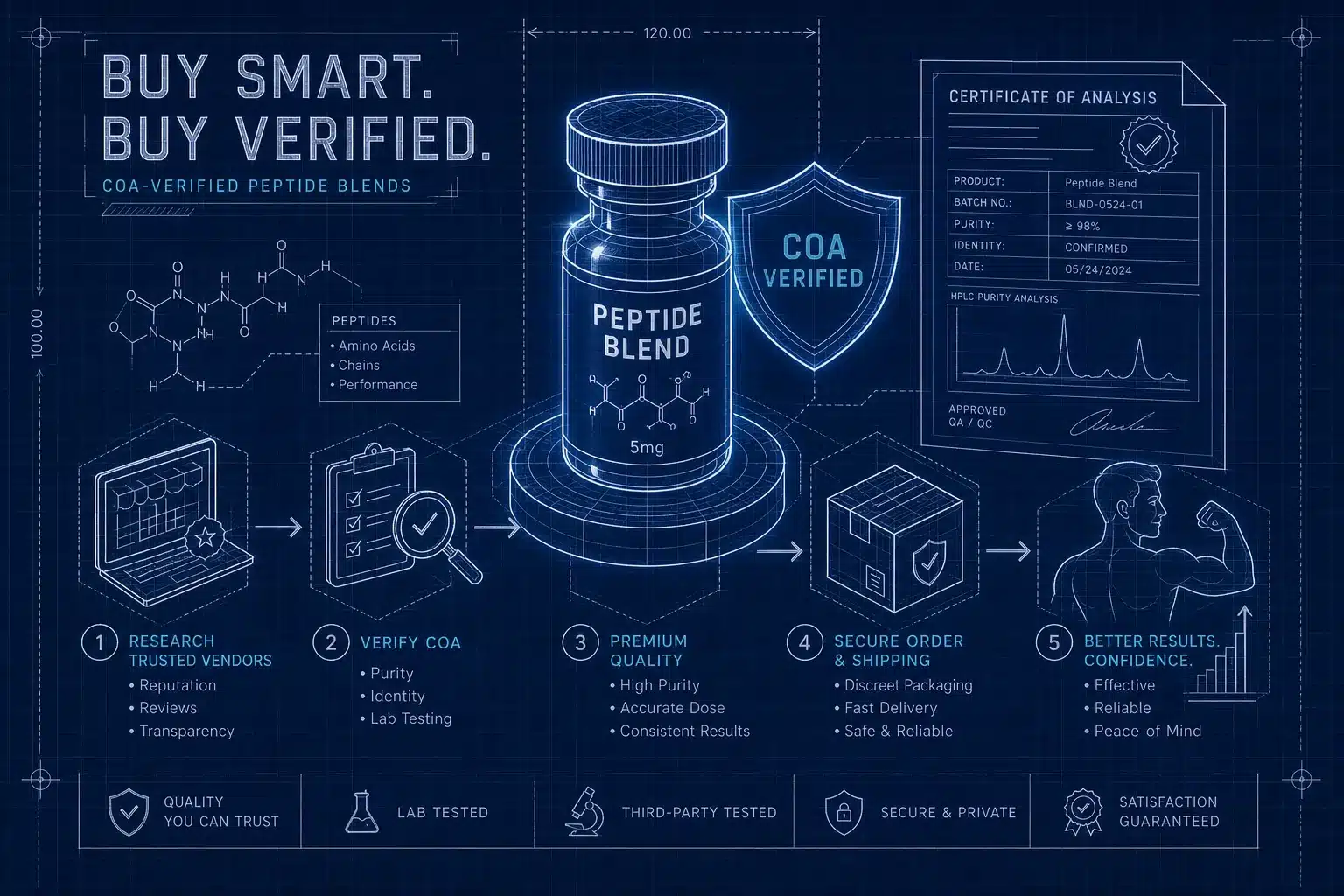
The grey market peptide space has a well-documented problem: vendors publish purity claims, quality badges, and “third-party tested” language on their product pages while providing nothing traceable, batch-specific, or independently verifiable to back those claims up. When you need to buy peptide blend online with COA verified ingredients for research, that gap isn’t a minor administrative inconvenience. It’s a research integrity failure. You can’t design a valid experiment around a compound you can’t actually verify.
This guide walks through everything you need to evaluate COA documentation intelligently: what a legitimate certificate contains, how to read HPLC and mass spec data together, what fabricated documents look like, and what separates a compliant RUO supplier from a risky one. R-Peptide Supply (Grey Peptide Shop) is built around batch-specific COA documentation across its catalog, including peptide blend products, a standard this guide uses as its practical reference point. By the end, you’ll have a concrete checklist you can apply to any vendor before you place an order.
What a peptide COA actually tells you
What’s inside a batch-specific certificate of analysis
A batch-specific COA is a lab report tied to one specific production run, not a standing quality statement that a supplier applies to every product it sells. At minimum, it should include the peptide name and sequence, the batch or lot number, the date of testing, the issuing lab’s identity, a measured purity result, the identity confirmation method, and supporting chromatogram or spectral data. Each element serves a distinct verification function, any gap reduces the document’s evidentiary value. For a practical checklist of the elements you should expect on peptide COAs, see this resource on certificates of analysis for peptides.
The lot number match is particularly important. The batch number printed on the COA must correspond exactly to the lot number on the vial label. If those identifiers don’t align, the COA doesn’t document the compound you received. It documents something else. A mismatch makes the certificate functionally decorative regardless of how professional it looks.
How to read HPLC and mass spec results together
HPLC measures purity by separating the components in a sample and comparing the area of each peak on the chromatogram. The main peptide peak should dominate. Secondary peaks signal impurities, degradation products, or incomplete synthesis byproducts. The reported purity percentage is calculated as the main peak area divided by total peak area, so a higher number reflects fewer detectable impurities under that specific method and those specific conditions.
Mass spectrometry confirms identity by comparing the observed molecular weight to the expected mass for the target compound. A matching mass supports identity confirmation, but MS alone doesn’t establish purity. The strongest validation combines both: high HPLC purity plus a matching MS mass. High HPLC purity with a wrong MS mass means the sample is clean but the identity is unconfirmed. A matching MS mass with poor HPLC purity means the compound is present but the sample is significantly contaminated. Both data points are required to draw a confident conclusion about what you’re working with. For more on how labs use HPLC and mass spectrometry for peptide validation, this overview of HPLC and mass spectrometry services is a useful technical reference.
Purity thresholds and what research-grade really means
Accepted HPLC purity ranges for research use
Purity requirements vary depending on what you’re doing with the compound. At 70 to 85%, a peptide is generally acceptable for lower-stringency screening, ELISA applications, and peptide arrays. Quantitative in vitro work, receptor-ligand studies, and bioassays typically require 90 to 95%. Many published mechanistic studies where impurity effects could directly confound a binding readout require 98% or higher.
For most independent researchers and labs sourcing blends like BPC-157 + TB-500 or GHK-Cu formulations, 95% HPLC purity is a widely cited practical floor. Anything below that introduces meaningful uncertainty into experimental outcomes, particularly when you’re working with multiple active compounds in a single vial. It’s also worth noting that “research-grade” is not a regulated term. Any vendor can apply it to any purity level. The number on the COA is what matters, not the label on the product page. If you need practical sourcing advice for compounds like BPC-157, consult guidance such as How to Source BPC-157 with a Verified Certificate of Analysis, Research Peptides Supply.
What purity percentage actually measures (and what it doesn’t)
HPLC purity is method-dependent. A “98% purity” result is only valid under the specific column, solvent system, gradient, and detection wavelength used in that test run. A different method applied to the same batch can produce a different number. This is why the COA needs to list the test method and conditions, not just the final result. A purity number without supporting methodology is a claim, not documentation.
For peptide blends specifically, each component should meet its own purity specification individually, not just pass as part of a combined mixture average. A blend where one high-purity component masks the poor quality of another gives a misleading total picture. Rigorous COA documentation for blends addresses each active compound as a discrete analytical question. For practical advice on testing peptide purity yourself or what to expect from analytical reports, see this guide on how to test peptides for purity.
How to spot a fabricated or misleading COA
Red flags on the COA document itself
Fabricated documentation usually fails basic cross-checks. The most common warning signs are straightforward to identify once you know what to look for. No issuer contact information, or a generic email address with no verifiable lab identity behind it, is an immediate concern. Vague item descriptions that could apply to any product, with no peptide sequence and no lot number, mean the document isn’t tied to anything specific.
Pay attention to the chromatogram images. HPLC chromatograms for different batches should show natural variation in peak shape, baseline, and retention time. Identical peak patterns appearing across supposedly distinct batch reports suggest the images were reused. QR codes and verification links that lead nowhere, redirect to the seller’s own website, or produce no verifiable output are a clear indicator that the document wasn’t issued by an independent lab.
How to verify a COA is real before you commit
Start with the lot number. Cross-reference the batch number on the COA against the number on the product listing or shipping invoice. They must match exactly. Then look up the issuing lab independently, using a search outside the vendor’s website, and confirm it’s a functioning analytical operation with a verifiable history and contact information you can actually reach. For a primer on what a COA should include and how researchers use them, this article on certificates of analysis: what researchers need to know is a helpful read.
If the COA includes a QR code or verification link, test it against the issuing lab’s official domain, not a link provided only by the seller. The strongest confirmation comes from contacting the lab directly and asking whether they issued that specific report for that specific lot number. Any supplier who only offers trust language without providing a downloadable, lot-specific COA document should not clear your sourcing threshold.
What a legitimate RUO supplier should provide before you buy
Legal labeling and compliance expectations for US buyers
US buyers should expect clear “For Research Use Only” and “Not for Human Consumption” labeling on every product. These aren’t optional disclaimers. They signal that the vendor understands the compliance context they’re operating in and are part of the labeling framework that distinguishes research chemicals from consumer health products. That said, FDA evaluates intended use based on the totality of labeling, marketing, and context, not the disclaimer alone. Product pages and packaging should contain zero disease treatment claims, no human dosing instructions, and no marketing language that positions the compound as a therapy or supplement.
The more a vendor’s language sounds like a consumer health pitch, the more legally exposed that vendor is, and the more that exposure extends to the buyer. A “research use only” label paired with human-use language elsewhere on the site provides no meaningful protection. Legitimate RUO suppliers sell peptides as research chemicals and keep all public-facing communications consistent with that classification. For broader context on RUO classification and regulatory considerations, see general RUO guidance resources.
The documentation standard every peptide buyer should require
At minimum, every order should include a downloadable, batch-specific COA with HPLC purity data and MS identity confirmation, a lot number that matches the vial, and a named issuing lab with contact information you can verify independently. Beyond that, a clear supplier identity, an itemized order invoice with product names and lot numbers, and shipping documentation consistent with research-use classification all contribute to a traceable sourcing record.
Third-party testing is the gold standard, when the same company that produces the peptide also issues the COA with no independent lab involved, that’s a conflict of interest, not a quality guarantee. The issuing lab should be a distinct, identifiable analytical operation, not the vendor’s internal quality team presenting itself as an independent authority. For examples of suppliers that maintain third-party testing practices, this list of verified peptide suppliers with certificates can be a useful cross-check during vendor evaluation.
How to buy peptide blend online with COA verified ingredients from R-Peptide Supply
What R-Peptide Supply’s blend documentation covers
R-Peptide Supply (Grey Peptide Shop) structures its catalog around batch-specific COA documentation, including for its peptide blend products. The documentation model is built so each COA corresponds to the actual production lot in the vial, not a standing certificate reused across multiple runs. That distinction matters because it’s the only way a COA functions as a verification tool rather than a marketing asset.
The blend catalog includes multi-component formulations targeting tissue repair, skin biology, and recovery research categories. Having COA documentation that accounts for each component individually is what separates a documented blend from an untested mixture. Researchers and lab buyers can review purity data before making sourcing decisions, not after the vials arrive.
Catalog scope and ancillary supply access
R-Peptide Supply serves both individual researchers and labs ordering at volume, with multi-vial bundle formats and wholesale pricing tiers available. Standard logistics, volume pricing, reliable shipping, and direct support access, are handled without the opacity typical of grey market sourcing. For labs that regularly order at scale, see this more detailed vendor guide: Buy Peptides in Bulk: Pricing, MOQs, and COA Checklist, Research Peptides Supply and the online sourcing companion Buy Peptides in Bulk Online: The Complete Sourcing Guide, Research Peptides Supply.
Ancillary supplies including bacteriostatic water, acetic acid water, and benzyl alcohol are available alongside peptide orders, so researchers aren’t left sourcing reconstitution supplies from a separate vendor. The broader catalog spans growth hormone secretagogues, weight management peptides, skin and beauty compounds, and additional research categories, all held to the same COA documentation standard applied to blend products.
Pre-purchase checklist to buy peptide blend online with COA verified ingredients
What to confirm before placing an order
Use these six criteria as a decision filter for any vendor you’re evaluating. Each checkpoint maps to a specific documentation failure mode that’s common in the grey market peptide space.
- Does the vendor provide a downloadable, batch-specific COA for the blend, not a generic quality statement on the product page?
- Does the COA include both HPLC purity data and MS identity confirmation, with the test method and conditions listed?
- Does the lot number on the COA match the lot number on the product listing or invoice?
- Is the issuing lab independently identifiable, with contact information verifiable outside the vendor’s website?
- Does the product carry “For Research Use Only” labeling with no human-use claims anywhere on the page?
- Does the vendor provide traceable order documentation, including an invoice with product names, lot numbers, and supplier identity?
Why this checklist protects your research
Each item on this list corresponds to a distinct failure mode. A missing COA means purity is unverified. No lot match means the COA is decorative. No independent lab means the claims are unverifiable. Human-use language is a regulatory red flag that signals how the vendor operates. These aren’t abstract concerns: they determine whether the compounds in your inventory are actually what they’re labeled to be.
Treat this as a sourcing discipline, not a one-time filter. Researchers who apply this standard consistently build a more reliable compound inventory over time and reduce the risk of experimental outcomes being confounded by undocumented variability in their materials. Applying this checklist to any vendor, including R-Peptide Supply, is how you buy peptide blend online with COA verified ingredients and build a sourcing record you can actually stand behind. For additional perspectives on third-party testing and supplier evaluation, see this piece on third-party tested peptides.
Buying with documentation confidence
Buying peptide blend online with COA verified ingredients is achievable. It requires knowing what to look for, not trusting a vendor’s marketing copy. A legitimate COA is batch-specific, includes both HPLC purity data and MS identity confirmation, names a verifiable independent issuing lab, and matches the lot number on the vial. Each of those requirements exists for a reason, and vendors who can’t meet all of them are asking you to accept claims rather than evidence.
The six-point checklist in this guide applies to any vendor you evaluate. R-Peptide Supply is built around the documentation standard this guide describes, batch-specific COAs, independent lab verification, and catalog coverage that extends from single-compound vials to multi-component blends. If you’re ready to source from a vendor whose documentation practices align with that standard, R-Peptide Supply is a practical starting point. For a broader industry perspective on evaluating peptide vendors and red flags to watch for during supplier audits, consider vendor evaluation resources such as how to evaluate peptide vendors and supplier verification lists.