


Blog
Best research peptides for fat loss: what studies show

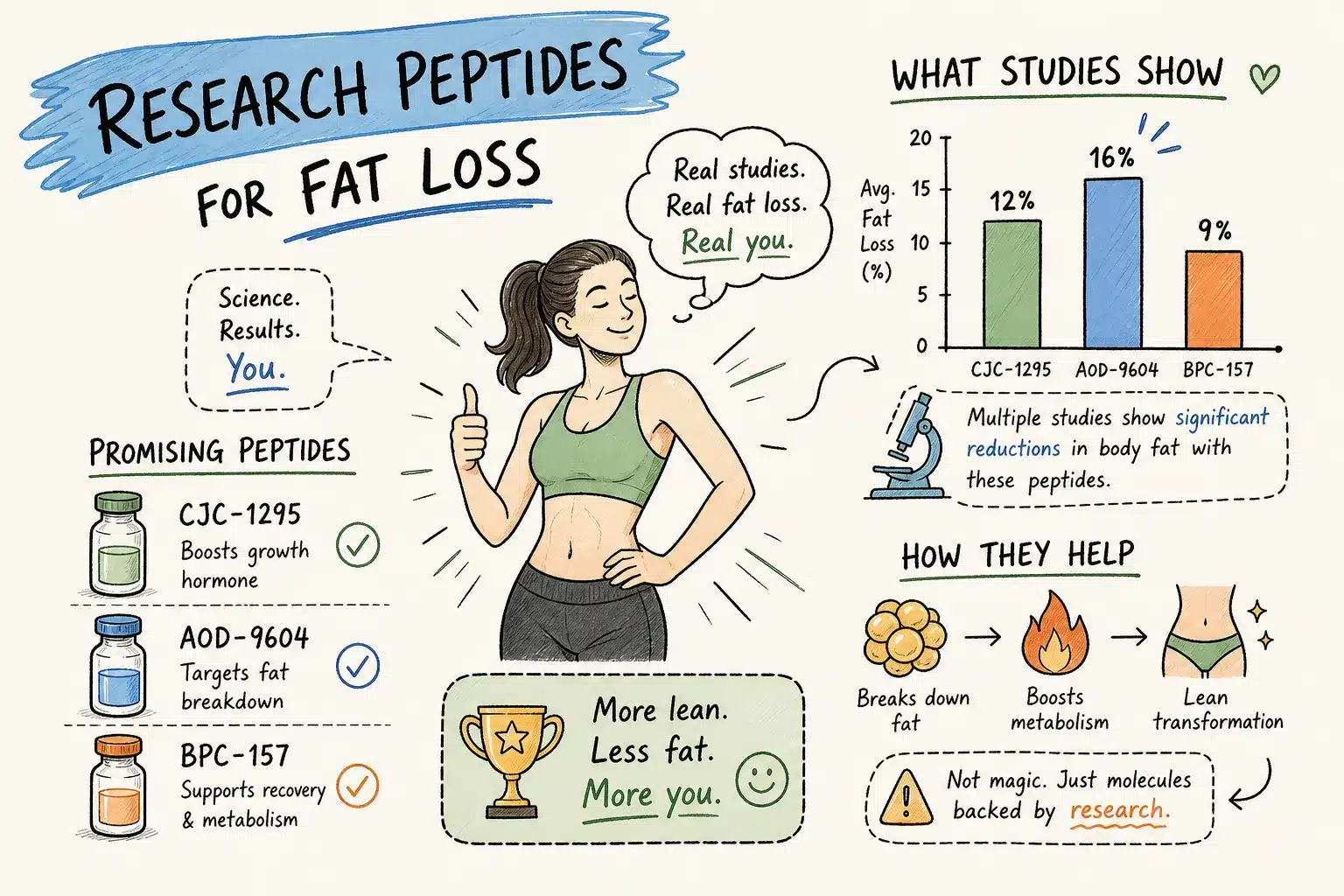
The fat-loss peptide market is loud. Social media feeds, forum threads, and supplement blogs treat semaglutide, AOD-9604, ipamorelin, and HGH Fragment 176-191 as if they belong in the same clinical conversation. They don’t. Some of these compounds have Phase 3 randomized controlled trial data backing double-digit weight loss in thousands of participants. Others have mechanistically plausible stories that fell apart under real trial conditions. A few have never been adequately tested in humans at all.
This guide reviews the best research peptides for fat loss and weight management studies and summarizes what randomized trials and pre-clinical data actually show. It covers the full spectrum: FDA-approved GLP-1 agents (semaglutide, tirzepatide), early-phase compounds (AOD-9604), pre-clinical research tools (HGH Fragment 176-191), and GH secretagogues commonly paired with fat-loss claims (CJC-1295, ipamorelin). Interest in weight management compounds has grown alongside the clinical evidence on approved agents, making clarity more important, not less. What follows is a straight read of what each compound does, based on what studies show rather than what’s claimed.
Best research peptides for fat loss and weight management studies, evidence tiers
Grouping every weight management peptide under one umbrella creates real confusion when evaluating research utility or advising on protocol design. There are at least three distinct evidence tiers, and tier placement determines everything about how seriously you should take efficacy claims.
The evidence tiers that separate approved drugs from research compounds
The first tier contains FDA-approved agents with Phase 3 RCT data: semaglutide (Wegovy), tirzepatide (Zepbound), and liraglutide (Saxenda). These compounds have been tested in thousands of participants in randomized, double-blind, placebo-controlled trials with body weight as the primary endpoint.
The second tier includes compounds with early-phase human trials showing a signal but no regulatory approval, such as AOD-9604 and tesamorelin. The third tier holds pre-clinical or research-use compounds with mechanistic rationale but no robust human fat-loss outcomes: HGH Fragment 176-191, CJC-1295, and ipamorelin belong here. Tier placement matters because researchers designing studies and clinicians advising patients need to know whether they’re working with proven therapeutics, investigational signals, or mechanistic hypotheses.
What “research peptide” means in practice
The research-use-only (RUO) designation applies specifically to compounds that haven’t earned FDA approval for human therapeutic use. AOD-9604 and HGH Fragment 176-191 are sold as research compounds precisely because their clinical trial programs were insufficient to achieve approval. Being available for research purchase doesn’t mean a compound is clinically validated; it means it occupies a regulatory and evidentiary space where further study is warranted. That distinction keeps expectations calibrated when sourcing or studying these compounds.
GLP-1 and GIP agonists among the best research peptides for fat loss and weight management studies
When evaluating which peptides produce measurably significant fat loss in human trials, the GLP-1 and GLP-1/GIP agonist class is where the evidence concentrates. These compounds have completed large Phase 3 RCTs, carry FDA approval for chronic weight management, and have published trial data available for independent review.
Semaglutide: what the STEP trials actually reported
Semaglutide 2.4 mg weekly (Wegovy) produced a mean body weight loss of approximately 15% at 68 weeks in 1,961 adults with overweight or obesity enrolled in the STEP 1 trial (Wilding et al., NEJM, 2021). Participants also received dietary counseling and physical activity support, so the compound’s contribution is additive rather than standalone. The once-weekly subcutaneous injection protocol uses a structured dose-escalation schedule designed to improve GI tolerability during early treatment. This is the current benchmark for pharmaceutical weight loss: real RCT data, a large sample, and a defined primary endpoint.
As of 2026, FDA has also approved a higher-dose Wegovy HD 7.2 mg formulation for the same chronic weight-management indication, and semaglutide’s label has expanded to include cardiovascular risk reduction and MASH treatment in relevant populations.
Tirzepatide: how dual agonism raised the efficacy ceiling
Tirzepatide (Zepbound) acts on both GIP and GLP-1 receptors, and that dual agonism is widely cited in the mechanistic literature as the basis for its greater efficacy versus semaglutide monotherapy. In SURMOUNT-1 (Jastreboff et al., NEJM, 2022), participants on the 15 mg weekly dose achieved approximately 21% mean weight loss at 72 weeks, among the most impressive outcomes ever recorded in a large-scale obesity RCT. The trial used a weekly subcutaneous injection protocol with titration through 5 mg, 10 mg, and 15 mg dose levels. The strong clinical interest in tirzepatide reflects those trial results directly. For a focused primer on tirzepatide in the context of peptide research, see Tirzepatide Peptide for Weight Loss: Everything You Need to Know, Research Peptides Supply.
Next-wave agents worth watching
Retatrutide showed approximately 24% mean weight loss at 48 weeks in early-phase trials, with TRIUMPH-1 now running to 104 weeks. Survodutide reported roughly 19% at 46 weeks in its early-phase program. Neither is commercially available in approved form, and both should be treated as “watch this space” rather than established options. Their early numbers are compelling, but Phase 3 completion and regulatory review are still required before clinical conclusions can be drawn. A recent Nature analysis highlights the promise of these next-wave agents while underscoring the need for long-term safety and durability data.
Research peptides with early human or pre-clinical fat-loss data
Outside the GLP-1 class, several peptides have been studied under the fat-loss or body composition banner. Results range from mildly promising to clearly insufficient, and reading what those trials actually found is essential for setting realistic expectations around peptide therapy for weight management.
AOD-9604: promising mechanism, underwhelming human outcomes
AOD-9604 is the C-terminal lipolytic fragment of growth hormone. It generated initial interest when a 12-week study reported approximately 2.6 kg loss versus 0.8 kg for placebo, and early pre-clinical data showed fat-specific lipolytic activity without significant IGF-1 or glucose effects. The mechanism was credible. Then a larger 24-week trial in 536 subjects failed to produce significant weight loss, and the development program was discontinued due to lack of efficacy.
AOD-9604 remains available as a research compound and is a useful tool for studying fat metabolism pathways in controlled settings. It is not a proven obesity treatment by any clinical standard. The pre-clinical signal simply didn’t survive the larger trial, which is exactly the kind of outcome that evidence-tiering is designed to flag. For obesity peptide clinical trials context, AOD-9604 sits firmly in the cautionary column. For broader context on peptide research and reviews of early-stage compounds, see this open-access review on peptide interventions.
HGH Fragment 176-191: pre-clinical lipolytic activity and where the evidence stops
HGH Fragment 176-191 is the C-terminal section of growth hormone believed to retain GH’s lipolytic properties without the growth-promoting or insulin-resistance effects seen with full-length HGH. Rodent and adipose-tissue pre-clinical studies suggest it may influence lipolysis through pathways involving cAMP, PKA, and hormone-sensitive lipase activation, though the precise receptor mechanisms are not consistently established across studies. In those models, it behaves more selectively on adipose tissue than full-length HGH.
Human evidence is essentially absent. This makes HGH Fragment 176-191 a genuinely useful compound for in vitro or animal model research into fat metabolism pathways, not a human obesity therapeutic. Its research value is real; its clinical validation is not.
GH secretagogues and their actual role in body composition research
CJC-1295 and ipamorelin appear in weight management discussions routinely because they raise GH and IGF-1 levels. The jump from “raises GH” to “produces meaningful fat loss” is not supported by outcomes data, and making that distinction clearly is part of reading the fat-loss peptide research literature accurately.
CJC-1295: what the human pharmacology data actually contains
CJC-1295 is a GHRH analog with a well-characterized human pharmacokinetic profile, including a reported half-life of approximately 5.8 to 8.1 days and documented sustained increases in GH and IGF-1 after subcutaneous dosing. The published human trials focused on those hormone-level endpoints, not body composition. No well-powered clinical trial has demonstrated that CJC-1295 meaningfully reduces fat mass in healthy adults. Its research value lies in GH-axis studies, pituitary function research, and pharmacokinetic modeling.
Ipamorelin: selective GH secretagogue, limited body-composition evidence
Ipamorelin is a selective GHSR agonist with a clean tolerability profile in available studies. It stimulates GH pulses without the cortisol or prolactin elevations seen with some other secretagogues, which makes it useful in research protocols studying GH dynamics. Claims that it “supports fat loss” are mechanistic extrapolations, not outcomes-based findings from human trials. No RCT exists measuring fat mass or lean mass as a primary or secondary endpoint for ipamorelin, and no human pharmacokinetic study of the CJC-1295 plus ipamorelin combination has been published with body composition data.
Safety profiles across the fat-loss peptide spectrum
The safety picture differs significantly depending on which tier you’re evaluating, a distinction that matters for anyone designing a study or reviewing adverse event reporting.
GI adverse events: the primary tolerability issue for GLP-1 agents
Nausea, vomiting, diarrhea, and constipation are the dominant adverse events across both semaglutide and tirzepatide trials. In SURMOUNT-1, tirzepatide nausea rates ranged from 24.6% at 5 mg to 31.0% at 15 mg; vomiting ranged from 8.3% to 12.2% across the same doses. Most GI effects are mild to moderate, most prominent during dose escalation, and generally resolve as participants stabilize on their target dose. The structured titration schedules used in trials exist specifically to reduce GI burden during early treatment.
Serious safety signals worth tracking in long-term research
Gallbladder events and pancreatitis are the most consistently flagged serious concerns across the GLP-1 class, though absolute rates remain low. Gallbladder disease occurred in 0.6% of tirzepatide-treated participants in SURMOUNT-1 versus 0% in the placebo group. Acute pancreatitis across the tirzepatide program ran at roughly 0.33% to 0.39% depending on dose. Per FDA prescribing information for both agents, semaglutide and tirzepatide carry a class boxed warning for medullary thyroid carcinoma risk based on rodent data. Semaglutide-specific literature, including data from the SUSTAIN-6 cardiovascular outcomes trial and subsequent FDA safety communications, flags signals for retinopathy complications and NAION.
AOD-9604, CJC-1295, and ipamorelin have substantially thinner long-term safety data simply because they haven’t been studied in large populations over extended durations. That isn’t a clean bill of health; it’s an evidence gap that researchers should account for in protocol design.
Sourcing research-grade weight management peptides for your lab
Once you’ve matched compounds to your study design, sourcing becomes the practical question: purity documentation, batch traceability, format options, and pricing at the volume you need.
What COA documentation should actually cover
A legitimate Certificate of Analysis for a research peptide should include HPLC purity percentage, mass spectrometry confirmation of molecular identity, lot number, and testing date, consistent with standard laboratory quality-assurance expectations for research-use compounds. Lot-level traceability is non-negotiable when comparing results across experiments or sharing data with collaborators; without it, you can’t verify that two samples are actually the same compound at the same purity level. This is a quality benchmark, not a regulatory formality, and it applies to every RUO compound in your workflow. For practical advice on purchasing peptides with verified documentation, see Buying weight loss peptides online with lab-verified purity, Research Peptides Supply.
R-Peptide Supply as a wholesale source for the full catalog
R-Peptide Supply (Grey Peptide Shop) is a wholesale supplier carrying the weight management peptide compounds discussed in this article, including tirzepatide, HGH Fragment 176-191, AOD-9604, ipamorelin, and CJC-1295, with COA documentation and bulk pricing options. Multi-vial bundle formats support high-volume research workflows. For labs and resellers who need traceability across multiple compounds within a single study protocol, consolidating under one documented, wholesale-priced supplier is a practical advantage. Check the current catalog directly for up-to-date pricing, availability, and shipping terms.
What the evidence means for selecting the best research peptides for fat loss and weight management studies
The evidence tiers here aren’t arbitrary. Tirzepatide and semaglutide hold the RCT evidence for fat loss in humans: large trials, defined endpoints, FDA approval, and real adverse event data to work with. AOD-9604 had a genuinely interesting early signal that didn’t survive a larger controlled trial, stopped for exactly the reason evidence-based medicine exists. HGH Fragment 176-191 has a credible lipolytic mechanism in pre-clinical models and no meaningful human fat-loss outcomes. CJC-1295 and ipamorelin are GH-axis research tools with pharmacokinetic value, not fat-loss therapeutics in any clinical sense.
Understanding which tier each compound belongs in is the foundation of sound fat-loss peptide research. Getting sourcing right means working with a supplier who provides the documentation to confirm what you’re actually studying. R-Peptide Supply carries COA-verified, wholesale-priced inventory across every compound discussed here. For a comprehensive research-oriented overview, see Weight loss peptides: a research guide to fat loss compounds, Research Peptides Supply. Browse the full catalog at R-Peptide Supply to source what your protocol requires, backed by the documentation your research depends on.