


Blog
GLOW Stack Peptide Blend: Skin and Recovery Research

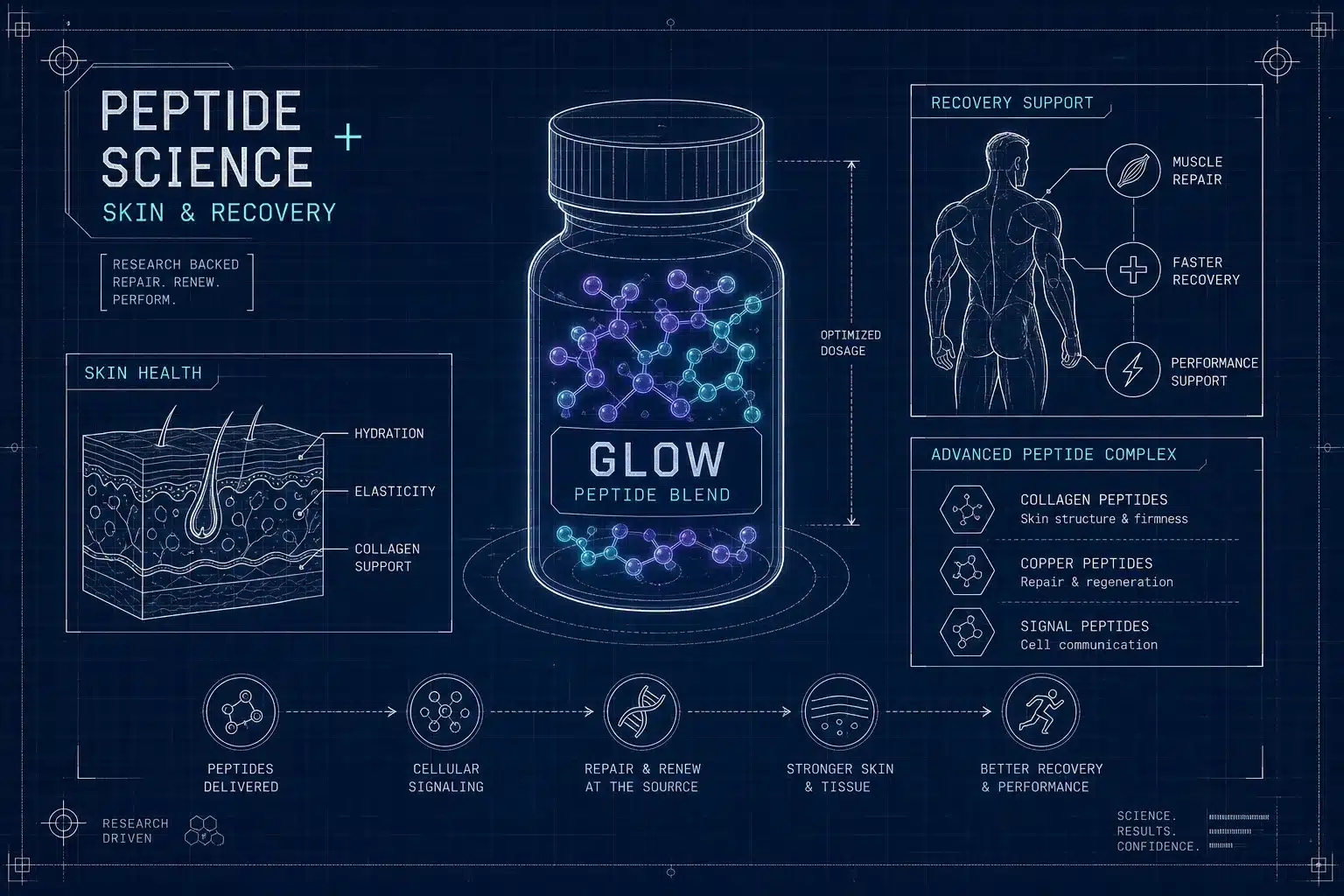
Studying skin rejuvenation and tissue recovery in parallel is not straightforward. Both processes involve multiple biological pathways firing at different times, and testing one compound at a time misses the interactions between those pathways. That is the core rationale behind multi-peptide research formulations like the glow stack peptide blend for skin and recovery studies, which combines GHK-Cu, BPC-157, and TB-500 (Thymosin beta-4) into a single protocol designed to study collagen synthesis, angiogenesis, and cell migration together rather than in isolation.
Each compound in this combination maps to a different phase of the wound healing cascade, which makes it a practical model for researchers studying full-spectrum skin repair and recovery. R-Peptide Supply carries the GLOW stack as part of its peptide blend catalog, making it a useful reference point for labs building multi-compound protocols. This article breaks down what each peptide contributes in research models, what the clinical evidence actually shows, how researchers administer this stack, and what to look for when sourcing it.
Glow Stack Peptide Blend for Skin and Recovery Studies: What It Is and Why Researchers Study It as a Combined Formulation
The GLOW stack peptide blend is not a random grouping of three popular research peptides. Each compound targets a different phase or biological pathway in skin repair and tissue recovery, and the combination is built to study complementary effects within a unified model rather than running three separate experiments.
GHK-Cu is studied primarily for its role in collagen synthesis and keratinocyte proliferation, making it the remodeling-phase compound in this stack. BPC-157 targets angiogenesis, fibroblast recruitment, and multi-tissue repair, placing it in the proliferative and early remodeling phases. TB-500 focuses on actin regulation and re-epithelialization driven by cell migration, which positions it at the inflammatory-to-proliferative transition. Together, these three cover the wound healing cascade from initial cell mobilization through tissue remodeling.
Single-compound studies cannot capture synergistic pathway interactions. When you run GHK-Cu alone, you see collagen output. Adding BPC-157 and TB-500 to that model lets researchers test whether the angiogenic and migratory signals those peptides activate actually alter how collagen-stimulating effects play out, a fundamentally different research question, and the one this glow stack peptide blend is designed to address. R-Peptide Supply’s GLOW stack formulation is available with COA documentation and in multi-vial formats suited to extended lab protocols, making it a practical sourcing reference for researchers building combined models.
GHK-Cu in Skin Research: What the Human Trial Data Actually Shows
Of the three compounds in the GLOW stack, GHK-Cu has the most robust human evidence base, concentrated in a series of 12-week topical trials on photoaging and photodamage. These studies are the clearest signal in the clinical literature that this compound drives measurable changes in skin biology.
The Photoaging Trials: Study Designs and Primary Endpoints
The most cited trials cover four distinct populations. A 12-week facial cream study in 71 women with mild to advanced photoaging measured skin density, thickness, laxity, clarity, fine lines, and wrinkle depth, and reported improvements across all endpoints. A parallel periocular study in 41 women compared GHK-Cu eye cream against placebo and vitamin K cream, with GHK-Cu outperforming both on wrinkle reduction and skin density gains. A third trial enrolled 67 women aged 50 to 59 and applied GHK-Cu twice daily for 12 weeks, finding improvements in laxity, clarity, firmness, mottled pigmentation, and dermal keratinocyte proliferation on histology.
A notable data point comes from a 1-month thigh-skin biopsy study comparing GHK-Cu directly against vitamin C cream and retinoic acid on collagen production measured by immunohistology. Collagen production increased in 70% of GHK-Cu-treated subjects, compared to 50% for vitamin C and 40% for retinoic acid. That is a meaningful margin in a head-to-head design, and it explains why GHK-Cu draws the most attention among collagen-stimulating peptide researchers. These topical and clinical trial signals are summarized in the published trial literature on GHK-Cu and photoaging, including a series of 12-week topical trials that provide the primary human evidence base for collagen and density changes (12-week topical trials on photoaging).
Where the GHK-Cu Evidence Base Gets Thin
The limitations here are real and worth stating plainly. Every one of these trials involves small sample sizes, topical formulations, and short durations. There are no large randomized controlled trials, no long-term human safety data for systemic exposure, and no trials in populations outside women with photoaging. For researchers studying GHK-Cu as part of the GLOW stack via subcutaneous or systemic delivery, these topical trials establish a signal for collagen synthesis and skin density improvement, but they do not tell you what injectable or systemic administration produces. That gap is an open research question, not an answered one.
BPC-157 and Tissue Repair: Strong Animal Data, Limited Human Confirmation
BPC-157 is the most studied compound in preclinical tissue repair literature. The rodent data is genuinely compelling across multiple tissue types. The human data is not yet there, and that gap defines where BPC-157 sits as a research target right now.
What Preclinical Models Show Across Tendon, Muscle, and Skin Repair
The foundational tendon paper from Sikiric et al. (2003) used transected Achilles tendon defects in rats and reported improved biomechanical strength, histology, and defect closure with BPC-157. A 2011 study published in the Journal of Applied Physiology built on that work by examining tendon outgrowth, cell survival, and cell migration in a rodent model. Later preclinical work extended findings to tendon-to-bone repair, including conditions where healing is typically impaired by corticosteroid exposure. For muscle, rodent studies describe enhanced myogenesis, fiber regeneration, and improved functional recovery. For skin, the most documented model is alkali-burn wound injury, where BPC-157 accelerated healing and was associated with increased ERK1/2 activity in regenerating tissue. For a detailed overview of BPC-157 research uses and experimental contexts, see the summary of top research uses of BPC-157 (Top Research Uses of BPC-157 Peptide Explained, Research Peptides Supply).
The proposed cellular mechanisms for angiogenesis are specific enough to note separately. BPC-157 increases VEGFR2 mRNA and protein expression in human vascular endothelial cells, promotes VEGFR2 internalization, and activates downstream Akt-eNOS signaling. Blocking endocytosis with dynasore blocked both the internalization step and the Akt-eNOS activation, which suggests the mechanism is receptor internalization-dependent. Fibroblast recruitment follows a different signaling path: FAK and paxillin phosphorylation drive cell migration and attachment at injury sites, providing the structural reorganization that supports tissue ingrowth. Several preclinical and mechanistic studies illustrate these signaling cascades and receptor-level effects (angiogenesis and receptor-internalization mechanisms), and the original tendon models are indexed in PubMed (foundational tendon paper).
The Human Evidence Gap and What It Means for Lab Protocols
There are no robust randomized controlled trials in humans for BPC-157. A registered clinical trial for acute hamstring strain explicitly acknowledges that human evidence is limited and that a controlled trial is needed to establish both benefit and safety. One pilot study appears in reviews, but the overall clinical base does not support efficacy conclusions yet. For researchers, that gap is the rationale for studying BPC-157, not a reason to avoid it. Human translation of preclinical peptide findings remains unresolved, and protocols designed to address that question are both legitimate and necessary. The best human dose, route, and treatment window remain undefined, which makes every protocol design decision meaningful.
TB-500 in Wound Healing and Recovery: What Phase 2 Trials Actually Demonstrate
TB-500 occupies a middle position in the evidence hierarchy. The human wound healing data is more established than BPC-157’s, but it is limited to specific indications. The musculoskeletal recovery claims that circulate in the research community are not backed by published human trial results.
Human Wound Healing Trials: The Venous Stasis and Pressure Ulcer Data
The phase 2 human trial data covers three wound types. A randomized trial in 73 patients tested Tβ4 gel at varying concentrations over 84 days for venous stasis ulcers, reporting accelerated wound healing with approximately 25% of patients achieving complete healing within three months (phase 2 venous stasis ulcer trial). A phase 2 trial in 143 patients with stage III and IV chronic pressure ulcers and venous stasis ulcers found that Tβ4 accelerated healing by almost a month in patients who healed (phase 2 pressure ulcer trial). A randomized, double-blind trial in epidermolysis bullosa patients reported improved healing in treated wounds. The preclinical mechanistic foundation includes a rat model where Tβ4 increased re-epithelialization, contraction, collagen deposition, and angiogenesis, summarized in the clinical and preclinical wound-healing literature (preclinical and clinical Tβ4 wound-healing review).
Why Musculoskeletal Recovery Claims Outpace the Trial Evidence
The phase 2 evidence establishes a wound-healing signal, but it is indication-specific and does not extend to muscle, tendon, or ligament recovery. Published human trial results for musculoskeletal applications do not yet exist. There is also a compound identity issue researchers should account for: the “TB-500” sold as a research peptide is a synthetic analog of Tβ4, not the exact form used in the human wound-healing trials. That distinction adds a meaningful layer of uncertainty when interpreting both the human data and the preclinical findings in the context of sourced research compounds.
How the Three Peptides Interact in Combined Skin and Recovery Models
Complementary Mechanisms Across the Wound Healing Cascade
The three compounds cover distinct windows in the repair sequence. TB-500 is most active at the inflammatory-to-proliferative transition, driving cell migration, actin upregulation, and re-epithelialization. BPC-157 operates through the proliferative and early remodeling phases, managing angiogenesis and fibroblast recruitment through the VEGFR2 and FAK pathways described above. GHK-Cu takes over in the remodeling phase, driving collagen crosslinking, keratinocyte proliferation, and tissue density restoration. A combined GLOW stack protocol attempts to study the full cascade from a single model, which is the primary design advantage over single-compound approaches in peptide therapy for skin and recovery research.
Safety Signals and Contraindications Researchers Track in Combined Protocols
GHK-Cu has the clearest safety profile of the three, based on its human trial history. Local irritation is the primary reported signal. This includes redness, itching, tingling, and occasional swelling or bruising at the application site. Transient dizziness, nausea, and headache have been reported after injection. Standard cautions include Wilson’s disease and other copper metabolism disorders, pregnancy and breastfeeding, active cancer, and severe liver or kidney dysfunction.
BPC-157 and TB-500 lack established human adverse event profiles, so the primary safety concern for both compounds is the thin evidence base rather than a documented pattern of harm. For combined protocol documentation, researchers should track injection-site reactions, nausea, dizziness, and systemic responses as primary signal endpoints. Theoretical cautions around active malignancy apply to all three compounds given their shared involvement in angiogenesis and cell migration pathways.
Lab Protocols, Administration Methods, and Sourcing the GLOW Stack Peptide Blend for Skin and Recovery Studies
The practical structure of GLOW stack research protocols follows a consistent pattern across clinic and lab settings, though dosing is always individualized to the research goal and compound-specific half-life considerations.
Administration Routes and Cycling Frameworks Used in Research Settings
The dominant route for injectable GLOW stack components is subcutaneous injection using thin-gauge insulin syringes into the abdomen or thigh. Intramuscular administration is used by some clinics for localized recovery protocols, and intradermal delivery appears in facial skin research settings, though neither is a universal standard. For skin-isolated research goals, topical GHK-Cu formulations applied once or twice daily remain a practical option that aligns directly with the human trial evidence base. Cycling frameworks run from 4 to 8 weeks or 8 to 12 weeks of active dosing followed by 2 to 4-week breaks.
One application reported in clinic settings is post-procedure recovery: the GLOW stack administered once daily for 3 to 4 weeks following facelift, neck lift, or blepharoplasty procedures, with patients self-injecting at home under physician supervision. This protocol has not been validated in controlled trials and should be treated as an emerging practice rather than an established standard. For additional practical guidance on peptide therapy and clinical protocol considerations, researchers often consult focused resources on peptide therapy development and clinical implementation (BPC 157 Research Peptide: Benefits, Uses, and Scientific Insights, Research Peptides Supply).
Sourcing the GLOW Stack: COA Verification and Bulk Format Options
For researchers sourcing this formulation, compound purity and lot-traceable documentation are non-negotiable baseline requirements. R-Peptide Supply carries the GLOW stack (BPC-157 + GHK-Cu + TB-500) with COA documentation for each component, covering purity percentage and HPLC data. Multi-vial formats support extended lab protocols without the friction of repeated single-vial ordering. For labs building these protocols, R-Peptide Supply provides bulk and wholesale options, with each compound’s COA, lot number, and purity data available from the point of purchase, eliminating a common sourcing headache for research teams that need documentation to hold up in a lab setting. Additional product- and stack-specific summaries are available for teams evaluating combined formulations (Glow peptide stack : BPC-157, GHK-Cu & TB-500 Research).
Summary: Evidence Tiers and Protocol Implications
The glow stack peptide blend for skin and recovery studies is a research tool designed to examine complementary mechanisms across the skin and tissue repair cascade. GHK-Cu brings the strongest human evidence base, concentrated in collagen synthesis and photoaging trials with clear outcome measures. BPC-157 contributes a robust preclinical signal across multiple tissue types; current human research is working to confirm whether those findings translate. TB-500 has documented phase 2 wound-healing data that does not yet extend to musculoskeletal applications, and the compound-identity distinction between sourced TB-500 and the Tβ4 used in those trials deserves attention in any protocol design.
Researchers working with this combination should treat the three compounds as occupying different evidence tiers rather than assuming uniform validation across all applications. Protocol design needs to reflect those distinctions, particularly in how outcomes are measured and how safety data is documented. For labs building these protocols, R-Peptide Supply provides the GLOW stack with COA documentation and bulk-friendly pricing suited to sustained research programs. For an overview of practical peptide-stack guides and considerations when combining BPC-157, TB-500, KPV, and GHK-Cu, several peptide therapy guides and stack resources compile dosing frameworks and evidence summaries for lab use (peptide stack guide and considerations).