


Blog
Buy GHK-Cu in 2026: Purity, COAs, Formats, Pricing

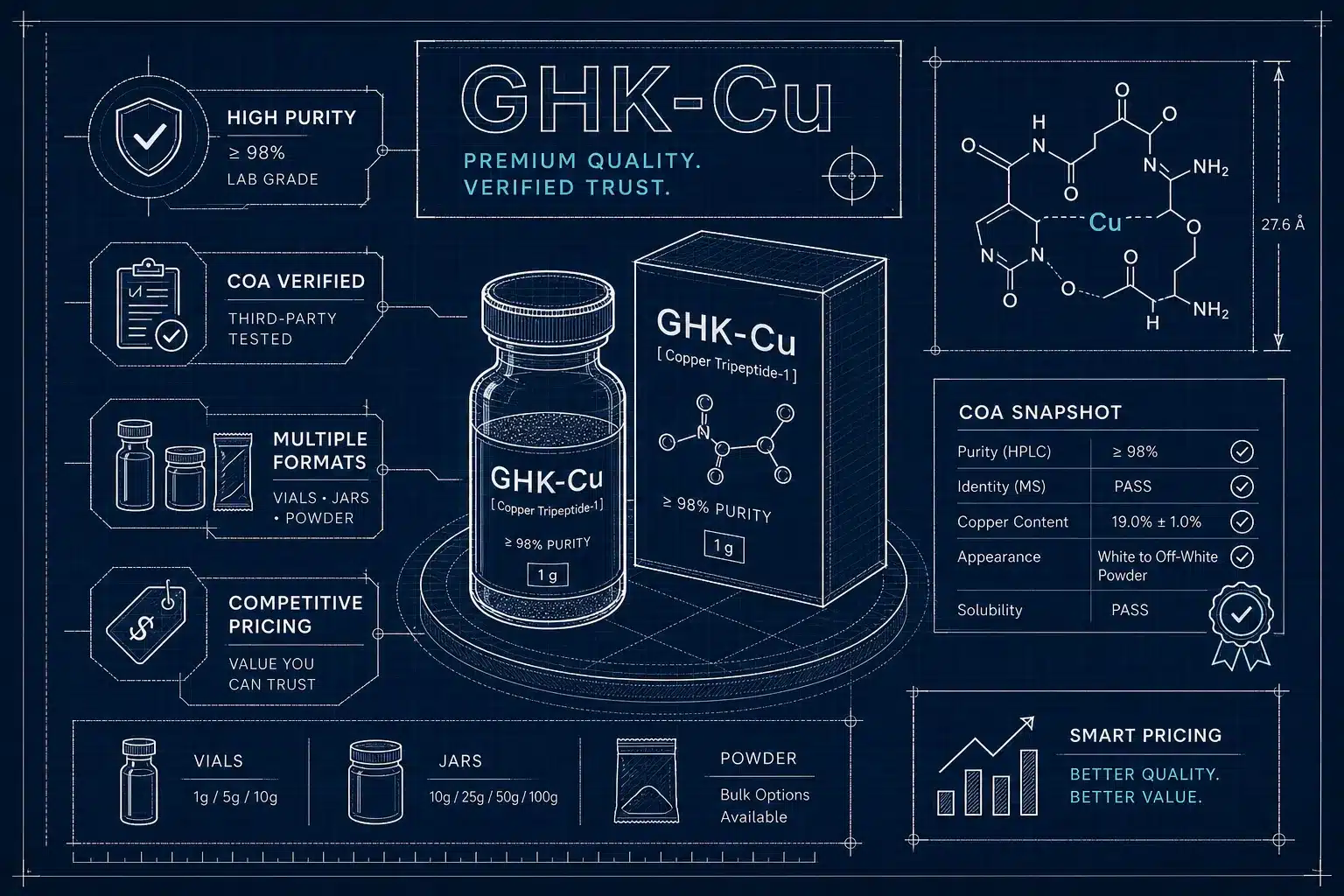
Researchers, clinic operators, and lab procurement teams looking to buy GHK-Cu in 2026 face a more complex market than a simple product search suggests. The molecule sits at the intersection of cosmetic ingredient law, RUO (research-use-only) peptide supply, and physician-compounded topicals, each with different compliance rules, purity expectations, and sourcing channels. Getting the wrong product from the wrong source wastes budget, creates documentation gaps, and in some cases introduces real quality risk.
What follows is a clear breakdown of product forms, what a credible COA looks like in 2026, realistic price benchmarks, and a vendor verification checklist you can use before placing any order. For labs and clinics that need a wholesale, lab-tested source, R-Peptide Supply (Grey Peptide Shop) carries lyophilized GHK-Cu vials and powder in multiple formats, visit the storefront to review current product listings, COA samples, and pricing tiers.
Compliance and intent: the first sourcing decision
Confirm intent and compliance before you order copper peptide
The first decision is clear-cut: are you sourcing a cosmetic ingredient, an RUO research compound, or a physician-compounded topical? Each path has a different legal footing. OTC cosmetic products containing Tripeptide-1 (the INCI name for GHK-Cu) are regulated as cosmetics, not drugs, provided the product makes only appearance-based claims and does not imply wound healing, tissue repair, or any disease treatment. If a product crosses that line in its marketing, it moves into drug territory and requires a different compliance framework entirely.
RUO supplies are sold with “not for human consumption” labeling and are intended for in-vitro studies, formulation R&D, and laboratory work. That label is a compliance requirement, not a loophole. Documentation discipline matters here: retain your COA, lot number, invoice, and supplier contact information for every purchase. On the sports side, GHK-Cu is currently not on WADA’s Prohibited List (verify against the current WADA list before each study cycle, as it updates annually).
Cosmetic topicals vs research-use-only supplies
Topical GHK-Cu serums and creams sold through retail channels are cosmetic products. They’re formulated at OTC-typical concentrations, usually 0.01% to 1%, and marketed on appearance claims like “smoother skin” or “visible anti-aging.” Physician-compounded topicals occupy a different tier: higher concentrations, written under a prescriber’s order, and governed by compounding pharmacy rules rather than cosmetic law. Neither of these is the same as purchasing lyophilized GHK-Cu peptide from an RUO supplier.
RUO powder and vials serve in-vitro research, formulation development, and training lab workflows. The key distinction is not the molecule but the intended use, how the product is labeled, and what claims the seller makes. Mixing up these channels creates compliance exposure. Source your RUO compound from a supplier with explicit RUO labeling, documented purity, and a proper COA, not from a skincare brand’s ingredient page. Researchers specifically looking to buy copper peptides for lab use should confirm the supply channel is RUO-designated before ordering.
Where R-Peptide Supply fits in your options
R-Peptide Supply (Grey Peptide Shop) is a US-focused wholesale supplier of research-grade peptides, including GHK-Cu in lyophilized vial and powder formats. According to the vendor, every batch ships with a COA covering identity, purity, and contaminant panels, and multi-vial bundles are available for labs, resellers, and clinic procurement teams. The support team can pull batch-specific documentation on request, a practical asset when you’re maintaining a sourcing log for audit purposes. Review current product pages and available COA samples directly on the storefront to confirm current stock and documentation standards.
Purity standards that actually matter
Read a GHK-Cu COA like a lab lead
A credible COA for GHK-Cu in 2026 starts with identity confirmation, specifically LC-MS confirmation of the copper-complexed tripeptide at approximately 402 Da. HPLC purity should be reported from a reverse-phase method with the chromatogram included, not just a number. The copper content specification, typically 13.5, 16.5% w/w by ICP-MS or equivalent elemental analysis, confirms the copper complex is properly formed rather than simply mixed. Lot number and production date on the COA must match the label and invoice exactly. For a concise primer on GHK-Cu and how it’s described in public-facing resources, see an independent GHK-Cu peptide overview.
Purity expectations have tightened. The minimum acceptable threshold from a reputable RUO supplier is 95% HPLC purity, but leading suppliers are hitting 98% to 99%+ on verified lots. A COA that states a round number like “99%” without showing the chromatogram, impurity peaks, or retention time data is a soft claim at best. Ask for the raw data if it’s not attached.
Methods and metrics to see: HPLC, LC-MS, ICP-MS
The analytical trifecta for GHK-Cu is HPLC for purity, LC-MS for identity, and ICP-MS for copper and heavy metals. HPLC gives you the main peak area percentage and shows any impurity shoulders; the chromatogram should be legible and dated. LC-MS confirms the molecular identity against the expected copper-complex mass. ICP-MS or a comparable elemental technique quantifies the copper content and checks for lead, arsenic, cadmium, and mercury contamination.
For sterile vials, the COA should additionally include endotoxin testing, with a passing result at no more than 10 EU/mg relative to intended use and route, plus a sterility result. Residual solvent data, particularly for TFA (trifluoroacetic acid) used in synthesis, should be present or explicitly noted as not detected. If a supplier offers sterile vials but the COA has no endotoxin or sterility result, that’s a significant documentation gap. Note that GHK-Cu is not currently marketed in a pharmaceutical-grade injectable format through RUO channels; researchers requiring sterile preparations should confirm the specific lot’s sterility documentation before use.
Spot red flags on a copper peptide COA
Generic templated reports with no laboratory name, no analyst signature, and no instrument details are the most common red flag. Mismatched lot numbers between the COA and the product label indicate either a documentation error or, worse, a recycled report from a different batch. Missing impurity data or a purity section that shows only a final percentage without supporting chromatographic evidence should prompt a follow-up request before purchase.
Unusual rounding, such as a purity listed as exactly “99.0%” with no decimal variation across multiple batches, is worth questioning. Real analytical results show natural batch-to-batch variation. A supplier whose every batch reports the same round number is either not testing thoroughly or presenting summary data rather than actual results.
Which GHK-Cu format should you choose?
Lyophilized vials and GHK-Cu powder: common sizes and storage
The most common lyophilized RUO formats in 2026 are 25 mg, 50 mg, and 100 mg vials. Research powder is also available in gram-scale jars for formulation work. Both formats require storage at -20°C for long-term stability, with an expected shelf life of 18 to 24 months when stored sealed, dry, and protected from light. Short-term storage at 2, 8°C is acceptable for working stock but should not be the default for unopened material. For detailed manufacturer guidance on proper storage, handling, and stability considerations, consult a dedicated storage and handling resource.
Reconstitution in lab settings uses bacteriostatic water or other appropriate media depending on the study protocol. A 50 mg lyophilized vial reconstituted with 5 mL of bacteriostatic water yields 10 mg/mL; with 2.5 mL, you get 20 mg/mL. Reconstituted solutions stored at 2, 8°C should be used within 28 to 30 days with bacteriostatic water. All handling and labeling should reflect the RUO status of the material.
Topical GHK-Cu serum and cream: percent ranges and packaging
OTC cosmetic serums typically land between 0.01% and 1% GHK-Cu, with retail bottles in the 15 to 60 mL range. Physician-compounded topicals run higher, often 2% to 10%, and are dispensed under a prescriber order rather than sold over the counter. Stability of topical formulations depends on pH, packaging, and preservative system. Amber or airless packaging is standard practice to limit light and oxidation exposure, degradation in poorly packaged topicals can occur within weeks of opening, making packaging specification a meaningful quality signal. Some formulation experts discuss why roughly a 3% topical concentration is often cited as a practical efficacy/stability compromise in compounding contexts.
Handling, reconstitution notes, and shipping
Lyophilized peptides ship ambient for most domestic orders, arriving as a dry, stable powder or cake. On receipt, inspect the vial for seal integrity, absence of moisture ingress, and label accuracy against the accompanying documentation. Log the lot number immediately. Cold-chain shipping is an option for sterile vials or solution formats and may be required for international shipments with specific handling requirements. Retain all shipping documentation with the COA for your traceability file.
Pricing benchmarks and how to compare offers
2026 price bands for powder, vials, and topicals
For RUO GHK-Cu powder, the realistic 2026 market range from reputable US suppliers is approximately $30 to $60 per gram, with variation driven by purity tier, testing scope, and order volume (based on observed supplier listings and recent market quotes). Lyophilized 10 mg vials typically run $40 to $55 per unit at retail quantities. Wholesale and multi-vial bundle pricing reduces the per-mg cost substantially, which is where lab procurement teams and resellers gain real budget advantage. Topical cosmetic serums at OTC concentrations price differently and aren’t directly comparable to RUO compound pricing.
Do the cost-per-mg math and bundle savings
A single 50 mg vial priced at $120 works out to $2.40 per mg. A ten-vial bundle at $90 per vial drops that to $1.80 per mg, a 25% reduction without changing the product. Powder pricing by the gram is even more efficient for formulation labs running high-volume protocols. At R-Peptide Supply, the vendor states that orders over $200 qualify for free shipping, which shifts the effective cost-per-mg further in your favor on any meaningful reorder. Running the math before each purchase cycle is a basic procurement habit that compounds savings over time.
The factors that actually matter in vendor selection
The cheapest vial on the market costs more than a mid-priced vial if it arrives without documentation and you spend hours chasing a COA that never comes. Criteria that genuinely matter in vendor selection include public COA access by lot number, documented batch history, response times under 24 hours, and a clear returns or replacement policy for damaged or out-of-spec product. Suppliers who can answer specific analytical questions about their testing methods are demonstrating supply chain competence, not just making marketing claims.
Vendor verification and a clean-room buyer’s checklist
Seven checks before you purchase GHK-Cu online
Use this sequence before committing to any new supplier:
- Supplier identity: verified business name, physical address, and contact information.
- Domain age and history: domains registered within the past 6, 12 months on peptide storefronts are a consistent fraud indicator, run a WHOIS lookup and check the site’s Wayback Machine history before ordering.
- Product specification sheet: confirms the form, concentration, and lot format before purchase.
- Sample COA access: request a real COA for a current lot before ordering, not a generic example document.
- Support responsiveness: send a technical question and measure response time and quality.
- Review authenticity: check for verified purchaser reviews, not just star ratings on the vendor’s own site.
- Packaging QC on arrival: inspect seals, labels, and fill weight against the COA before logging into inventory.
How to verify a batch COA and lot traceability
Lot number verification is the single most important post-delivery step. The number printed on the vial label, listed on the invoice, and shown on the COA header must match exactly. Any discrepancy should be resolved with the supplier before the material enters your workflow. If the supplier provides a QR code or portal for COA verification, use it and save the confirmation. Archive every COA as a PDF with the order date and supplier name in the file name so you can pull it quickly during an audit or reorder inquiry.
Payment, shipping, and documentation to keep on file
Maintain a sourcing log that records supplier name, order date, lot number, COA file location, and any correspondence about the batch. This takes minutes per order and becomes invaluable when you need to trace a compound back to its source during a study review. Preferred payment methods vary by supplier; R-Peptide Supply supports secure payment processing with clear transaction records. Keep invoices, shipping confirmations, and COAs together in a single folder per order for clean traceability.
Recommended wholesale source: R-Peptide Supply’s lab-tested GHK-Cu
Our quality and traceability workflow
R-Peptide Supply states that every GHK-Cu lot goes through third-party analytical testing before it ships. According to the vendor, the testing panel covers HPLC purity, LC-MS identity confirmation against the expected copper-complex molecular weight, ICP-MS copper content within the 13.5, 16.5% w/w specification, and heavy metals screening. Sterile lot testing is stated to include endotoxin and sterility results. Signed COAs are issued per lot and are available on request at any point, including after purchase for audit documentation, request a sample COA from the current batch to review the testing scope before ordering.
Available formats, bundles, and ancillary supplies
R-Peptide Supply carries GHK-Cu in lyophilized vial formats and research powder, with multi-vial bundles designed for labs and resellers running ongoing protocols. Ancillary supplies including bacteriostatic water and acetic acid water are listed in the same storefront, keeping your reconstitution workflow consolidated in a single order. Check current product pages for bundle availability, ancillary stock, and any compound combination offerings relevant to your research focus.
How to access wholesale pricing, free shipping, and support
Wholesale account setup involves contacting the support team with your lab or clinic details and intended use case to access tiered pricing. The vendor states that free shipping applies automatically on orders over $200, which most multi-vial orders will clear. COA requests by lot number can be submitted at any time through the support channel. Setting up a recurring order schedule with a standing COA request is a practical way to maintain documentation continuity without manual follow-up each cycle.
When you’re ready to buy GHK-Cu, the decision comes down to three fundamentals: matching the product form to your intended use, verifying purity through credible third-party documentation, and selecting a supplier whose traceability workflow holds up under scrutiny. For an independent guide on where to buy GHK-Cu safely and market tips, consult a recent buying guide. The buyer’s checklist in this guide gives you a repeatable process for evaluating any new vendor. The COA verification steps give you the analytical literacy to read what you receive rather than simply accept it.
Suppliers who make COAs easy to access and lot traceability transparent are demonstrating exactly the supply chain competence that justifies a long-term wholesale relationship, and that discipline pays off in both cost-per-mg savings and audit-ready documentation. For labs, clinics, and resellers ready to source lab-tested copper peptide at scale, R-Peptide Supply (Grey Peptide Shop) is a solid starting point. Request the current batch COA, review the product listings, and place your first order with a paper trail you can build on. Additional resources on topical concentration considerations (for example, discussions on why ~3% is often cited as a practical topical concentration) and manufacturer storage guidance (see a GHK‑Cu storage and handling guidance) may help inform formulation and compounding choices.