


Blog
Ipamorelin vs Hexarelin: A Researcher’s Comparison Guide

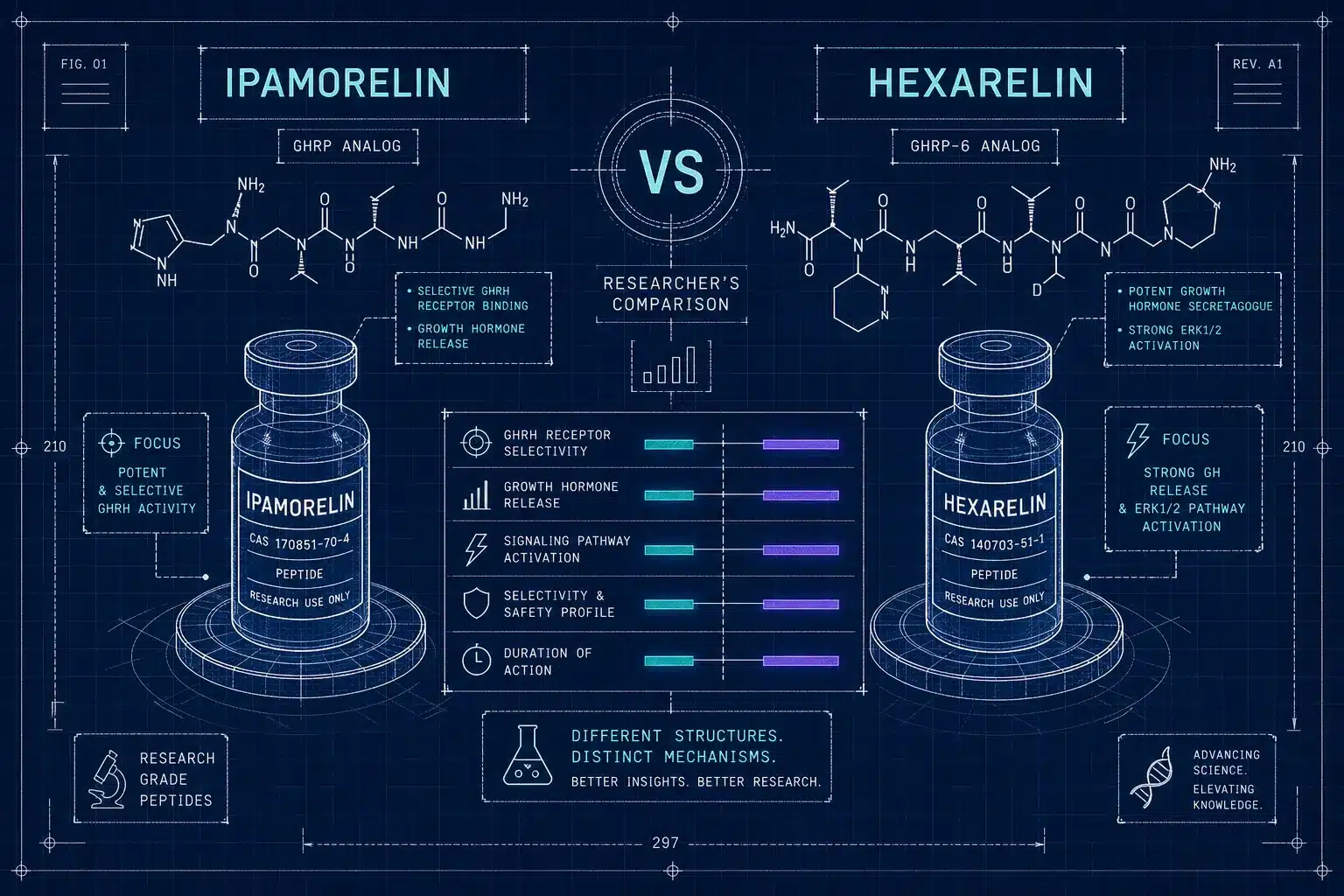
Both ipamorelin and hexarelin activate GHS-R1a and drive growth hormone release from pituitary somatotrophs. On paper, they look interchangeable. In practice, this ipamorelin vs hexarelin for growth hormone research comparison reveals that choosing the wrong compound for your experimental endpoint introduces confounders, complicates data interpretation, and can send a multi-week protocol sideways before you catch the problem.
This guide draws from peer-reviewed pharmacology, controlled animal studies, and available human PK data to give you a concrete decision framework. For labs planning head-to-head comparative protocols, sourcing both peptides from a single COA-verified supplier is the cleanest starting point. R-Peptide Supply stocks ipamorelin and hexarelin in research-grade bulk formats, so you’re working from verified, lot-traceable material on both sides of the comparison.
What follows covers receptor mechanism, GH output data, off-target hormone effects, tachyphylaxis risk, and dosing frameworks. By the end, you’ll have enough to design a GH secretagogue study without guessing which compound belongs in which protocol.
Receptor selectivity: how ipamorelin and hexarelin differ at GHS-R1a
Both peptides share a core mechanism. They bind GHS-R1a, activate Gq/11-coupled signaling, trigger phospholipase C activation with downstream IP3/DAG generation, and mobilize intracellular calcium to drive GH secretion from somatotrophs. The pathway is the same. The receptor engagement breadth is not.
Ipamorelin is the more selective agonist. Published pharmacology reviews report no significant stimulation of ACTH, cortisol, prolactin, LH, FSH, or TSH at research doses. That selectivity is a direct research design advantage: when your endpoint is GH-axis biology specifically, ipamorelin gives you a cleaner signal with fewer confounding variables to account for in your analysis. For background on secretagogue classes and receptor biology, see What Are Growth Hormone Secretagogues? Complete Guide, Research Peptides Supply.
Hexarelin is the more potent GHS-R1a agonist, but it engages secondary endocrine pathways that ipamorelin does not. Its lower selectivity means off-target pituitary hormone stimulation is a real consideration in study design. For researchers studying isolated GH-axis physiology, that’s noise. For researchers interested in the full range of GHS-R1a signaling effects, including cardiovascular endpoints, it’s a deliberate feature rather than a liability.
Ipamorelin vs hexarelin GH output and pulse dynamics
The human PK data for ipamorelin shows a clean, brief pulsatile response. A controlled study reports a single GH episode with peak at approximately 0.67 hours (roughly 40 minutes post-dose), followed by rapid exponential decline. The maximal GH production rate cited in that study is 694 mIU/L/h. Terminal half-life runs approximately 2 hours, and GH returns to baseline within a few hours. That profile mirrors physiological pulsatile GH release, which is useful when your research question requires mimicking endogenous secretion patterns.
The hexarelin data comes primarily from controlled rat studies rather than matched human PK trials. A mean peak GH response of 301 ± 37 ng/mL was recorded after a first injection, with a 30-minute AUC of 5,585 ± 700 ng/mL·30 min. A second dose administered two hours later still produced a substantial response, 149 ± 47 ng/mL peak and 3,056 ± 908 ng/mL·30 min AUC, but the reduction is notable and represents early evidence of partial desensitization. For a direct comparison overview and practical protocol notes, consult Ipamorelin vs Hexarelin: Which GH Secretagogue Wins?, Research Peptides Supply.
A direct human head-to-head comparison with matched peak and AUC metrics does not exist in the published literature. Cross-species comparisons carry real interpretive limitations, and researchers should treat them accordingly. What the available data does support is that hexarelin produces a larger measured GH peak and AUC in the rat model, while ipamorelin in humans produces a shorter, single-peaked response at approximately 40 minutes.
Off-target hormone effects and cardiovascular signals
Cortisol and prolactin outputs matter in research design because they represent confounders in metabolic and endocrine studies. Ipamorelin’s published profile shows negligible stimulation of either hormone at therapeutic-range doses. The comparative pharmacology literature confirms no ACTH or cortisol release at doses more than 200-fold above the GH ED50, and no PRL changes across the compounds tested. When your goal is isolating GH-axis biology, ipamorelin eliminates two major confounders upfront.
Hexarelin’s lower selectivity introduces documented risk of cortisol and prolactin co-stimulation. That’s not disqualifying, but it means those hormones need to be included in your monitoring panel and controlled for in your analysis. Failing to account for them doesn’t make the problem disappear; it just moves the error into your data.
Hexarelin has a unique cardiovascular biomarker signal with no ipamorelin equivalent in the literature. A controlled human study reported an acute LVEF rise from 64.0 ± 1.5% to 70.7 ± 3.0% after hexarelin administration, with no significant change in mean blood pressure or heart rate; see the original clinical report for methodology and numbers: controlled hexarelin cardiac study. Additional data from animal models includes increased cardiac output, reduced wedge pressure, lower troponin-I, and reduced TNF-α in ischemia/reperfusion models.
In GH-deficient patients, hexarelin raised peak LVEF from 57 ± 2% to measurably higher values compared to controls. This cardiovascular signal makes hexarelin an actively studied compound in cardiac physiology research, not simply a noisier GH secretagogue. Ipamorelin has no comparable cardiovascular biomarker data in published literature, which reinforces its narrower GH-axis focus.
Ipamorelin vs hexarelin: tachyphylaxis and dosing considerations
Hexarelin’s tachyphylaxis profile is the most documented of the two. Repeated exposure produces partial, reversible desensitization attributed to changes in GHS-R density. The rat dosing data showing reduced AUC on second administration two hours later is early evidence of this at the acute level. Published review literature documents reduced effectiveness with prolonged use, and discontinuation restores GH release parameters.
GHS-R1a desensitization onset occurs within 2 to 5 minutes of hexarelin exposure, with receptor function partially recovering by approximately 3 hours and near-complete recovery by 6 hours in GHS-R trafficking studies. For researchers designing multi-week or chronic-exposure hexarelin protocols, these findings have direct operational implications. Baseline responsiveness must be measured before the protocol begins, and washout periods need to be planned explicitly rather than assumed. A treatment hiatus is the most supported mitigation strategy in the published literature; no formally validated cycling schedule with a specific on/off duration has been established across species.
Ipamorelin’s tachyphylaxis profile is less extensively documented in long-term human data. What the evidence does clearly support is that ipamorelin produces no cortisol or prolactin spikes with repeated dosing, removing one common desensitization concern associated with less selective secretagogues. For repeated-dose protocols, ipamorelin’s cleaner receptor engagement makes it the more predictable compound. That said, researchers should build in monitoring checkpoints regardless of compound selection, the absence of evidence for tachyphylaxis is not the same as evidence of its absence.
Dosing protocols and safety monitoring in published research
Ipamorelin has a reasonably documented preclinical dosing range. A key rat study used 0, 18, 90, or 450 micrograms per day via subcutaneous injection three times daily over 15 days, with bone growth rate and body weight as primary endpoints. Separate animal research describes continuous subcutaneous infusion at 0.5 mg/kg/day via pump, single-dose protocols at 1 mg/kg, and repeated-dose designs at 0.1 to 1 mg/kg four times daily at roughly 3-hour intervals.
Clinical-range ipamorelin regimens are described at 100 to 300 micrograms per day, often once daily or split into two to three doses, commonly timed to sleep to align with endogenous GH pulse patterns. Safety monitoring across studies focused on IGF-1 levels, other metabolic parameters, and symptom tracking. The preclinical literature is more robust than the long-term human data, and researchers should weight sourcing decisions accordingly. For context on alternative peptides and clinical considerations, see Sermorelin peptide for sale: what researchers need to know, Research Peptides Supply.
Hexarelin has been studied through parenteral routes including subcutaneous and intravenous administration across a range of experimental protocols. Dose and route vary significantly by study design and species, so researchers designing comparative protocols should pull dose and route data directly from the primary paper matching their target endpoint. Safety monitoring for hexarelin studies should explicitly include cardiovascular endpoints given the documented cardiac biomarker activity. Relying on generalized summaries for hexarelin dosing introduces avoidable imprecision into your protocol.
Sourcing both peptides for comparative research
When running a comparative GH secretagogue protocol, any difference in compound purity between your ipamorelin and hexarelin batches introduces an uncontrolled variable that can invalidate your results. HPLC-verified purity with lot-traceable COAs is the baseline requirement, not an optional quality add-on. A proper COA should include compound identity, purity percentage, lot number, and testing methodology. Sourcing from a supplier without that documentation carries that uncertainty forward into every data point you generate.
R-Peptide Supply stocks both ipamorelin and hexarelin in bulk vial formats with COA-backed purity verification from a single supplier. For labs running comparative studies, consolidating procurement from one source eliminates batch-to-batch variability risk across vendors, a source of noise that researchers frequently underestimate in comparative peptide research. Both compounds are available as research-use-only materials, with free shipping on orders over $200 and 24/7 support for procurement logistics.
Ancillary supplies including bacteriostatic water are also available through R-Peptide Supply, so researchers can establish a complete reconstitution workflow without sourcing from multiple vendors. That matters most when you’re managing tight lab timelines and don’t want reconstitution supply gaps interrupting a scheduled protocol.
Choosing the right compound for your endpoint
The decision framework is straightforward once you know your endpoint. Choose ipamorelin when selectivity matters: it delivers a clean GH-axis signal with minimal cortisol and prolactin stimulation, while its predictable pulse dynamics and well-documented repeated-dose profile make it the default for research questions that require isolating GH biology without off-target hormone confounders.
Hexarelin is the right choice when potency is the priority, or when your research question involves broader GHS-R1a biology, cardiovascular endpoints, or receptor downregulation dynamics. Its documented cardiac biomarker effects make it specifically valuable for cardiology-adjacent GH secretagogue research that ipamorelin simply cannot replicate.
Neither compound is universally superior. This ipamorelin vs hexarelin for growth hormone research comparison makes one point clearly: the right choice depends entirely on your experimental endpoint. Whichever compound you select, COA-verified purity from a consistent supplier is the starting point for any credible comparative protocol. If you’re ready to move from protocol design to procurement, R-Peptide Supply carries both compounds in the formats and documentation standards that research-grade work requires.