


Blog
What to Look for in a Peptide COA Before Buying Online

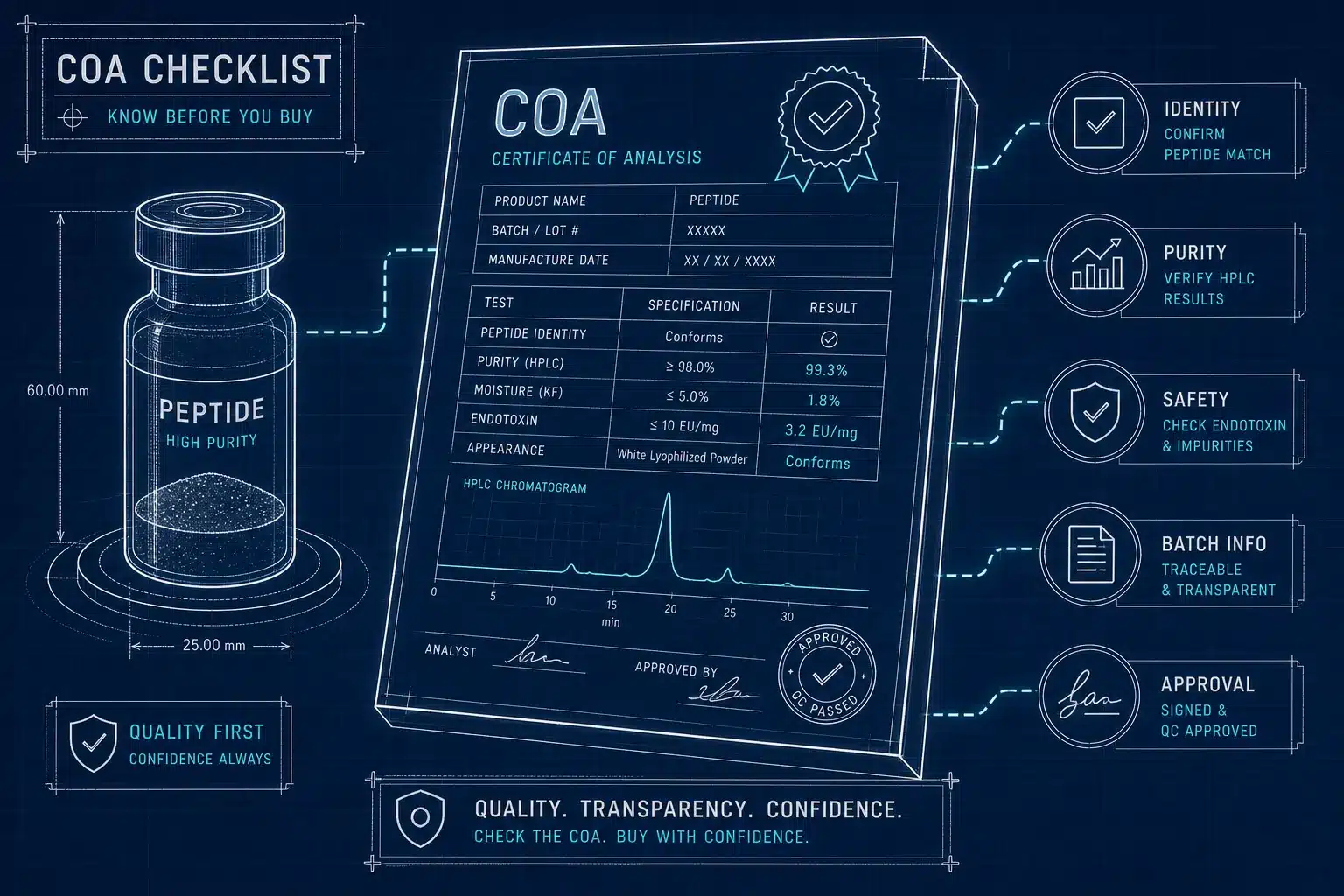
Knowing what to look for in a peptide COA when buying online is the single most important skill a research buyer can develop. The package arrives, the vials look clean, and the vendor has attached a PDF labeled “Certificate of Analysis.” It has a logo, some numbers, and a chromatogram image that looks official enough. Many buyers rely on the presence of a COA as a signal of legitimacy and stop there. That assumption is exactly what low-quality vendors count on.
COA quality varies drastically across the online peptide market. Some documents are thorough, third-party verified, and traceable to a specific production batch. Others are recycled templates with placeholder data, or worse, fabricated outright. Without knowing what a legitimate COA is supposed to contain, you cannot tell the difference between the two just by looking at the formatting. The document’s appearance is not the credential; the data inside it is.
This guide walks through every field, every test, and every verification method that separates a trustworthy certificate of analysis peptide document from one designed to look the part. By the time you finish reading, you will have a practical checklist you can apply to any COA before committing to an order, whether you are sourcing a single compound or placing a wholesale order for a full research catalog.
Reading a peptide COA: the metadata every document must show upfront
Before you look at a single test result, the document’s basic identifiers tell you whether the COA is traceable to a specific product batch or just a recycled template attached to whatever is being sold that week. These fields are not technical, but they are the foundation of everything else.
The COA must show the full compound name, the complete amino acid sequence (not just a common abbreviation), and a unique lot or batch number. The lot number is the link between this document and the specific vials you are purchasing. If it is missing or listed as “N/A,” the document cannot be verified against any particular production run, which means it has no traceability value at all.
A credible COA also includes both a manufacturing date and a retest or expiration date. These fields confirm when the compound was produced and how long its documented quality is considered valid. Missing dates are a soft red flag; they often indicate the COA was generated without reference to an actual production batch. Finally, check for both a theoretical molecular weight (derived from the known amino acid sequence) and an observed molecular weight (measured through mass spectrometry). Both numbers must be present and must align. A discrepancy here means either the wrong compound was tested or the data was manipulated.
What to look for in a peptide COA when buying online: HPLC and mass spectrometry
Purity and identity are the two non-negotiables on any peptide COA, and they come from two separate analytical methods. A COA that includes only one of them is incomplete, regardless of how professional the document looks.
HPLC separates the target peptide from related impurities and degraded material. The purity percentage is calculated by dividing the area of the main peak by the total area of all detected peaks. Research-grade peptides should show purity at or above 95%, and premium-grade compounds often test at 98% or higher. The COA should include the actual chromatogram image, not just a reported number. The image allows basic visual verification that the data has not been cropped, blurred, or otherwise altered before delivery, though for definitive confirmation, request the raw chromatogram file or validate the batch through the testing lab’s portal directly. For a practical discussion of HPLC testing and how labs report peptide purity, see HPLC testing for peptide purity here.
Mass spectrometry confirms compound identity by measuring the molecular weight of the tested sample and comparing it to the expected theoretical value. HPLC tells you how pure the sample is; MS tells you whether it is actually the compound you ordered. Both tests must appear on the COA. A document with only HPLC purity and no MS identity confirmation leaves the compound’s identity unverified, which is a critical gap for any serious research application.
One distinction that trips up even experienced buyers is the difference between HPLC purity and net peptide content. HPLC purity reflects the percentage of UV-detectable material that is the target peptide. It does not account for non-UV-detectable components like water, TFA counterions, or residual salts. A compound can read 99% pure by HPLC and still be only 70, 85% actual peptide by mass. Net peptide content is measured through quantitative amino acid analysis, and a complete COA for precision applications will include this figure alongside the HPLC purity. If you need to calculate an exact working dose from your vial weight, you need both numbers.
Who issued the COA and how to confirm it is credible
A COA is only as credible as the laboratory that produced it. A polished PDF generated by the vendor’s own team is not quality documentation; it is a self-report with no independent check on the results, the equivalent of grading your own exam and presenting the score as objective evidence. For background on what vendors mean when they advertise “lab tested” materials, consult What Does “Lab Tested Peptides” Actually Mean for Researchers?, Research Peptides Supply.
The issuing lab’s name, address, and accreditation status should appear directly on the COA. ISO/IEC 17025 accreditation is the internationally recognized standard for testing and calibration laboratories, and it signals that the lab operates with documented competence, measurement traceability, and impartiality. Recognized third-party labs in this space include Eurofins Scientific, SGS, Intertek, and Optima Labs. An authorized, dated signature from QA personnel at the testing lab should also appear on the document. Without that signature, there is no formal chain of custody. For an explanation of ISO/IEC 17025 and why it matters for peptide testing, see this primer on ISO/IEC 17025 for peptide testing here.
Several reputable labs provide online verification portals where you can enter a unique batch code or verification number from the COA and confirm the test results directly. Optima Labs, for example, allows buyers to visit their site and validate a specific batch in seconds using the code printed on the COA. If the vendor’s document does not include a verifiable code, or if the lab name cannot be confirmed through a basic web search, that is a clear reason to pause before placing an order. Any vendor worth sourcing from will provide COAs tied to real, verifiable batch data on request.
Additional tests that matter depending on your application
Standard research-grade COAs focus on identity and purity. Depending on how the compound will be used in your protocol, however, additional testing may be directly relevant to your work and your results.
Sterility testing confirms the compound is free from viable microorganisms. Endotoxin testing, conducted using the LAL or rFC method, confirms the absence of bacterial lipopolysaccharides that can trigger immune responses even in a technically sterile sample. These tests are not standard on lyophilized research powders, but they become critical for any application involving injection or in vivo use. A product can pass sterility and still carry active endotoxins; these are separate measurements that address separate risks. If your protocol requires sterile compounds or involves cell-based assays where endotoxin interference is a concern, verify explicitly that the COA includes both reports before ordering.
Heavy metals testing confirms the absence of toxic metal contaminants like lead, arsenic, or mercury that can enter a compound during synthesis. This level of documentation is most relevant for GMP-compliant or clinical-grade applications. For standard research use it is often excluded, but knowing to request it when sourcing compounds for high-compliance work is a mark of an informed buyer. Understanding which tests apply to your specific use case helps you ask the right questions upfront rather than discovering gaps after the order ships.
Red flags that signal a falsified or unreliable COA
Spotting a fabricated document does not require a chemistry background. Several visual and logical inconsistencies recur in low-quality or falsified COAs, and most of them are visible within the first 60 seconds of review.
Blurry or truncated HPLC chromatograms are a primary warning sign. If the chromatogram image is cropped, low resolution, or missing axis labels, the peak data cannot be independently validated. Authentic labs produce clean, fully rendered spectral outputs because their workflow generates them automatically. A COA with degraded spectral data frequently indicates a vendor cutting corners or lifting an image from another source; follow up by requesting raw data or checking the lab’s batch verification portal before proceeding.
Batch identifier issues are equally telling. A lot number that does not match the vial label, an absent lot number, or a lot number that appears on multiple different product COAs with identical test data are all signs of document recycling. Vendors who reuse old test results across new batches are effectively selling unverified product under the cover of documented legitimacy. The batch number is the one field that must be unique to each production run; if it is not, the document is not a real COA.
Finally, check the molecular weight alignment. The observed molecular weight on the MS data must match the compound’s theoretical molecular weight within an acceptable margin. A mismatch means the tested sample may not be the compound claimed on the label. A COA without a dated, authorized signature from the issuing lab also has no chain of custody, regardless of how complete the rest of the document appears.
How R-Peptide Supply structures its COA documentation
After working through this checklist, the most useful reference point is seeing what complete documentation looks like in practice. At R-Peptide Supply (Grey Peptide Shop), COAs are built to include the full compound name and amino acid sequence, a unique lot number, manufacturing and retest dates, an HPLC chromatogram with the stated purity percentage, MS-confirmed molecular weight with both theoretical and observed values, and the issuing third-party laboratory’s credentials and authorized signature, each field corresponding directly to the verification criteria outlined above.
Compounds across the catalog, from How to Source BPC-157 with a Verified Certificate of Analysis, Research Peptides Supply and TB-500 for Sale: Verified Vendors, Purity Checks & Red Flags, Research Peptides Supply to Tirzepatide and IGF-1 LR3, are intended to ship with documentation traceable to the specific production batch you receive. Requesting a COA before placing your order should return verifiable batch data rather than a generic template repurposed from a previous run. That level of traceability is the baseline expectation for any serious wholesale supplier, not a premium feature. For an example of a vendor COA process overview, see this COA process summary here.
Apply the checklist from this article to any COA you encounter, and you will be able to assess it clearly within minutes. Understanding what to look for in a peptide COA when buying online, from lot traceability and HPLC chromatograms to third-party lab credentials and MS identity confirmation, is what separates a sourcing decision you can stand behind from one you cannot verify. The difference between a credible quality document and one designed to resemble one is almost always visible in the details, long before you reach the test results. For an accessible overview of certificates of analysis and researcher guidance, see Certificates of Analysis: What researchers need to know.
Quick-reference checklist: what to look for in a peptide COA when buying online
- Lot/batch number, unique to the production run and matching your vial label
- Full compound name and amino acid sequence, not just an abbreviation
- Manufacturing date and retest/expiration date, both present and plausible
- HPLC chromatogram image, clean, fully rendered, with axis labels and a purity value at or above 95%
- MS identity confirmation, observed molecular weight matching the theoretical value
- Net peptide content, amino acid analysis result included for precision-dosing applications
- Third-party lab name, address, and ISO/IEC 17025 accreditation status
- Authorized, dated QA signature from the issuing laboratory
- Batch verification code, cross-referenceable through the lab’s online portal
- Sterility and endotoxin reports, required for injection or in vivo applications