


Blog
Buy GHK‑Cu vials online with verified COAs: lab guide

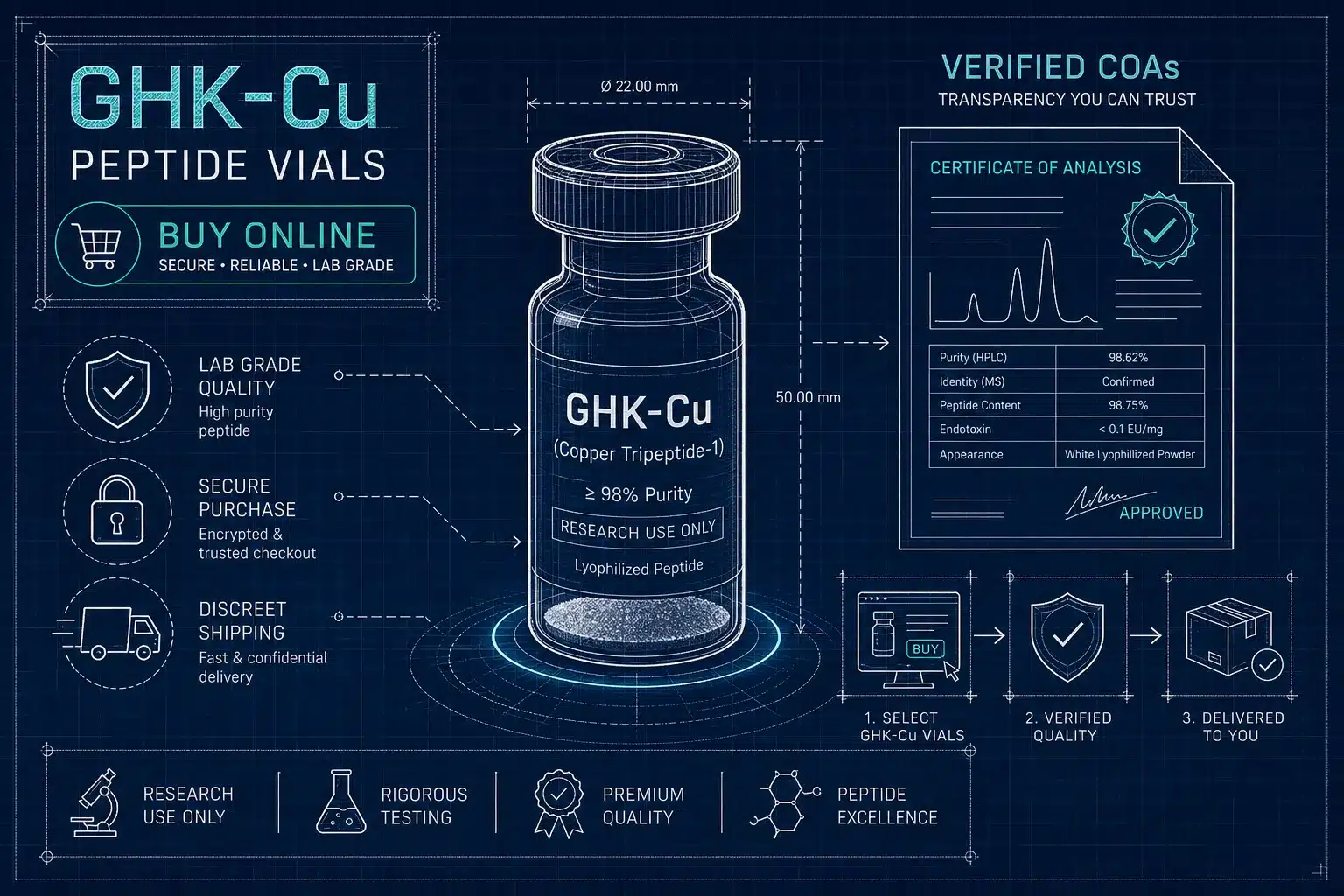
When you set out to buy GHK‑Cu vials online with verified COA, research integrity is on the line. The difference between credible data and wasted effort often comes down to whether your copper peptide arrives with lot‑matched documentation that proves what is in the vial. This guide shows what real COAs look like, how to verify them in minutes, and where to source transparently. Make lot‑matched documentation your non‑negotiable baseline.
GHK‑Cu is widely available as research‑grade material, yet not every supplier proves identity and purity with the same rigor. Your aim is straightforward: verify HPLC purity, confirm identity by mass spectrometry, and trace the report to the exact lot in your hand. Do that consistently and your lab’s notebook, audits, and results remain defensible.
What a verified GHK‑Cu COA should show
Identity and purity: HPLC percentage and LC‑MS confirmation
A trustworthy COA reports purity by HPLC as a clear percentage (ideally with at least two significant digits). Treat one‑number claims like “99%” without chromatograms, method notes, or acceptance criteria as insufficient. Typical research‑grade expectations start at ≥95%, with high‑end GHK‑Cu commonly stated at 98, 99% or higher. HPLC + MS outperforms HPLC alone.
Identity requires mass spectrometry. Look for LC‑MS or MS confirmation that matches the expected molecular mass for GHK‑Cu rather than a generic peptide ID. Purity tells you how much of a single peak is present; identity tells you that peak is the right compound. You need both to rule out close analogs or process artifacts.
Batch traceability that matches your vial
The COA must carry a lot or batch number, sample ID, and test date that align exactly with your vial’s label. Do not accept a shared or rolling certificate, even if the product name matches. Include synonyms on intake, since GHK‑Cu is also listed as Copper Tripeptide‑1 in some reports, which helps avoid mix‑ups during audits.
Lab details and accreditation
Look for the testing lab’s name, location, and an ISO/IEC 17025 accreditation status that covers HPLC and LC‑MS within scope. Reputable reports also show a certificate or report ID and often a QR code that resolves to the specific lot page. A QR that lands on a generic marketing page is not traceability; it is advertising.
Value‑add quality panels
Beyond identity and purity, some suppliers include TFA content, endotoxin, sterility screens, residual solvents, or heavy metals. These are valuable when present, yet they are not universal baselines for research‑only copper peptide vials, so never assume they were performed unless clearly listed. Appearance notes should read as a blue to blue‑green lyophilized powder, consistent with copper complexation.
COA verification workflow you can run in minutes
Match the item in hand to the document
Start with your vial. Check the lot number, the labeled mass and format, and the product naming. Common lyophilized GHK‑Cu vial sizes include 50 mg and 100 mg; your COA should mirror the stated mass and presentation. If the document shows a different mass or format, stop and escalate.
Validate the testing source
Confirm the lab’s ISO/IEC 17025 status via a public directory or the accreditation body using independently sourced contact details. Scan the QR code if present and verify that it resolves to a report page for your exact lot, not a generic product page. If a QR is missing, ask the vendor for a certificate ID and a direct report link.
Cross‑check methods and numbers
Each result should list a method and units, and state acceptance criteria or a specification range. HPLC purity should read like 99.4%, not >99% without context, and the LC‑MS section should present the observed mass. If the lot number does not match, the COA does not apply.
Document your audit for traceability
Save the COA PDF, any screenshots of QR‑resolved pages, and your email trail with the lab or vendor. Name files with the lot number and test date so your team can retrieve them quickly during audits. Add a short note in your notebook on who verified what and when to lock in your chain of custody.
How to evaluate online suppliers of GHK‑Cu
Supplier checklist to buy GHK‑Cu vials online with verified COA
- Public, lot‑specific COAs with historical lots visible and downloadable.
- Third‑party testing called out plainly (not vague “lab tested” claims).
- Clear research‑use‑only language and no dosing or human‑use claims.
- Traceable report elements: lab name, methods, units, acceptance criteria, and dates.
Operational hygiene that protects your work
Look for real‑time stock indicators, stated shipping timelines, and responsive support that answers documentation questions. Packaging details matter for stability, so verify light‑resistant outer materials, desiccant where appropriate, and tamper evidence. Vendors that run clean operations tend to run clean documentation too.
See vendor examples that emphasize operational hygiene for high‑purity grey market peptides.
Pricing and packaging sanity checks
Expect clear presentation of vial sizes (e.g., 50 mg and 100 mg) and formats. Ancillary supplies such as bacteriostatic or sterile water should be sold separately rather than bundled in ways that blur RUO intent. Large, unexplained price gaps versus typical market ranges can be a red flag, probe the paperwork and vendor credibility rather than assuming price parity across formats.
Vendor example: R‑Peptide Supply (Grey Peptide Shop)
R‑Peptide Supply (Grey Peptide Shop) states that its GHK‑Cu (50mg/100mg) x10vials vials ship with lot‑matched documentation including HPLC purity and LC‑MS identity, with QR or certificate identifiers that trace to the specific lot. Treat these as vendor claims and verify on the current product page and COA before purchase. Using vendors that provide this level of documentation simplifies audits and apples‑to‑apples comparisons.
Where to buy GHK‑Cu vials online with verified COA
Other vendors that publish batch COAs (neutral listing)
Examples often cited by researchers include Verified Peptides, Umbrella Labs, Pure Health Peptides, and BioLongevity Labs. Practices change, so confirm the presence of batch‑specific PDFs, test methods, and the lab’s accreditation details on each site before purchase. Documentation parity is how you compare offers fairly.
Compare documentation apples‑to‑apples
Require HPLC purity plus MS identity on the same lot, with test dates, lab name, and batch traceability. Favor third‑party laboratories and complete panels over potency‑only claims. When two offers look similar on price, the stronger and more recent COA should carry more weight. For more on method expectations and chromatography reporting, consult the ultimate guide to HPLC testing for peptides.
Red flags that disqualify a seller
- No public COAs, or certificates that look generic or reused across products.
- Mismatched or missing lot numbers, or COAs with outdated test dates.
- Pages with aggressive medical claims, dosing instructions, or before‑and‑after imagery on a “research” item.
Research‑use‑only compliance: US, EU, and UK at a glance
United States: research material, not a medicine
Source GHK‑Cu as research material only and avoid suppliers that frame it for human administration. Injectable compounding draws added scrutiny, and sellers should not provide dosing guidance or imply therapeutic intent. Keep RUO language on product pages, invoices, and labels.
EU and UK: cosmetics vs medicines vs research
In the EU and UK, the line is drawn by intended use and claims. Cosmetic ingredient claims differ from medicinal claims, and RUO labeling alone is not a shield if the marketing effectively promotes human use. Import decisions hinge on declared use and presentation, so align paperwork, invoices, and labels.
What compliant pages and labels show
Expect clear RUO statements, no dosing or therapeutic claims, and visible batch numbers. A proper documentation pack includes lot‑matched COAs and, when relevant, links to the testing lab or a QR that resolves to the specific report. Your internal SOPs should capture these artifacts at receipt for vendor qualification.
Why COA clarity protects your research
Lot‑matched, method‑specific documentation supports audits, reproducibility, and institutional review. When reviewers can trace a result back to HPLC and MS data on the exact vial, confidence rises and questions drop. Documentation is part of the experiment, not an afterthought.
Handling lyophilized GHK‑Cu: storage, reconstitution, and shipping
Storage and shelf life
Keep lyophilized GHK‑Cu dry, protected from light, and frozen near −20 °C for long‑term stability. Many labs treat frozen dry vials as stable for roughly 1, 2 years under proper conditions with minimal temperature cycling. After reconstitution, store at 2, 8 °C and plan to use within about 30 days if prepared with bacteriostatic water, or within 7, 10 days if prepared with plain sterile water. Always follow the vendor’s stability guidance on the COA or product page, as durations can vary by formulation and container closure.
Reconstitution basics for consistency
Let the sealed vial come to room temperature before opening to minimize condensation. Add diluent slowly down the glass wall, then swirl gently until dissolved rather than shaking vigorously. Record the concentration and date on the vial and in your notebook so any downstream results are traceable to a known preparation.
Packaging and shipping you should expect
For unreconstituted lyophilized vials, ambient shipping is common, provided the vial is sealed and protected from light and moisture. Expect a light‑resistant outer package, desiccant when appropriate, and tamper evidence. Consider materials such as Tyvek industrial active packaging. Move vials to cold storage on arrival and follow the vendor’s storage guidance immediately.
Also check vendor pages for clear shipping documentation and logos used by sellers of high‑purity grey market peptides.
Copy‑paste mini SOP
- Receipt: inspect package integrity; confirm vial lot, mass format (50 mg or 100 mg), and labeling against the packing slip.
- Verification: scan QR or open COA PDF; match lot and test date; note HPLC purity plus MS identity in your intake log.
- Storage: place dry vials at −20 °C in light‑protected secondary containment with desiccant; avoid repeated freeze, thaw.
- Reconstitution: warm sealed vial to room temperature; add sterile or bacteriostatic water slowly; swirl to dissolve; label concentration and date.
- Documentation: save COA and screenshots in a lot‑named folder; record who verified and when; link the record to your experiment ID.
Control light, moisture, and temperature from day one. Those three variables explain most stability issues with copper peptide vials and are fully under your control.
The playbook is straightforward: verify HPLC purity with specific percentages, confirm identity by LC‑MS, and ensure every number and date maps to your vial’s batch. Keep procurement RUO‑compliant across jurisdictions and favor suppliers that meet you with lab‑level documentation, not slogans. If you plan to buy GHK‑Cu vials online with verified COA, use the checklists here to standardize intake and protect your results.