


Blog
How to Verify Grey-Market Peptide Purity With a COA

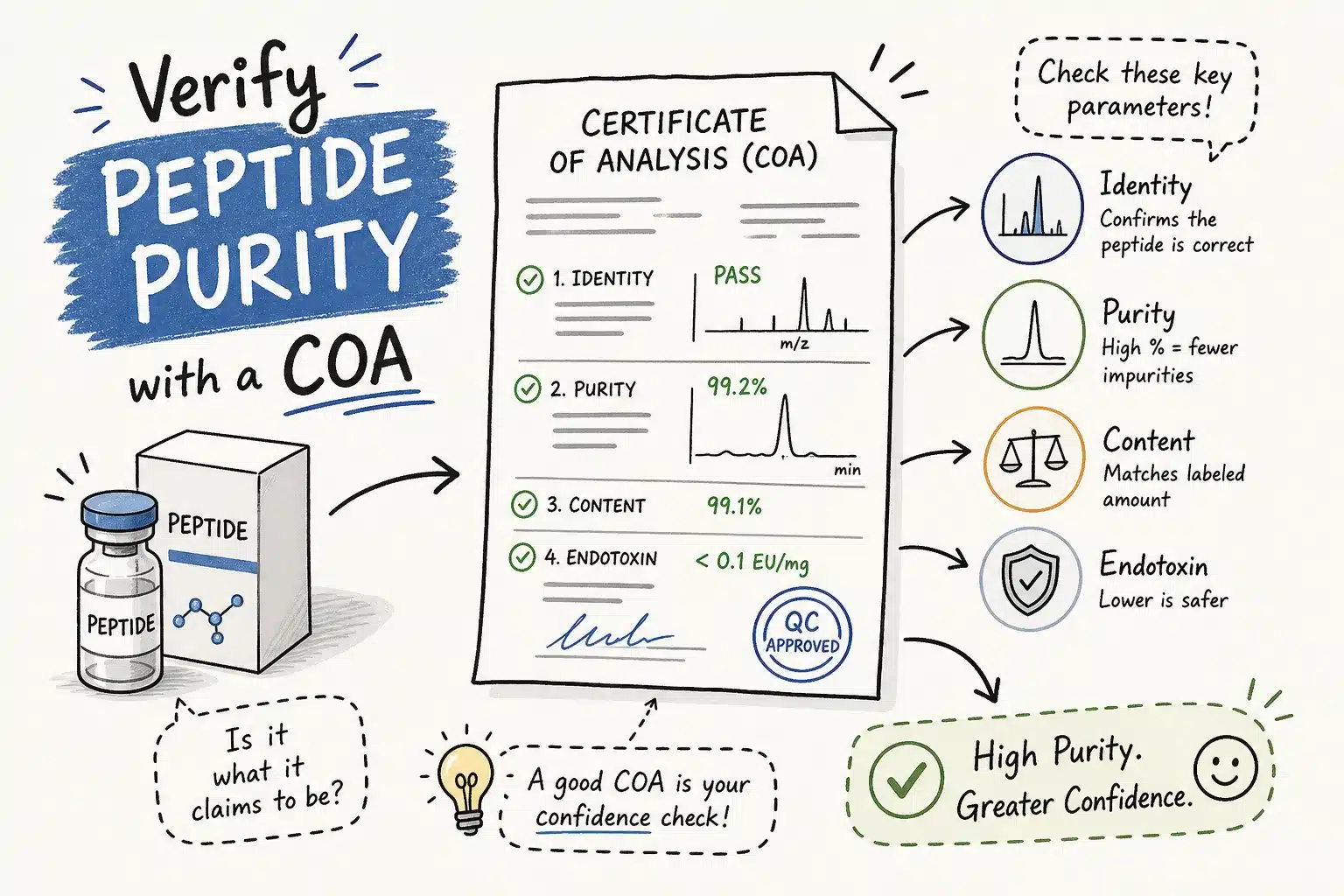
When you order a research peptide from a grey-market supplier, you can’t inspect the compound yourself. You can’t verify its structure under a microscope or run it through your own analytical instrument. The Certificate of Analysis is the only document standing between you and an unknown substance, knowing how to verify the purity of grey-market peptides with a COA is the most important skill a research buyer can develop. A polished, professionally formatted PDF does not automatically mean a verified compound.
A small number of suppliers treat third-party COA documentation as a baseline requirement rather than a marketing add-on. R-Peptide Supply is one of them, providing independently verified COAs with every order as standard practice. That’s the benchmark you should hold every vendor to before placing an order. Most don’t meet it.
By the end of this walkthrough, you’ll be able to read HPLC purity data critically, interpret mass spectrometry results, identify the specific patterns that indicate a falsified document, and confirm whether the testing lab on that COA is actually accredited. These are learnable skills, and you don’t need a chemistry degree to apply them.
What a legitimate peptide COA must contain
Most researchers skim a COA looking for the purity percentage and stop there. That number is the minimum disclosure, not the standard for a trustworthy document. A legitimate COA is a structured analytical report with specific required fields, and a missing field isn’t a minor formatting issue.
Core identity and lab verification fields
The header section of a valid COA must include the testing laboratory’s full name, physical address, and contact information. The lab must be an independent third party, not the supplier’s internal team or an unnamed “in-house facility.” ISO 17025 accreditation should be listed, and the peptide itself must be identified by its full chemical name, amino acid sequence notation, CAS number, and molecular formula. Without these fields, you have no way to confirm that the document refers to a specific, traceable compound. Missing any one of them is a disqualifying gap, not a formatting oversight.
Traceability markers: lot number, test date, and analyst signature
The batch or lot number on the COA must match exactly what’s printed on your physical vial label. This is the single most important traceability link in the document, and a mismatch or absent lot number means the report describes a different batch, not yours. The testing date confirms the analysis is recent and not recycled from a prior batch. Manufacturing and expiration dates allow you to assess shelf-life, particularly relevant for lyophilized peptides stored long-term.
An analyst’s name or signature adds accountability: someone is asserting that the tests were performed and that the results are accurate. No signature means no named professional stands behind the data.
How to verify peptide purity with a COA: reading HPLC data
HPLC purity is the most commonly reported figure on any peptide COA, but a raw percentage without supporting context tells you almost nothing. The number means something only when you can evaluate the full analytical section behind it.
Interpreting the chromatogram and area percentage method
Percent purity is calculated using the peak area method: the area of the main peak divided by the total area of all detected peaks, multiplied by 100. As a concrete example, a main peak area of 2,500,000 out of a total detected area of 2,575,000 gives you 97.1% purity. Detection is typically run at 214 nm to capture the peptide backbone, or at 280 nm for peptides containing aromatic residues like tryptophan or tyrosine. A trustworthy COA will disclose the column type, mobile phase composition, gradient conditions, and flow rate, enough information to evaluate whether the method was appropriate and reproducible. For a technical overview of column selection and method parameters see RP-HPLC peptide purity analysis.
Verify grey-market peptide purity: clean peaks vs. impurities and co-elution
A high-purity chromatogram shows one sharp, symmetrical, Gaussian-shaped peak with a flat baseline and no significant adjacent signals. Impurities appear as smaller secondary peaks at different retention times, shoulder peaks on the main peak, split peaks, or unusually broad peaks that indicate poor separation. The most problematic scenario is co-elution, where two compounds share an identical retention time and appear as a single clean peak. Standard HPLC cannot distinguish between co-eluting compounds, which means a visually clean chromatogram can still contain a hidden impurity. LC-MS is the tool needed to catch this scenario, which is why mass spectrometry data is not optional on a complete COA. For practical information on how labs combine HPLC and LC‑MS to verify peptide identity and purity, review methods for HPLC testing for peptide purity.
Decoding the mass spectrometry section
HPLC tells you purity. Mass spectrometry tells you identity. These are two different questions, and a COA that only answers one of them is structurally incomplete, regardless of how high the purity number is. Practical guides to what belongs in a COA can help you interpret spectra; see this primer on peptide certificates of analysis for examples of expected spectral data and reporting conventions.
Theoretical vs. observed molecular weight
The theoretical molecular weight is calculated from the peptide’s amino acid sequence using standard atomic masses. The observed molecular weight is what the instrument actually measures from the ionized sample. Both values must appear on the COA, and they must match within a narrow tolerance. A correct purity reading paired with a mismatched molecular weight is a strong signal that the compound in the vial is not what the label claims. This peptide identity confirmation step is non-negotiable; skipping it leaves a critical verification gap.
What missing or mismatched MS data signals
One of the most common shortcuts in low-quality or falsified documentation is including HPLC purity data while omitting MS results entirely. Some vendors substitute a text statement like “molecular weight confirmed” in place of actual spectra data with measured m/z values. That substitution is not equivalent to a real MS report, and it provides no independently verifiable information. If the observed molecular weight doesn’t appear alongside the theoretical value, the identity of the compound has not been analytically confirmed. Period.
Red flags that expose a fake or low-quality COA
Armed with the knowledge of what a real COA contains, spotting a falsified one becomes significantly more straightforward. These are the specific signals that should stop a purchase before it happens.
Missing fields and template-style document patterns
The most basic version of a suspect COA lists a purity percentage with no chromatogram image, no method parameters, and no lot number. This format tells you nothing verifiable about the compound. A more sophisticated but equally problematic pattern involves vendors reusing the same COA PDF across multiple batch numbers or product listings: compare analytical reports from different orders or across vendor sites and you’ll sometimes find identical documents with only the product name changed. For compounds intended for injectable research applications, a COA that omits endotoxin levels and residual solvent data is a disqualifying omission because purity does not equal sterility, and bacterial endotoxins are invisible in standard purity testing.
Vendor-issued reports and unverifiable lab names
The most common fraud pattern is straightforward: the supplier generates their own COA using an internal lab or lists a lab name with no verifiable address, contact information, or accreditation status. If a basic internet search for the lab name returns no results, that’s not a minor gap in documentation, it disqualifies the document entirely. Also watch for language like “FDA-registered facility” used to describe the testing source, without specifying which independent entity actually performed the analysis. FDA registration of a manufacturer is separate from independent third-party analytical testing, and conflating the two is a deliberate misdirection.
How to confirm the testing lab’s credentials
Knowing that a COA should come from an ISO 17025-accredited lab is useful context. Knowing how to confirm that accreditation in under two minutes is the actionable version of that knowledge.
ISO 17025 accreditation registries and public lookup tools
The major U.S. accreditation body directories are publicly searchable and free to use. A2LA maintains a searchable portal at portal.a2la.org. ANAB is searchable at search.anab.org. PJLA has its own search tool, and NVLAP (the National Voluntary Laboratory Accreditation Program) is accessible through NIST. When you run a search, confirm three things: the lab’s accreditation is current and not suspended, the scope of accreditation covers the specific test methods listed on the COA, and the lab’s listed address matches what appears on the document. A lab that doesn’t appear in any registry has an unverified accreditation claim, regardless of what the COA states.
When to send your sample for independent third-party testing
Even a well-structured COA from a legitimately accredited lab can theoretically be assigned to a product that wasn’t actually tested from that specific batch. Independent third-party testing is the highest-confidence step available to a researcher. Several labs accept mailed samples: Freedom Diagnostic in Michigan charges approximately $225 for net peptide content analysis with a three-business-day turnaround. ACS Labs in Florida accepts nationwide mail-in samples with a 9-to-11 business day turnaround and provides a free quote. Finnrick in Texas currently offers free testing for samples shipped to their facility. For compounds used in repeated or long-term research protocols, independent verification is worth the cost and the time.
What transparent COA documentation looks like from a trustworthy supplier
Knowing what to check is half the equation. The other half is choosing a supplier whose documentation process is built around actual verification rather than compliance theater. The difference between those two approaches shows up clearly in the structure of the documents they provide.
R-Peptide Supply’s approach to lab-verified documentation
R-Peptide Supply (Grey Peptide Shop) structures COA documentation as a standard part of every order, not a selective disclosure. Each analytical report covers compound identity, HPLC purity with a full chromatogram, and mass spectrometry confirmation, tied to lot numbers that correspond directly to the shipped vials. This applies across the full catalog, from BPC-157 and TB-500 to Tirzepatide, IGF-1 LR3, and the GLOW stack blends. The lot number on the document matches the label on the vial. That lot traceability is what “standard practice” looks like for buyers who need accountability, not just a downloadable PDF that may or may not reflect the actual product. Learn more about our approach to lab-tested peptides and how that practice impacts reliability.
How to verify purity of grey-market peptides with a COA: buyer’s checklist
Apply this checklist to any supplier before purchasing:
- COA issued by a named, independently verifiable third-party lab
- HPLC chromatogram image present, not just a purity percentage
- Lot number on the COA matches the vial label exactly
- Theoretical and observed molecular weight both listed with measured m/z values
- Lab accreditation status confirmed via A2LA, ANAB, or PJLA
- Endotoxin and residual solvent data included for injectable-use research applications
Any supplier that can’t meet these criteria on request is telling you something important about how they operate.
Reading a COA is a skill, not a specialty
The framework in this guide gives you a clear, repeatable process for how to verify the purity of grey-market peptides with a COA. Confirm that required fields are present. Evaluate the HPLC data with the chromatogram in front of you. Confirm that molecular weight data from mass spectrometry is included and matches. Cross-check the lab’s accreditation through a public registry. Recognize the document patterns that indicate falsification or recycling.
Suppliers that provide transparent, lab-verified documentation with every order make this process significantly easier because the analytical report is there to be checked. Suppliers that provide a purity number and nothing else are telling you that verification wasn’t part of the workflow. Choose accordingly, and treat independent third-party testing as the final confirmation step for any compound you plan to use across repeated or extended research protocols. If your focus is on therapeutics-related products, including investigational weight loss agents, remember that the same documentation standards apply, consider resources on how to buy weight loss peptides online with lab-verified purity when evaluating vendors. For product selection and availability, browse our research peptides for sale listings.