


Blog
How the GLOW Stack Works: BPC-157, GHK-Cu, and TB-500

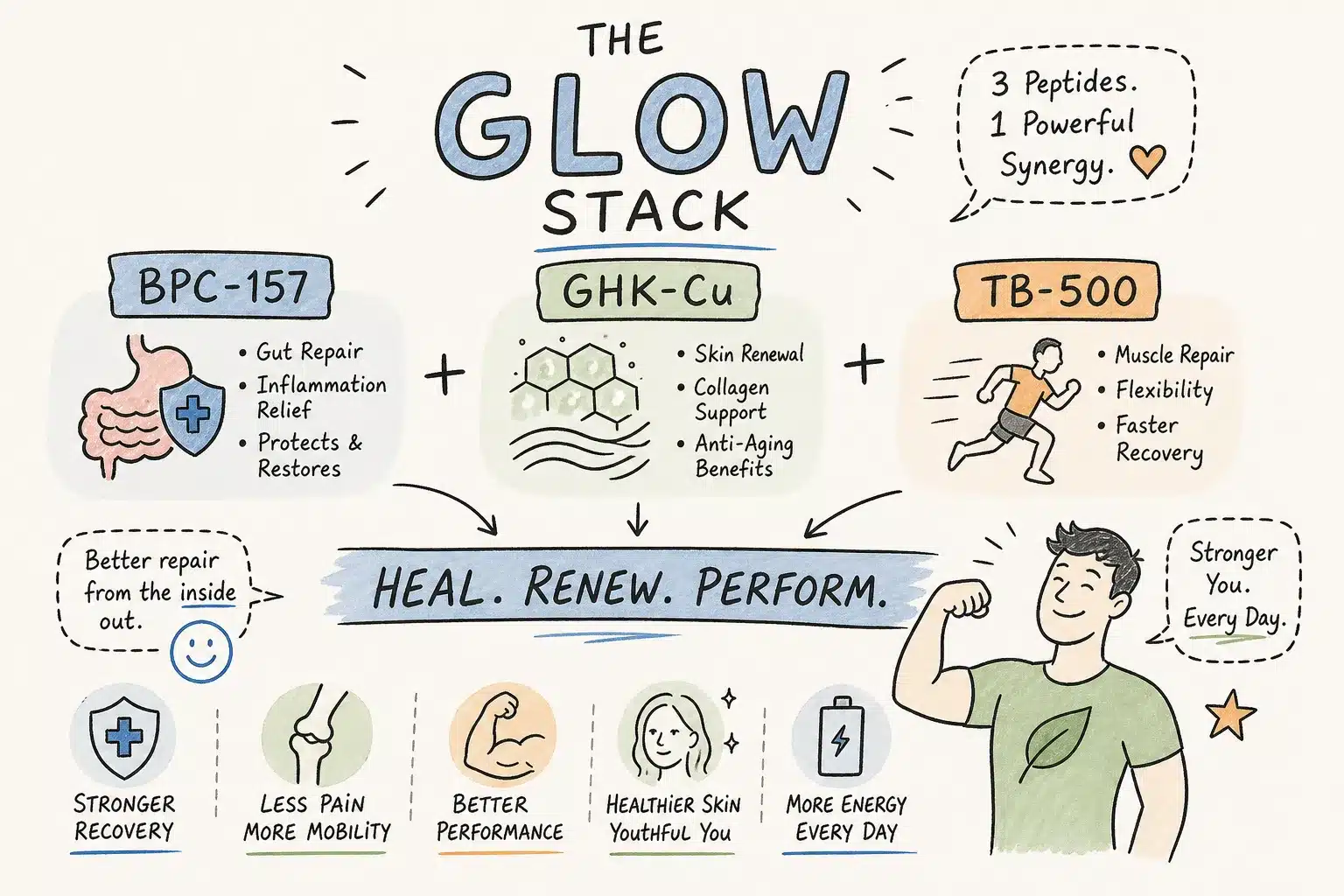
How does a BPC-157 + GHK-Cu + TB-500 peptide stack work synergistically in lab research? That’s the structural question this article is designed to answer. Combining peptides with non-overlapping mechanisms is one of the more defensible ideas in tissue repair research, not because stacking is automatically additive, but because biological repair moves through distinct phases. Targeting multiple phases simultaneously with mechanistically independent compounds makes more sense than flooding a single pathway. That logic is exactly what the GLOW stack reflects: BPC-157 for vascular signaling, TB-500 for directed cell migration, and GHK-Cu for matrix deposition and cross-linking. These three compounds represent three separate intervention points within the same repair cascade.
What follows is a practical breakdown of how each compound works at the molecular level, why the combination is theoretically compelling, what the preclinical record actually shows (including where the evidence stops), how to reconstitute and store all three correctly, and which endpoints you should track to test synergy in a controlled model. If you’re designing a tissue repair or skin regeneration experiment, this is the framework you need before you order a single vial.
What each compound actually does at the molecular level
Before evaluating any combined effect, you need a clean mechanistic baseline for each compound. Vague claims about compounds “supporting healing” don’t hold up in a lab setting, specific mechanisms do.
BPC-157: growth factor signaling and vascular ingrowth
BPC-157 is a synthetic 15-amino-acid peptide derived from a gastric protein sequence. Its primary mechanistic profile centers on upregulation of VEGF (vascular endothelial growth factor) expression and other pro-angiogenic factors reported in the literature, which drives angiogenesis in damaged tissue. Published rodent models, including alkali-burn skin wound studies, demonstrate increased VEGF-a expression, enhanced endothelial proliferation, and in vitro tube formation at doses ranging from 200 ng/mL topically to 10 µg/kg administered intraperitoneally. BPC-157 also shows interactions with the nitric oxide system and has demonstrated consistent effects on tendon fibroblast proliferation in rat tendon, corneal, and wound models. The critical stacking point: BPC-157 acts early in the repair cascade, building the vascular infrastructure that downstream repair processes depend on.
TB-500: actin dynamics and directed cell migration
TB-500 is a synthetic analog of thymosin beta-4, a ubiquitous intracellular protein that regulates actin polymerization. Its core function is facilitating cell migration, particularly for endothelial cells, keratinocytes, and myoblasts moving into injured zones. Rodent tissue-repair models have used TB-500 at approximately 1, 10 mg/kg via subcutaneous, intraperitoneal, or local injection, with wound-healing schedules running daily or every other day for 14 to 21 days. TB-500’s principal role is governing the structural mechanics of cells moving through an already-signaled repair environment, though some contexts show secondary associations with angiogenesis. That distinction is what makes TB-500 and BPC-157 complementary rather than redundant in a stacked protocol. For deeper background on thymosin beta-4 and actin dynamics, consult the available literature on thymosin-beta4 and actin polymerization in wound models: thymosin beta-4 and actin dynamics.
GHK-Cu: collagen synthesis, lysyl oxidase, and matrix maturation
GHK-Cu (glycine-histidine-lysine complexed with copper) is a naturally occurring plasma tripeptide that declines significantly with age. In human dermal fibroblast cultures, it increases production of collagen type I and III, activates lysyl oxidase (the copper-dependent enzyme responsible for cross-linking newly formed collagen and elastin fibers), and upregulates pro-angiogenic factors via TGF-beta/integrin pathways. The mechanism for lysyl oxidase activation is straightforward: GHK-Cu delivers bioavailable copper directly to fibroblasts, and lysyl oxidase requires copper to function. This places GHK-Cu firmly at the matrix maturation phase, downstream of the signaling work that BPC-157 initiates, which is exactly where you want it in a sequential repair model.
How does a BPC-157 + GHK-Cu + TB-500 peptide stack work synergistically? The biological case
Each compound has a defined role. The more consequential question is whether those roles are structured to work in coordination across the repair timeline rather than in parallel isolation.
Sequential phases of repair: signaling, migration, and matrix deposition
Tissue repair isn’t a single event. It moves through overlapping phases: inflammation resolution, vascular ingrowth, cell proliferation, and matrix remodeling. BPC-157 addresses vascular signaling at the early phase, creating the vessel architecture a repair zone needs. TB-500 enables cells to migrate across that environment and populate the injury site. GHK-Cu then drives matrix deposition and collagen cross-linking in the later remodeling phase, converting early-stage repair tissue (collagen III-dominant) into structurally mature tissue (collagen I-dominant). Mapped to these phases, the stack doesn’t look redundant, it looks like a coordinated protocol covering three distinct bottlenecks within one experimental model.
The synergy argument: why non-overlap matters in lab research
In pharmacology, synergy requires more than combining two compounds that each produce a positive result. True synergy means the combined effect exceeds what you’d calculate from the sum of individual effects, and that outcome is more likely when the compounds act through mechanistically independent pathways, because independent mechanisms don’t compete for the same receptors or signaling nodes. BPC-157, TB-500, and GHK-Cu don’t overlap in their primary targets: one works on VEGF signaling, one on actin polymerization, one on lysyl oxidase activation and collagen gene expression. The Bliss Independence Model formalizes this logic, it predicts the expected combined effect assuming independence, and any observed effect above that prediction qualifies as synergistic. For this stack, the theoretical case is structurally sound. Whether it holds experimentally is a separate question, and one the current literature hasn’t yet answered.
What preclinical evidence actually shows, and where the gaps are
The standalone datasets for each compound are meaningful. The combination data has an honest gap that any serious researcher should understand before designing a study, and precision matters when distinguishing what the science supports from what it merely implies.
BPC-157 and GHK-Cu: the stronger standalone records
BPC-157 has the most substantial standalone preclinical record of the three. Published rodent studies report healing effects across tendon, muscle, corneal, and wound tissue models at dose ranges of approximately 1, 50 µg/kg, with a frequently cited reference dose around 10 µg/kg administered intraperitoneally or intramuscularly. Angiogenic effects have been replicated across rat tendon, corneal, and wound models, and the mechanistic pathway through VEGF and VEGFR2 upregulation is well-documented in that literature; for example, alkali-burn skin wound models report accelerated epithelialization and vascular ingrowth in treated animals (alkali-burn wound study). GHK-Cu has solid in vitro evidence from human dermal fibroblast cultures: increased collagen I and III production at nanomolar concentrations, upregulation of elastin synthesis, lysyl oxidase activation via copper delivery, and measurable VEGF expression in irradiated fibroblasts. Animal wound-healing models also show increased capillary density and improved tissue remodeling scores.
The combination study gap and what it means for your research
As of mid-2026, no peer-reviewed primary studies have been identified that test BPC-157 plus TB-500, BPC-157 plus GHK-Cu, or all three compounds together in a controlled rodent or in vitro model. The synergy hypothesis is theoretically supported based on mechanistic independence, but it has not been experimentally demonstrated. For researchers, that isn’t a reason to abandon the model, it’s a reason to design the experiment carefully, pre-specify endpoints before data collection, and frame results as hypothesis-generating rather than confirmatory. Labs running these models now have a genuine opportunity to generate data that doesn’t yet exist in the published literature on how a BPC-157 + GHK-Cu + TB-500 peptide stack works synergistically in controlled conditions. For additional context on designing stack experiments and expected benefit summaries, see our BPC-157, GHK-Cu, TB-500 stack research: benefits explained.
Reconstituting and storing the stack in a lab setting
Protocol precision at the bench determines whether your peptide data is interpretable. Improper reconstitution or storage introduces variables that contaminate results before any biological effect can be measured.
Solvent selection and pH compatibility
Bacteriostatic water is the most commonly recommended solvent for all three compounds. Its typical pH of approximately 5.5 falls within a range commonly cited for peptide stability, though researchers should consult each compound’s product data sheet for lot-specific pH guidance. GHK-Cu is the most pH-sensitive of the three: the copper-chelate complex can become unstable outside a narrow pH band, and solution darkening serves as a visual indicator of copper dissociation, review the supplier’s technical sheet for the precise stability window, as published sources vary. Normal saline and alkaline buffers should be avoided for this reason. For cell culture applications, filter-sterilize the reconstituted stock through a 0.22 µm syringe filter before adding to media, and use the diluted preparation immediately rather than storing it in culture media.
Post-reconstitution storage, stability, and handling technique
After reconstitution in bacteriostatic water, all three compounds are commonly reported as stable at 2, 8°C for up to 28 days, though lot-specific stability should be verified against each peptide’s COA. Lyophilized peptides held for long-term storage belong at -20°C in a dry, low-traffic environment. During reconstitution, direct the solvent stream against the vial wall rather than onto the lyophilized cake, then gently swirl for 30, 60 seconds. Vigorous shaking damages peptide structure and is one of the most common handling errors in lab settings. Monitor GHK-Cu solutions for color darkening between uses; a darkened solution signals copper dissociation and the preparation should not be used. When working from a pre-blended GLOW-format vial, bacteriostatic water is the standard reconstitution choice, but confirm lot-specific pH compatibility via the vendor’s COA before assuming co-administration stability across compounds.
Measuring synergy: endpoints and the Synergy Index
A stacking study without pre-specified endpoints produces observations, not data. Define your measurement framework before you administer a single dose.
Molecular and histological markers for tissue repair
VEGF expression is the primary biomarker for assessing angiogenic response. Synergy is inferred when the stack produces significantly higher VEGF than the arithmetic sum of individual peptide responses at matched doses. Collagen I and III ratios, measured via Picrosirius Red staining, track tissue maturation: an accelerated shift from collagen III (early repair) to collagen I (mature tissue) indicates more efficient remodeling. Capillary density, quantified by CD31 or CD34 immunostaining, gives you a histological count of new vessel formation per field. Together, these three metrics cover angiogenesis, matrix quality, and structural maturation, mapping directly onto the three mechanisms you’re testing in the stack.
Functional tests and applying the Synergy Index
Tensile strength is the gold-standard functional endpoint for tendon and skin repair models: measured in Newtons or MPa, it directly reflects whether the repaired tissue can perform its mechanical role. Load-to-failure and elastic modulus round out the functional panel. To calculate synergy formally, apply the Synergy Index: SI equals the combined effect divided by the sum of the individual effects. An SI above 1.0 indicates a synergistic interaction; a value near 1.0 indicates additivity. Pre-specifying these endpoints before data collection is the operational difference between rigorous research and post-hoc rationalization. If you run the Bliss Independence Model across a dose matrix, you can also map where synergy appears strongest and whether it holds across concentrations, a critical check when evaluating how a BPC-157 + GHK-Cu + TB-500 peptide stack works synergistically across experimental conditions.
Sourcing COA-verified compounds for GLOW stack research
What quality documentation should include
A legitimate research peptide supplier provides a Certificate of Analysis for each lot that includes compound identity confirmed by HPLC or mass spectrometry, purity percentage, lot number for traceability, and the name of the testing laboratory. For a three-compound stack, receiving documentation that covers all three in a single verified order simplifies lab recordkeeping and ensures consistent lot provenance across your entire experiment. Sourcing the same compounds from three separate vendors with independent lot cycles complicates documentation continuity and introduces potential inconsistency in experimental baselines.
Why R-Peptide Supply’s GLOW stack simplifies the sourcing workflow
R-Peptide Supply offers the GLOW stack as a pre-configured bundle containing BPC-157, GHK-Cu, and TB-500 in a single COA-verified order. For labs that need all three compounds without sourcing them separately across multiple vendors, this format reduces documentation overhead and supports consistent quality traceability across the entire stack. The sourcing structure is designed for labs that need compounds verified from one traceable source and ready to reconstitute, whether for individual research use or bulk experimental runs. If you’re building a protocol around how a BPC-157 + GHK-Cu + TB-500 peptide stack works synergistically in your model, starting with consistent, documented source material is the first step in keeping your data clean. Review the detailed product and research notes on the Glow peptide stack to confirm ordering and COA procedures.
Putting the framework together
The three-pathway logic of this stack holds up under scrutiny. BPC-157 drives vascular signaling at the early phase of repair. TB-500 facilitates directed cell migration into the injury zone. GHK-Cu consolidates matrix deposition through lysyl oxidase activation and collagen I/III upregulation. These mechanisms operate on different molecular targets across different phases of the same repair process, which is what makes this stack theoretically compelling rather than simply commercially packaged. Understanding how a BPC-157 + GHK-Cu + TB-500 peptide stack works synergistically in lab research starts with that mechanistic map; for a concise research-focused summary see the GLOW Stack Peptide Blend: Skin and Recovery Research.
The honest caveat remains: preclinical combination evidence is still sparse. No published primary study has tested all three compounds together in a controlled model. That gap is an opening for researchers designing these experiments now. Use bacteriostatic water for reconstitution, verify pH compatibility against your lot’s COA, and track VEGF expression, collagen I/III ratios, capillary density, and tensile strength as your primary endpoints. Apply the Synergy Index to your results before drawing conclusions about additive versus synergistic effects.
For labs that need all three compounds verified, traceable, and ready to use, R-Peptide Supply’s GLOW stack bundle provides a documentation-consistent sourcing path. The science of what to measure and how to interpret it is the work. Getting the compounds right before you start is the foundation.