


Blog
HGH Fragment 176-191 vs AOD-9604 for Fat Loss Research

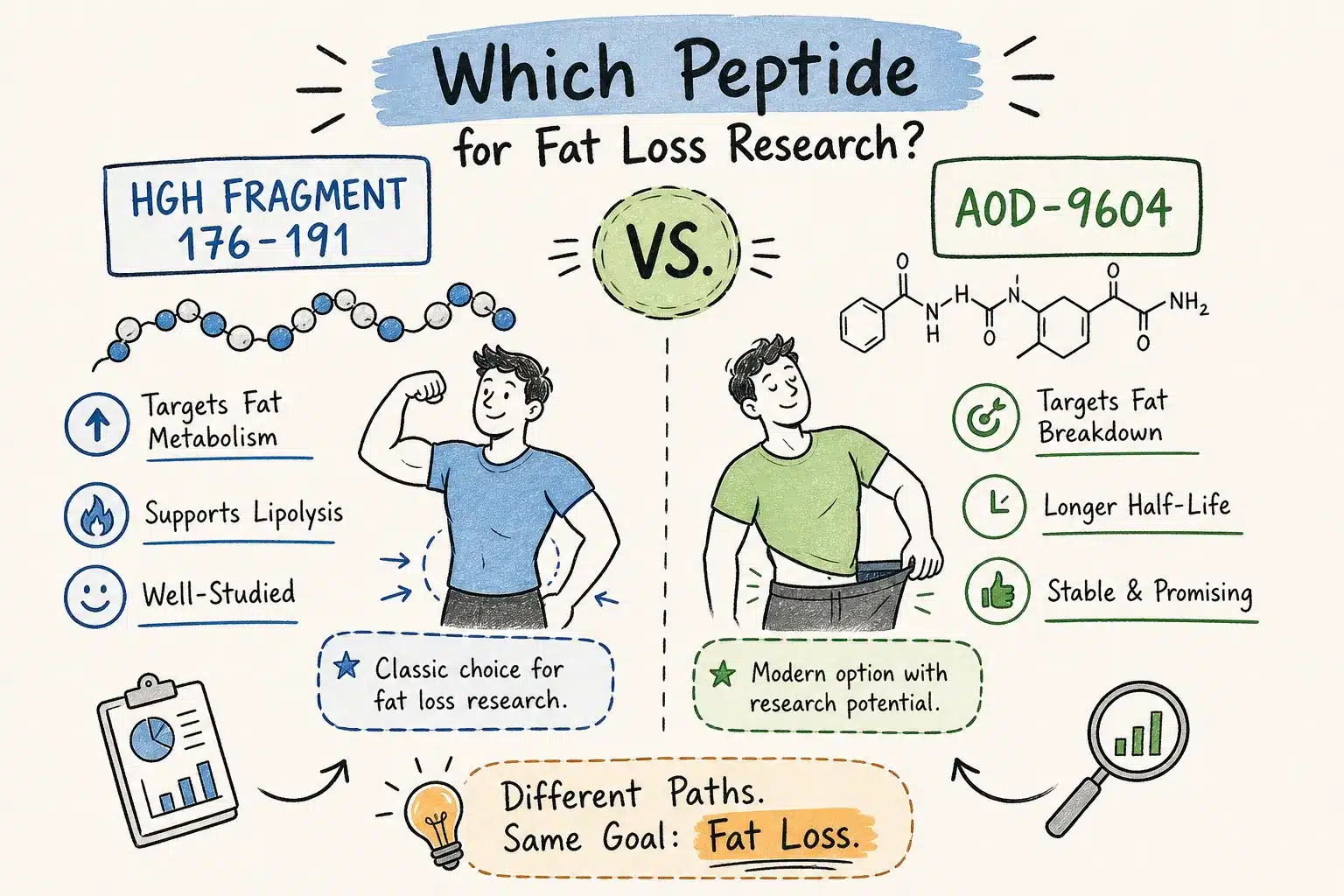
Meta description: How does HGH Fragment 176-191 compare to AOD-9604 for fat loss research? This guide breaks down molecular differences, preclinical findings, and clinical trial data to help researchers design better studies.
HGH Fragment 176-191 and AOD-9604 get treated as interchangeable in research forums constantly. Researchers reference them in the same sentence, cite each other’s data across both compounds, and occasionally order one when they mean to study the other. They are not the same compound, and that distinction matters significantly once a researcher begins designing a protocol around fat metabolism endpoints.
Understanding how HGH Fragment 176-191 compares to AOD-9604 for fat loss research starts at the molecular level, not the dosing table. This article covers the structural differences between the two peptides, the separate bodies of preclinical evidence for each, what the human clinical trial record actually shows (more limited and more complicated than most research content acknowledges), and what safety and regulatory framing looks like for both. Sourcing both compounds from a single supplier can reduce lot-to-lot documentation variability when the peptide itself is the variable under study, a practical consideration addressed in the protocol design section.
What separates these two compounds at the molecular level
AOD-9604 is not a brand name for HGH Fragment 176-191. It is a structurally modified analogue with two deliberate pharmaceutical changes. Researchers who skip this distinction frequently misinterpret divergent results between the two compounds, attributing mechanistic differences to dosing or model variation when the structural gap is the more plausible explanation. For a concise reference on AOD-9604’s derivation and research context, see the AOD9604 peptide: the HGH-derived fat metabolism fragment, Research Peptides Supply.
The Phe-to-Tyr substitution and what it does to receptor activity
The C-terminal phenylalanine at position 191 in HGH Fragment 176-191 is replaced by tyrosine in AOD-9604. This single amino acid swap is confirmed by the 18 Da molecular weight difference: approximately 1,799 Da for the unmodified fragment versus approximately 1,817 Da for AOD-9604. According to the original developer documentation and supporting preclinical work, the substitution was engineered to eliminate protein biosynthesis stimulation while retaining lipolytic activity, removing the muscle-growth signaling associated with full-length HGH. The current mechanistic evidence suggests AOD-9604 does not bind directly to the beta-3 adrenergic receptor (beta3-AR) with enhanced affinity; instead, it upregulates beta3-AR RNA expression in adipocytes, restoring receptor density in obese models to levels observed in lean animals.
Why the disulfide bridge changes stability and administration route
AOD-9604 includes a Cys182-Cys189 cross-link that HGH Fragment 176-191 lacks, or carries inconsistently depending on preparation method. This bridge significantly increases enzymatic resistance, with a direct consequence for study design: AOD-9604 is viable for oral administration in research settings, while HGH Fragment 176-191 requires parenteral delivery, typically subcutaneous. For researchers designing comparative protocols, administration route is not an equivalent variable between the two compounds. Specifically, oral versus injected delivery produces divergent pharmacokinetic parameters, including bioavailability, Cmax, and AUC, meaning a study comparing fat oxidation outcomes under a shared delivery method is not comparing the two compounds on equivalent pharmacokinetic terms.
How HGH Fragment 176-191 compares to AOD-9604: mechanistic differences in fat metabolism
The mechanistic picture for these two compounds diverges in ways that directly affect how researchers should frame their study hypotheses. Both peptides engage fat metabolism, but through different predominant pathways and with different depths of mechanistic evidence behind each. Examining how HGH Fragment 176-191 compares to AOD-9604 for fat loss research at this level of detail is essential before selecting either compound for a protocol.
AOD-9604 and the beta3-adrenergic receptor pathway
Chronic AOD-9604 administration in obese rodent models, specifically 2 mg/kg body weight daily via intraperitoneal injection for 14 days, upregulates beta3-AR RNA expression in white and brown adipose tissue to levels observed in lean mice. The knockout mouse data is particularly useful for interpreting this: long-term AOD-9604 treatment in beta3-AR-deficient mice failed to produce body weight reduction or sustained lipolysis, confirming that the chronic fat loss effect depends on this receptor pathway. Acute effects, however, persisted even in knockout animals, with measurable increases in energy expenditure and fat oxidation occurring via a separate, receptor-independent mechanism. This dual-pathway behavior is a critical design consideration when selecting dose-duration parameters for a study. The primary AOD-9604 rodent study is summarized in the literature and can be reviewed on PubMed for experimental specifics and outcomes: primary AOD-9604 rodent study.
HGH Fragment 176-191: antilipogenic rather than directly lipolytic
Rat adipose ex vivo assays show that HGH Fragment 176-191 exhibits antilipogenic activity but no significant direct lipolysis under typical assay conditions. Antilipogenesis (the inhibition of fat accumulation) is mechanistically distinct from lipolysis (the active mobilization of existing fat stores). Researchers who design studies expecting direct lipolytic activity from HGH Fragment 176-191 based on AOD-9604 data are working from a mechanistic assumption the preclinical evidence does not support. Both compounds share one important profile characteristic: neither elevates IGF-1 levels, which separates them from full-length HGH and substantially reduces cell proliferation risk in research models. For a practical procurement and research overview of the fragment, refer to the HGH Fragment 176-191 Peptide Research and Procurement Guide, Research Peptides Supply.
What the preclinical animal studies actually found
The single most important methodological fact about this body of literature is that no study has directly compared HGH Fragment 176-191 and AOD-9604 head-to-head in the same experimental design. Cross-study comparisons exist, but they compare results from different species, dosing regimens, and assay formats. Researchers drawing direct efficacy conclusions between these two compounds from the existing literature are working from an inference, not from controlled comparative data.
AOD-9604 in obese murine models: the 14-day intraperitoneal data
The primary AOD-9604 rodent study used 14 days of intraperitoneal administration at 2 mg/kg per day in obese (ob/ob) mice. Results showed measurable reductions in body weight and body fat percentage, increased lipolytic sensitivity, elevated fat oxidation rates, and favorable lipid metabolism markers including improvements in triglycerides and glucose tolerance. A critical translational note: these effects appeared in obese models only. Lean control animals did not show the same fat reduction outcomes, which has direct implications for how researchers frame translational relevance to non-obese models or populations.
HGH Fragment 176-191 in rat adipose tissue and the METAOD005 dataset
Rat adipose ex vivo findings for HGH Fragment 176-191 consistently show antilipogenic activity without strongly lipolytic behavior. The METAOD005 12-week murine study used 300 models across five concentration groups plus one control group and reported a statistically significant mean mass reduction in one peptide-exposed group with improved lipid markers, again limited to obese models. These are separate studies with different designs, different species, and different dosing regimens from the AOD-9604 intraperitoneal data. Treating these results as directly comparable introduces methodological noise that a well-designed comparative study would need to control for explicitly.
How HGH Fragment 176-191 compares to AOD-9604 in human clinical trial evidence
This is the section most research peptide content glosses over, and it is where the clinical reality of both compounds requires the most careful framing. The evidence base is not symmetrical, and one of these peptides has completed Phase 2b human trials with a result researchers should understand clearly before designing translational studies.
The AOD-9604 OPTIONS study: 536 subjects, 24 weeks, and a failed primary endpoint
The Phase 2b OPTIONS Study enrolled 536 subjects and ran for 24 weeks, measuring weight loss and body fat reduction as primary and secondary endpoints. The trial failed to meet its primary weight-loss endpoint versus placebo, and Metabolic Pharmaceuticals terminated development in 2007. An earlier 12-week Phase 2b trial with 300 obese patients produced more encouraging numbers: the 1 mg dose group lost an average of 2.8 kg compared to 0.8 kg for placebo, with small but consistent improvements in cholesterol profiles and a reduction in patients with impaired glucose tolerance. The 24-week failure is the defining clinical data point for AOD-9604; industry reporting on the program and trial outcomes is summarized in clinical communications and trade coverage such as the Metabolic Pharmaceuticals trial update: Phase 2b OPTIONS Study coverage. Researchers should frame translational expectations accordingly rather than anchoring on the more favorable 12-week numbers.
HGH Fragment 176-191: no published human efficacy data
There are no published human clinical trials or case reports evaluating HGH Fragment 176-191 specifically for fat loss in humans. Its preclinical antilipogenic activity has not been tested in a dedicated human efficacy study. This evidence gap is significant. The compound is frequently referenced alongside AOD-9604 in research discussions as though their clinical status is equivalent, it is not, and that distinction should be documented clearly in any study rationale or IRB framing, particularly when both compounds are cited together as research targets.
Safety profile and metabolic considerations for both compounds
Both compounds carry a favorable metabolic safety profile relative to full-length HGH, and that consistency is one of the primary reasons they remain active research targets despite the clinical trial setbacks. Researchers should still document regulatory framing accurately in study design.
Glucose, insulin, and IGF-1 neutrality across both peptides
Across both compounds, the consistent finding is no negative impact on blood glucose, no insulin resistance, no hyperglycemia, and no IGF-1 elevation. In obese rat models, HGH Fragment 176-191 showed no adverse effect on insulin sensitivity. AOD-9604 across six trials involving approximately 900 participants demonstrated no impairment in glucose metabolism even over 24-week treatment periods. This contrasts directly with full-length HGH, which carries diabetogenic risk. For metabolic research protocols, this neutrality profile is a key reason both peptides remain under investigation despite the absence of approved therapeutic status.
Side effect profiles and regulatory framing for research use
HGH Fragment 176-191 adverse events in trials were indistinguishable from placebo. Reported events include injection site reactions, mild dizziness, nasopharyngitis, and transient fatigue. AOD-9604 across its full clinical program had no single serious adverse event attributed to the compound. Neither peptide is FDA-approved for human use. Both are sold in the US under research-use-only framing, both are listed as banned substances by WADA, and both carry unknown long-term safety profiles. For general practitioner-facing context on peptide safety and best practices, see resources such as the top 10 things to understand about peptides. Also, regulatory and agency documentation should be cited directly in IRB submissions; relevant agency downloads can support that framing (for example, FDA source documents are often cited for regulatory context): FDA documentation. Researchers should document this clearly in study design and IRB submissions rather than relying on favorable short-term safety data to imply long-term clearance.
Setting up a comparative lipolysis study: what researchers need in place
Practical protocol design for a side-by-side study requires more than selecting dose ranges and duration. When the compounds being compared are structurally related but mechanistically distinct, sourcing quality and consistency become study design variables in themselves.
COA requirements and purity benchmarks for side-by-side assays
For comparative work between two structurally related peptides, HPLC-verified purity documentation at 99% or above is the recommended benchmark for research-grade material. Confirmed lot numbers for traceability, matched reconstitution conditions using bacteriostatic water, confirmed storage temperatures, and lyophilized format consistency across both compounds carry equal weight. For AOD-9604 specifically, COA documentation should confirm disulfide cross-link integrity, since the bridge is a defining structural feature affecting both stability and administration route. Rather than checking each requirement separately, researchers can consolidate: lot number, reconstitution protocol, storage parameters, and format should all be confirmed from a single supplier’s COA package before committing to a full study batch. Mismatched COA quality between the two compounds introduces variability that obscures genuine mechanistic differences, which defeats the purpose of a comparative design.
Where researchers typically source HGH Fragment 176-191 and AOD-9604 together
Sourcing both compounds from a single wholesale supplier simplifies COA cross-referencing and lot-level traceability across an extended study. R-Peptide Supply (Grey Peptide Shop) stocks both HGH Fragment 176-191 and AOD-9604 with third-party-verified COAs, wholesale pricing, and multi-vial bundle formats suited to 12-week or longer protocol designs. Researchers can review purity documentation before committing to a full study batch, the correct sequence for any study where compound quality is a controlled variable. Consolidated ordering with threshold-based shipping cost structures and available technical support further reduce logistical complexity for labs running extended comparative studies. For direct procurement options and product configurations, see Buy HGH Online: HGH Fragment 176-191, Research Peptides Supply.
The clearest path to interpretable data: comparing HGH Fragment 176-191 and AOD-9604 for fat loss research
HGH Fragment 176-191 and AOD-9604 share a common sequence origin and a favorable metabolic safety profile, and both represent genuine targets for peptide lipolysis research. They diverge in molecular stability, required administration route, mechanistic depth (particularly the beta3-adrenergic data for AOD-9604), and the weight of clinical evidence behind each. AOD-9604 completed Phase 2b human trials and failed its primary endpoint. HGH Fragment 176-191 has no comparable human data at all.
The more useful research question is not which peptide “works better” but which compound fits the specific research question, model system, and dose-duration design a study requires. A 14-day acute lipolysis assay in an obese murine model calls for a different compound selection rationale than a 12-week antilipogenic study in ex vivo adipose tissue. Both questions are valid. Neither answer should be imported from the other compound’s data.
When comparing HGH Fragment 176-191 with AOD-9604 for fat loss research, running both peptides in parallel, with matched COA quality and consistent sourcing, is the most direct path to interpretable comparative data. The structural and mechanistic differences between these compounds are real and measurable. A well-designed study should be built to detect them, not assume them away.