
Blog
Are Grey Market Research Peptides Safe for Lab Use?

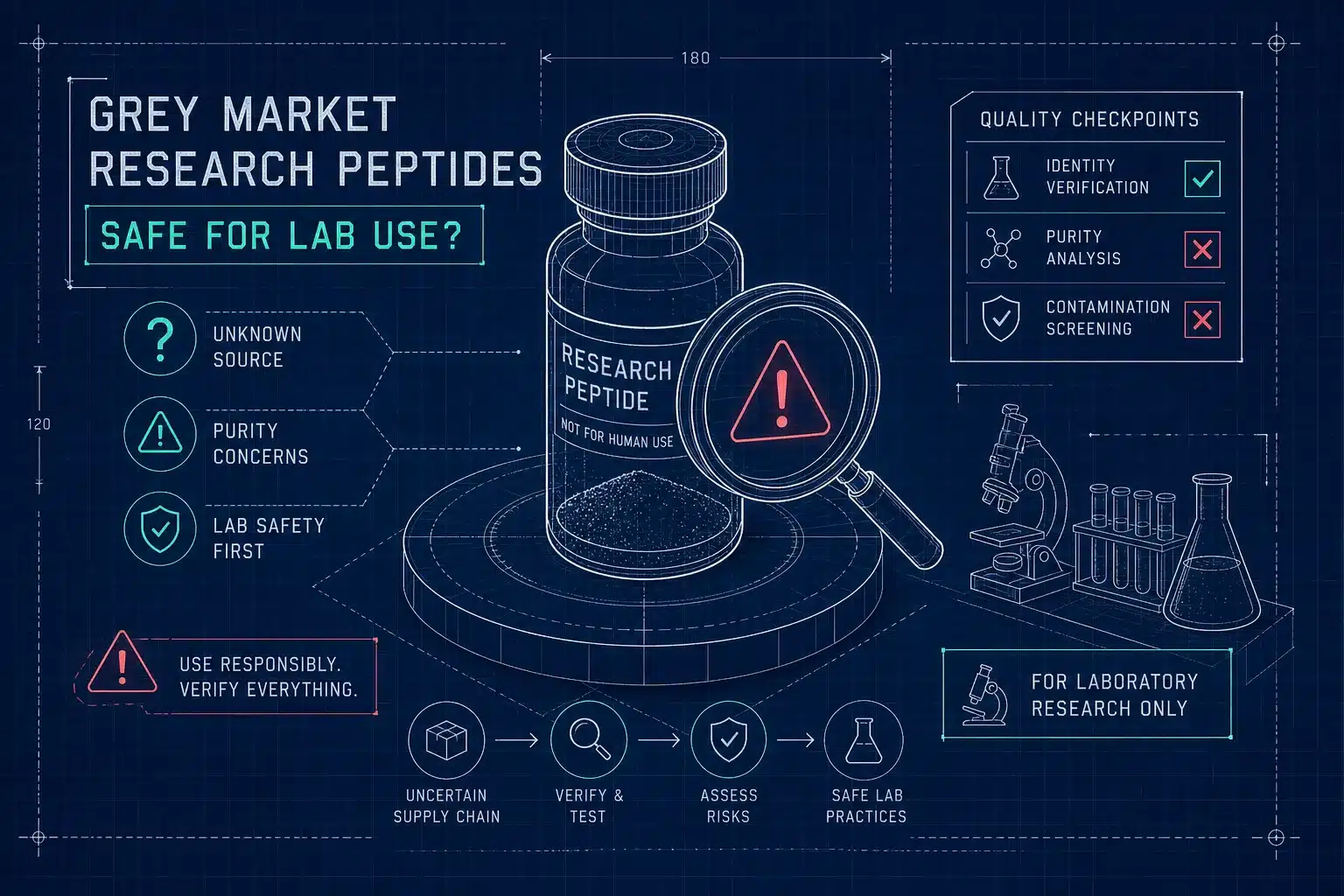
Are grey market research peptides safe for lab use? That question doesn’t have a simple yes or no answer, but it does have a framework, and most labs working with these compounds haven’t built one. Gray market research peptides are widely used in laboratories across the United States, which isn’t a secret and isn’t a controversy worth relitigating. What rarely happens is an honest, structured conversation about the specific risks those compounds carry and what a researcher can actually do about them.
The honest answer is that it depends entirely on what you mean by safe, and on who supplied the compound. Gray market peptides aren’t automatically dangerous. They also aren’t automatically equivalent to pharmaceutical-grade reagents. The risk profile is well-defined, the mitigation strategies are documented, and the sourcing decision matters more than most researchers factor in when they’re comparing prices on a Tuesday afternoon.
Some gray market suppliers have responded to these concerns by building rigorous quality documentation into their standard workflow. Others haven’t. That difference is what this article is about: a practical risk assessment framework, not a blanket warning against gray market sourcing.
What “gray market” actually means in peptide sourcing
Research-use-only (RUO) labeling is a legal designation, not a quality standard. When a compound is sold as RUO, it’s sold outside FDA-regulated drug channels. That means no mandated manufacturing standards, no required batch testing, and no formal quality oversight from a regulatory body. The quality burden shifts entirely to the supplier and the buyer, an important distinction from how most lab reagents are handled.
Gray market is not the same as counterfeit, and it’s not the same as illegal. These compounds occupy a legal gray zone: sold as research use only, not for human consumption, and outside the pharmaceutical supply chain. Researchers using them aren’t operating recklessly. They’re making practical sourcing decisions, often because gray market suppliers offer price points, catalog breadth, and compound availability that regulated channels simply can’t match.
Compounds like Tirzepatide, BPC-157, Ipamorelin, IGF-1 LR3, and GHK-Cu are available through gray market suppliers at price points that make research feasible for independent labs. The risk isn’t that researchers are naive; it’s that the due diligence framework for evaluating these suppliers is underdeveloped relative to how commonly they’re used.
Are gray market research peptides safe for lab use? Risk factors and mitigation
A 99.5% HPLC purity result sounds reassuring. It shouldn’t be taken at face value without understanding what HPLC actually measures. High-performance liquid chromatography confirms the relative abundance of the target compound in a sample. It does not test for endotoxins, microbial contamination, residual solvents, or heavy metals. A compound can score highly by HPLC and still carry substantial biological risk if those additional contaminant categories were never assessed.
Multiple published analyses have found that roughly 15% of gray market peptide samples carry measurable endotoxin contamination. For cell-based assays or animal studies, even trace endotoxin levels can produce confounding inflammatory responses, invalidate experimental results, or harm research subjects. Sterility testing is rarely included in a standard vendor COA. Residual solvents are a parallel concern: analytical studies have identified THF, dichloromethane, acetonitrile, ethanol, and toluene in gray market peptide samples, with THF detected across all samples in one published analysis at concentrations ranging from 20 to 900 ppb.
Heavy metal contamination is the least-discussed risk in gray market sourcing. Falsified peptide products examined in Belgian market surveillance were found to contain arsenic and lead, both class 1 elemental impurities, at levels researchers attributed to contaminated raw materials or purification equipment. These contamination vectors aren’t unique to falsified products. They apply anywhere manufacturing QC doesn’t include elemental testing, and elemental testing is often absent from gray market supplier programs.
What documented failures actually look like
The research literature provides concrete examples of what happens when peptide stock quality fails. A published study in Clinical and Vaccine Immunology documented an HIV-1 peptide stock contaminated with an HCMV peptide at approximately 1% by weight. The contamination produced T-cell responses that appeared antigen-specific until the source was identified and the peptides were resynthesized. The same report identified similar contamination in two additional HIV-1-derived overlapping peptide sets from a separate supplier, discovered during routine QC.
These cases illustrate precisely why identity testing and lot-level documentation aren’t optional: they’re the only mechanism for catching this kind of error before it skews results. A 1% contaminant is invisible on casual inspection, invisible in a basic purity summary, and fully capable of generating a false positive that consumes months of follow-up work. For practical guidance on how labs should treat these issues in incoming materials, see the discussion of lab-tested peptides.
The FDA has cited serious adverse events linked to compounded peptides in clinical contexts, including ipamorelin given intravenously in gastric motility studies, Melanotan II case reports involving posterior reversible encephalopathy syndrome and sympathomimetic toxidrome, and AOD-9604-associated events with unclear causality. These events occurred in clinical or compounded settings rather than pure lab research, but the underlying contamination vectors are comparable: unverified manufacturing, inconsistent QC, and no sterility confirmation. The consequences and regulatory frameworks differ between clinical and RUO contexts, but the failure modes, unverified manufacturing, absent QC, no sterility confirmation, are structurally similar.
How COAs reduce quality uncertainty (and what they still miss)
A credible COA is batch-specific, not generic. It lists the peptide name and full sequence, the exact lot number, purity result with the analytical method used (typically RP-HPLC with UV detection), mass confirmation by LC-MS, the testing date, and the name and contact information of the laboratory that ran the analysis. If a supplier provides a single COA across an entire product line rather than individual lots, that gap should concern any lab professional sourcing the compound for real work.
The baseline a researcher should expect is lot-specific documentation tied to a named testing laboratory. ISO/IEC 17025 accreditation on the testing lab’s part adds an added layer of credibility to the analytical data, because it speaks to the lab’s demonstrated competence in performing the analysis, not just a vendor’s assertion that the analysis was done (see AccuPep quality as an example of supplier-level quality documentation).
Even a thorough HPLC-plus-LC-MS COA doesn’t address endotoxin load, sterility, residual solvent levels, or heavy metal content. Researchers sourcing gray market peptides for cell culture or in vivo applications should ask suppliers directly whether LAL endotoxin testing or bioburden assessment is available on request. The answer to that question is a useful signal about the supplier’s quality infrastructure, not just a box-checking exercise.
Are gray market research peptides safe for lab use in cell culture? QC checklist
Every incoming peptide should be confirmed by LC-MS for identity before use, regardless of what the vendor’s COA says. Mass spectrometry confirms that the compound matches the expected molecular weight, ruling out mislabeled vials or gross substitutions. Analytical RP-HPLC follows as the purity estimate, revealing truncation sequences, oxidized variants, or synthesis impurities. For routine RUO biochemical work, purity at or above 80 to 90% is generally acceptable; for receptor-binding assays, cell-based experiments, or publication-grade reference material, 95% is the appropriate floor.
When exact peptide quantity matters, amino acid analysis (AAA) provides an orthogonal quantitation method that HPLC alone cannot deliver. This matters for dose preparation, calibration standards, or any work where concentration accuracy affects conclusions. AAA is the right tool for those applications, not simply an upgrade from HPLC purity testing.
For any peptide that will contact cells or animals, LAL endotoxin testing is not optional. A practical internal limit of 0.01 EU/µg is cited by established peptide QC programs for sensitive biological applications. The acceptance criteria should always be tied to intended use: what is tolerable for a buffer-only biochemical assay is not tolerable for an in vivo dosing experiment. Acceptance criteria that don’t account for application context aren’t acceptance criteria, they’re placeholders.
Identity and purity
- LC-MS identity confirmation before use (required, not optional)
- RP-HPLC purity ≥ 80, 90% for routine RUO biochemical work
- RP-HPLC purity ≥ 95% for cell-based assays, receptor binding, or publication-grade use
- Amino acid analysis (AAA) when concentration accuracy is critical
Contaminant testing
- LAL endotoxin testing for any peptide contacting cells or animals (target: ≤ 0.01 EU/µg)
- Residual solvent screening for compounds with undisclosed synthesis history
- Elemental impurity testing when heavy metal exposure risk is relevant to the application
Vetting a gray market supplier before you order
Before placing an order, ask the supplier for a lot-specific COA for the exact batch you’re purchasing, confirmation of the analytical method used to determine purity, and whether LC-MS identity data is included as standard. Ask whether endotoxin or sterility testing is available on request, and ask for the name of the independent testing laboratory. A supplier that can answer all of these questions with actual documentation is demonstrating the quality infrastructure that makes gray market sourcing viable for real research work.
The red flags are specific and easy to identify once you know what to look for:
- Generic COAs that apply to an entire product line rather than individual lots
- No identifiable name for the testing laboratory behind the QC data
- No traceability between lot numbers and supporting documentation
- Purity claims presented without any stated analytical methodology
- Mismatched lot numbers between the COA and the vial label
A COA that doesn’t match the vial in hand is not a COA. It’s marketing material. Treat it accordingly, and factor that gap into your supplier assessment before it affects a result.
What responsible gray market sourcing looks like in practice is straightforward: lot-specific COAs, HPLC and LC-MS data from a named testing lab, clear RUO labeling, and a supplier who can explain their QC process rather than just describe the outcome. R-Peptide Supply has built this documentation framework into their standard workflow, with lot-specific COAs and LC-MS identity data available across their compound catalog, including BPC-157, TB-500, HGH Fragment 176-191, Ipamorelin, and GHK-Cu. That standard isn’t GMP, but it’s a structured and verifiable approach that distinguishes a credible supplier from one offering only a generic purity claim.
The framework matters more than the category
Whether gray market research peptides are safe for lab use comes down to process, not category. Purity testing alone is not sufficient. COAs are essential but incomplete unless they address identity, purity, and at minimum endotoxin risk for biological use. Supplier documentation quality is the most reliable proxy for manufacturing quality when direct facility audits aren’t possible.
The labs that navigate gray market sourcing successfully treat incoming peptides as unknown reagents until verified. They run identity confirmation before use, set endotoxin limits based on application, and choose suppliers who make that verification process transparent rather than opaque. Those habits don’t eliminate gray market risk. They convert it from an unknown into a managed variable.
For researchers working within gray market sourcing constraints, the path forward is documentation-first procurement. R-Peptide Supply structures their catalog around that standard, with lot-specific COAs and identity verification available across their full range of growth hormone secretagogues, weight management compounds, skin and recovery peptide blends, and ancillary supplies. That documentation infrastructure is what separates a supplier worth using from one that isn’t, and it’s the right criterion to optimize for when gray market sourcing is the practical choice. To explore their offerings, see their collection of high-purity grey market peptides.