


Blog
Ipamorelin Research Peptide: Mechanism, Data, and Lab Use

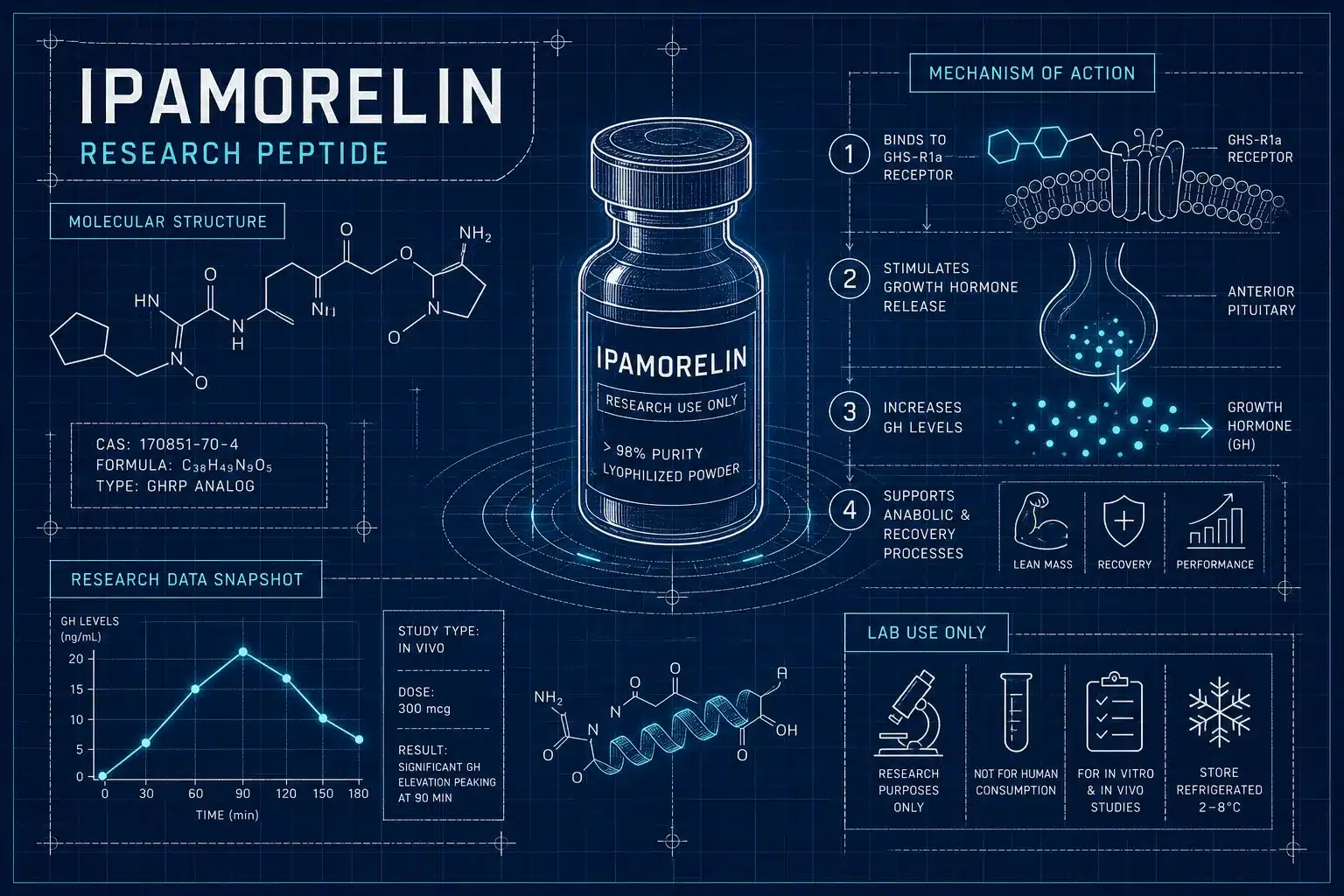
Most growth hormone-releasing peptides come with baggage. Stimulate GH and you get a cortisol spike, a prolactin bump, and a hunger signal loud enough to complicate any clean experimental readout. The ipamorelin research peptide breaks that pattern. This synthetic pentapeptide activates the ghrelin receptor on anterior pituitary somatotrophs and triggers a discrete GH pulse with minimal off-target endocrine perturbation in pre-clinical models, making it one of the most tractable GH secretagogues available for controlled research work.
That clean pharmacological profile is why ipamorelin appears consistently in GH-axis research and why researchers sourcing verified vials turn to suppliers like R-Peptide Supply (Grey Peptide Shop), where COA-documented ipamorelin is available in multi-vial formats without the minimum-order friction that slows down smaller labs. This article covers four areas that matter most for research use: how ipamorelin triggers GH release at the receptor level, what published study data actually shows, how to interpret dosing from the pre-clinical literature, and what purity and documentation criteria to hold suppliers to.
How ipamorelin research peptide triggers pulsatile GH release at the receptor level
The GHS-R1a binding cascade: from receptor activation to somatotroph exocytosis
Ipamorelin binds GHS-R1a, a G-protein coupled receptor expressed on anterior pituitary somatotrophs. Binding activates Gq/11-mediated phospholipase C (PLC), which cleaves membrane phospholipids into inositol triphosphate (IP3) and diacylglycerol. IP3 mobilizes intracellular calcium from the endoplasmic reticulum, and the resulting calcium surge drives GH granule exocytosis directly.
This calcium-dependent signaling cascade is mechanistically distinct from GHRH receptor signaling, which operates through adenylyl cyclase and cAMP. Because the two pathways converge on GH release from separate receptor systems, they act additively when co-activated. That additive relationship is the mechanistic foundation for ipamorelin-plus-GHRH-analog stacking in research protocols.
Why this pathway matters for research design
Because ipamorelin acts through the GHRP arm of GH regulation rather than the GHRH axis, researchers can use it to probe GHS-R1a-dependent GH secretion in isolation. Any experimental design that needs to stimulate GH without introducing GHRH-pathway variables benefits from this clean mechanistic separation. That specificity is what led Raun et al. (1998) to describe ipamorelin as the first selective growth hormone secretagogue.
Selectivity: how ipamorelin compares to GHRP-6, GHRP-2, and hexarelin
The off-target profile that defines ipamorelin’s research value
In the Raun et al. (1998) receptor profiling work published in the Journal of Pharmacology and Experimental Therapeutics, ipamorelin released GH from rat pituitary cells with an EC50 of 1.3 nmol/L, closely matching GHRP-6 in raw potency. The critical difference was endocrine selectivity. GHRP-6 and GHRP-2 produce moderate-to-significant elevations in cortisol, prolactin, and ACTH at research doses; hexarelin is more potent but carries cortisol and prolactin stimulation that blurs hormonal readouts. In the Raun et al. pre-clinical assays, ipamorelin generated minimal off-target endocrine perturbation at equivalent GH-releasing concentrations, a selectivity advantage that has not been fully characterized in controlled human trials. For a direct comparison see Ipamorelin vs Hexarelin.
That selectivity distinction matters practically. When cortisol and prolactin rise alongside GH in your study, attributing downstream outcomes to GH stimulation alone becomes analytically difficult. Ipamorelin removes that noise without sacrificing potency, which is why it is widely used as a selective GHS-R1a agonist in pre-clinical studies designed to isolate GH-axis effects.
Appetite and the ghrelin pathway: where ipamorelin diverges from native ghrelin
Native ghrelin activates hypothalamic circuits that drive appetite and energy homeostasis alongside its GH-releasing function. Ipamorelin mimics the GH-releasing function but produces comparatively modest appetite-stimulating effects in pre-clinical and early clinical observations. The precise mechanism behind this divergence, whether related to receptor distribution, blood-brain barrier penetration, or differential hypothalamic engagement, is not fully defined in the published literature. For GH-focused studies where caloric intake or feeding behavior is a confounding variable, that distinction makes ipamorelin significantly more tractable than full ghrelin agonists.
What pre-clinical studies actually show about GH pulse stimulation
Raun et al. (1998): potency benchmarking across species
The Raun et al. benchmarking data established ipamorelin’s potency profile across two species. In rat pituitary cell assays, the EC50 for GH release was 1.3 nmol/L, comparable to GHRP-6. In vivo, the ED50 in rats was 80 nmol/kg with a maximum GH response (Emax) of approximately 1,545 ng/mL. In conscious swine, the ED50 dropped to 2.3 nmol/kg, indicating higher sensitivity in larger animals. These cross-species findings confirmed that ipamorelin’s potency is comparable to GHRP-6 while maintaining a selective endocrine profile.
The receptor antagonist profiling in the same study used GHRP and GHRH antagonists to confirm that ipamorelin acts through a GHRP-like receptor, not the GHRH receptor. That mechanistic confirmation is what distinguishes this study from simple GH-release assays and makes it the foundational reference for understanding ipamorelin’s binding specificity.
Johansen et al. (1999): bone growth and longitudinal efficacy data
The Growth Hormone and IGF Research findings from Johansen et al. extended the pharmacological characterization into chronic dosing. In adult female rats receiving subcutaneous ipamorelin at 18 to 450 µg/day over 15 days, longitudinal bone growth rose dose-dependently from 42 µm/day in vehicle controls to 52 µm/day in the highest-dose group. Significant body weight gains accompanied the bone growth response. Critically, pituitary GH content remained unchanged after chronic treatment, indicating that ipamorelin does not deplete pituitary GH stores over time, and pituitary responsiveness showed only marginal reduction.
The preservation of pituitary GH content has direct implications for chronic dosing protocol design. It suggests that receptor sensitization, rather than depletion of secretory capacity, governs long-term responsiveness, which supports the rationale for sustained multi-week dosing windows in pre-clinical efficacy studies.
Gobburu et al. (1999): pharmacokinetic and pharmacodynamic modeling
The PK/PD work published in Pharmaceutical Research provided the temporal framework researchers need for dosing protocol design. Ipamorelin shows dose-proportional pharmacokinetics with a terminal elimination half-life of approximately two hours. The indirect response PD model placed the GH peak at 0.67 hours (roughly 40 minutes) post-administration, with a single discrete GH release episode that returns to baseline within two to three hours. The SC50 for half-maximal stimulation was 214 nmol/L, and the maximal GH production rate was 694 mIU/L per hour.
The practical implication of that two-hour half-life is direct: single-dose designs capture a clean, defined GH pulse, while twice-daily dosing is required for sustained GH elevation experiments. Each injection creates an independent secretory episode, which preserves pulsatile receptor sensitivity across the dosing interval. It is worth noting that the published pre-clinical literature does not report systematic downstream IGF-1 response data for ipamorelin, a gap that researchers designing IGF-1 outcome studies should account for in their protocols.
Research concentrations and administration protocols in the literature
Dose ranges used in pre-clinical animal studies
Animal studies used subcutaneous administration as the primary route. Johansen et al. (1998, Xenobiotica) reported approximately 20% intranasal bioavailability, and subcutaneous administration was preferred for its consistent absorption profile in pre-clinical work. Rat dose-response studies operated in the 18 to 450 µg/day range for bone growth endpoints, while in vivo GH stimulation studies in swine used intravenous bolus dosing to establish ED50 benchmarks at 2.3 nmol/kg. The short half-life defined by Gobburu’s model means that dosing frequency drives sustained GH exposure rather than increasing the per-dose amount.
Stacking considerations: ipamorelin with GHRH analogs in research settings
The mechanistic case for combining ipamorelin with GHRH analogs like CJC-1295 rests on receptor independence. Because ipamorelin targets GHS-R1a while GHRH analogs act on the GHRH receptor, the two pathways are independent, and co-administration in pre-clinical protocols produces additive GH output without receptor overlap or redundancy. Veldhuis and Bowers (2009) demonstrated in humans that simultaneous activation of GHRH and ghrelin receptors generates a synergistic GH pulse larger than either pathway produces alone, providing the physiological basis for this combination approach.
No published randomized controlled trial has validated a specific ipamorelin-plus-CJC-1295 protocol as of mid-2026. The rationale is mechanistically sound, but researchers designing studies around this stack should frame it as mechanistically motivated rather than clinically proven. That distinction matters for institutional review and publication.
Purity standards for ipamorelin research peptide: what the COA should show before you source
Minimum analytical specifications for research-grade material
Reputable ipamorelin suppliers verify material to ≥98.0% purity by reversed-phase HPLC at 214 nm, with high-quality batches routinely reaching 99% or above. Identity confirmation requires mass spectrometry, either ESI-MS or HRMS, targeting an [M+H]+ of 712.85 ± 0.1 m/z. Single impurities should not exceed 1.0%, total impurities should remain below 2.0%, and heavy metals require ICP-MS screening to ≤10 ppm. Water content and peptide content by quantitative amino acid analysis round out a complete COA package.
Purity alone does not confirm identity. A COA that shows an HPLC trace without a mass spectrum cannot confirm the compound is ipamorelin rather than a related truncated sequence. Any supplier that cannot provide third-party documentation against these parameters from an ISO/IEC 17025-accredited laboratory is not a credible source for research-grade material.
How R-Peptide Supply approaches ipamorelin documentation
R-Peptide Supply (Grey Peptide Shop) provides ipamorelin vials with verified COA documentation covering HPLC purity, mass spectrometry identity confirmation, and lot traceability. Multi-vial formats such as Ipamorelin 5mg × 10 vials suit both lab-scale ordering and reseller purchasing volumes, and the catalog fits within a research-use-only framework consistent with US regulatory requirements. Researchers evaluating any supplier should prioritize those who can furnish complete third-party COA documentation before purchase, and R-Peptide Supply structures its documentation around those criteria.
Safety signals and regulatory context researchers should understand
What controlled studies report on cortisol, prolactin, and adverse events
A prospective randomized controlled study (Sigalos and Pastuszak, published in Sexual Medicine Reviews, 2018) reported ipamorelin well tolerated at 0.03 mg/kg administered twice daily for up to seven days. Treatment-emergent adverse events occurred in 87.5% of the ipamorelin group versus 94.8% in the placebo group, a difference that was not statistically significant. Cortisol and prolactin measurements were not systematically reported in the published results of that trial, so the absence of documented differences should not be interpreted as confirmed null effects; the pre-clinical selectivity profile remains the primary evidence base for ipamorelin’s endocrine specificity. The FDA has issued a specific immunogenicity warning for compounded ipamorelin due to peptide aggregation risk, and serious adverse events including death have been documented with intravenous administration, a route that falls outside standard research protocols. Related registered studies can be reviewed on the clinical trials registry.
Research-use-only framing and what it means for lab sourcing decisions
Ipamorelin is sold in the US as a research-use-only compound and is not FDA-approved for human administration. Researchers sourcing ipamorelin must operate within that regulatory framing and prioritize suppliers who provide proper documentation, including lot traceability and third-party verified COAs, to support compliant in-vitro and pre-clinical workflows. Proper RUO documentation includes a lot number on the COA, a verifiable purity result from a named independent laboratory, and clear research-use labeling. Institutional review boards and compliance offices increasingly scrutinize compound sourcing documentation, and a COA with a traceable lot number is the minimum standard for defensible procurement.
Building a reproducible research program around ipamorelin
Ipamorelin’s utility as a research tool rests on GHS-R1a selectivity, a defined two-hour PK/PD profile, and minimal off-target endocrine noise acting in combination. Those properties make it a widely used and controllable GH secretagogue for pre-clinical work, and the study data from Raun, Johansen, and Gobburu provide the quantitative foundation that experimental designs should be built on. EC50 values, species-specific ED50 benchmarks, and the 40-minute GH peak are not just pharmacological details; they are the parameters that determine dosing frequency, sampling windows, and statistical power calculations.
None of that precision matters if the compound in the vial does not meet purity standards. Start with the COA, confirm mass spec identity against the 712.85 m/z target, and build the protocol from there. For researchers sourcing ipamorelin peptide for research use, Ipamorelin peptide for sale: your 2026 research sourcing guide, Research Peptides Supply provides the documentation infrastructure to support compliant lab and reseller workflows at accessible wholesale pricing. The COA is the floor, not the ceiling, of quality assurance.