


Blog
BPC-157 + TB-500 blend: how the Wolverine stack works

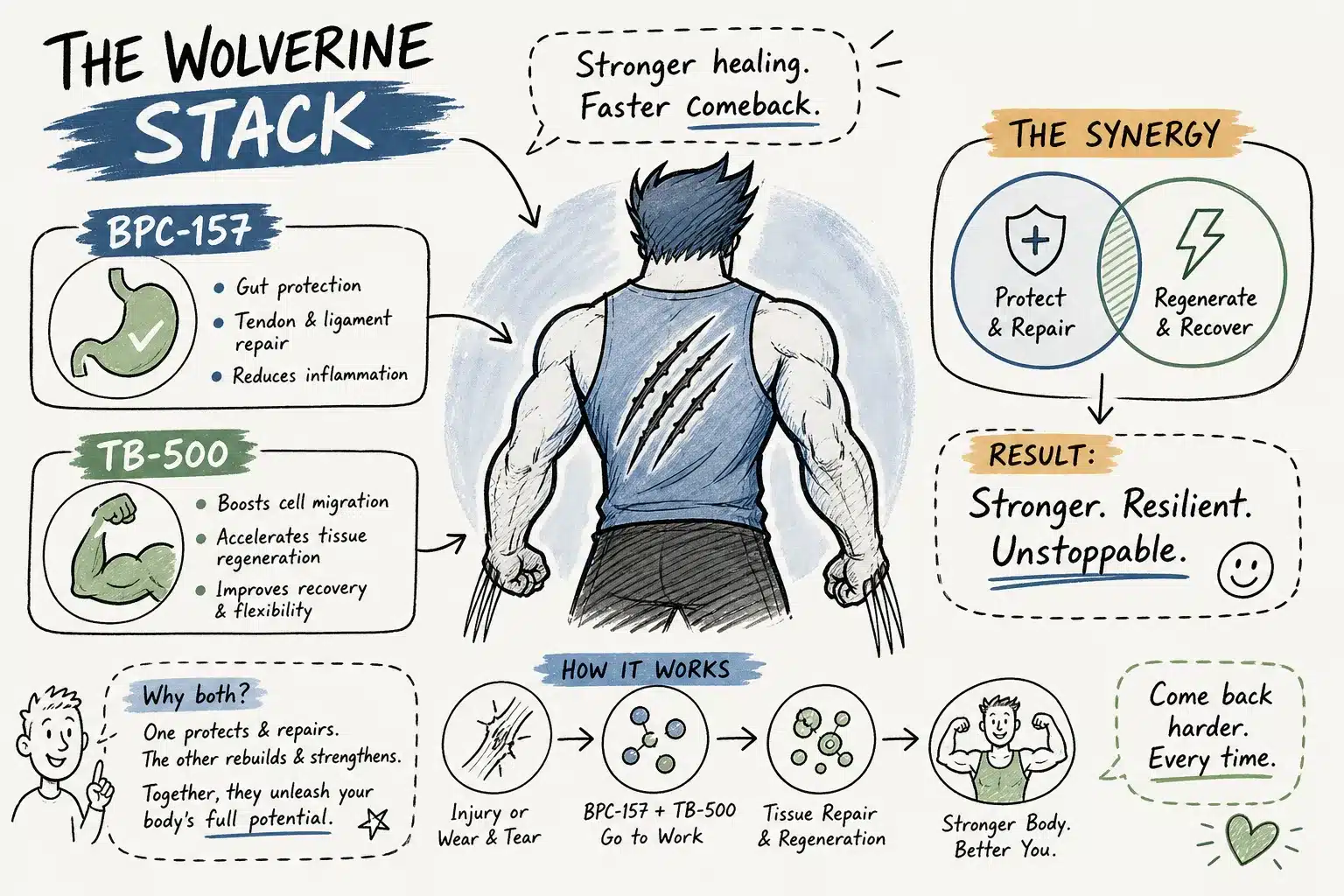
The BPC-157 + TB-500 blend, nicknamed the “Wolverine stack,” didn’t come from marketing. It came from researchers and biohackers who looked at the preclinical data for both compounds and drew an obvious analogy: two peptides with complementary repair mechanisms, layered together in a single protocol. The label stuck because it captures something real about the theoretical appeal of this peptide blend for healing. That said, expectations shaped by a comic-book metaphor can outrun the actual evidence, and the evidence here deserves an honest read.
This article covers what each compound does mechanistically, why their combination is considered non-redundant, what the human and animal data actually show, how research protocols are typically structured, what the safety picture looks like, and how to source a COA-verified blend responsibly. Nothing here constitutes medical advice or clinical prescription. This is written for labs, independent researchers, and anyone sourcing or designing research protocols with these compounds.
Why the BPC-157 + TB-500 blend makes mechanistic sense
The first question any researcher should ask about a peptide combination is whether the two compounds are doing the same job or different jobs. With the BPC-157 + TB-500 blend, the answer is genuinely different jobs, which is what makes the pairing rationally interesting rather than just additive marketing.
What BPC-157 does at the cellular level
BPC-157 is a synthetic pentadecapeptide derived from a gastric protective protein. In animal models, it activates VEGFR2 signaling in a VEGF-independent manner, promoting endothelial proliferation and neovascularization at repair sites. It also works through FAK-paxillin signaling to support fibroblast migration and tendon-to-bone reattachment, and modulates nitric oxide pathways via the Akt-eNOS axis. In rat Achilles tendon models specifically, BPC-157 upregulates growth hormone receptors on fibroblasts, amplifying JAK2 signaling when growth hormone is present. The operative framing in the research literature is that BPC-157 functions as a local repair initiator, concentrating its action near the site of injury or administration.
TB-500’s mechanism via thymosin beta-4
TB-500 is a synthetic fragment of thymosin beta-4 (TB4), not the full protein. This distinction matters because the research literature often conflates them, and they are structurally distinct. TB-500 is a seven-residue acetylated sequence (Ac-LKKTETQ) with a molecular weight of roughly 889 g/mol, compared to about 4,963 g/mol for full-length TB4. TB-500’s primary mechanism involves actin regulation and endothelial cell migration, supporting systemic anti-inflammatory signaling rather than localized angiogenesis. Because it’s a fragment, it may not reproduce all functions of the full thymosin beta-4 protein, and researchers should design experiments with that specificity in mind.
Where the two compounds complement each other
The pairing logic follows from the mechanisms: BPC-157 targets local tissue repair signaling while TB-500 facilitates broader, systemic cell migration and anti-inflammatory activity. In preclinical peptide therapy recovery research, the hypothesis is that they address different phases of the repair process without redundancy. BPC-157 initiates localized vascular and fibroblast activity; TB-500 supports the wider cellular recruitment and inflammation modulation that follows. This remains a plausible mechanistic argument grounded in preclinical data, not a proven clinical outcome. That framing matters for how researchers structure their protocols and interpret their results.
What the research actually shows (and where the gaps are)
The honest summary is that the preclinical data for both compounds is genuinely interesting, human data for BPC-157 is early and limited, and human data for TB-500 is essentially absent. Researchers working with this combination should enter with that calibration already set.
Preclinical data: what animal models suggest
Animal studies for BPC-157 have shown meaningful results in tendon healing, gut repair, and nerve regeneration across rat and rodent models. TB-500 preclinical work covers wound healing and some cardiac tissue studies, with results that have supported ongoing research interest. The outcomes in rodent models are meaningful enough to justify continued investigation, but extrapolation to human physiology requires appropriate caution. Biology between species differs in ways that are not always predictable. For a representative review of preclinical mechanisms and animal-model outcomes, see the detailed preclinical literature on BPC-157 and related peptides (PMC article on peptide mechanisms).
Human data for BPC-157: small, early, and worth tracking
The human evidence for BPC-157 spans several early-stage studies. Consider these signals in sequence:
- A Phase I pharmacokinetics trial measured safety, Cmax, Tmax, AUC, and elimination half-life in healthy volunteers.
- A retrospective intra-articular knee study contacted 16 patients six months to a year after receiving injections containing BPC-157 alone or BPC-157 plus TB4 (not TB-500 specifically): 14 of 16 reported significant pain relief.
- A pilot intravesical study for interstitial cystitis in 12 individuals reported 80, 100% symptom resolution at six weeks.
- A two-person IV infusion pilot in healthy adults showed no adverse events, with plasma levels returning to baseline within 24 hours.
- An ongoing hamstring injury trial measures time to return to sport, MRI-assessed injury volume, and functional outcomes (clinical trial record).
These are small, largely uncontrolled studies. They are meaningful signals, not established clinical evidence. For a broader overview of research uses and context around BPC-157 in preclinical and early human research, consult the summary of top research uses of BPC-157 (Top Research Uses of BPC-157 Peptide Explained).
TB-500’s evidence gap
No robust published human clinical trials for TB-500 exist in the current literature. The evidence base is almost entirely preclinical. This doesn’t invalidate research interest in the compound, but it does mean any human-use claims are unsupported by controlled data. The knee injection study mentioned above used BPC-157 with thymosin beta-4, not TB-500, so it should not be treated as evidence for the fragment specifically. A research-savvy audience deserves that level of clarity.
BPC-157 + TB-500 blend dosing frameworks
The dose ranges described here reflect common research protocols drawn from clinic-style practice patterns and preclinical study designs. Controlled human trials have not validated any standardized protocol. Frame these as reference points for research design, not clinical prescriptions.
BPC-157 dosing ranges and administration routes
BPC-157 is typically dosed in the microgram range: 200, 500 mcg per dose, once or twice daily. Subcutaneous injection near the site of interest is the most frequently described route in research models, based on its localized mechanism. Oral administration is also explored but is generally considered less bioavailable for applications targeting musculoskeletal tissue. Intra-articular and intravesical routes appear in specific study designs, as the human pilot studies above illustrate.
TB-500 dosing and injection schedules
TB-500 operates in the milligram range: 2, 5 mg per week is the most commonly reported range in BPC-157 TB-500 dosing protocols, often split across two or three subcutaneous or intramuscular injections. During a loading phase, every-other-day dosing is sometimes described; weekly dosing for maintenance follows in many clinic-style protocols. Both subcutaneous and intramuscular routes are used across the literature.
Protocol length and cycling in research contexts
Most documented research models run four to eight weeks, with some extending to twelve weeks. A 30-day loading cycle followed by a break or reduced maintenance dose is a frequently described structure. For lyophilized vials reconstituted with bacteriostatic water, standard practice involves slow injection of diluent down the vial wall, gentle swirling rather than shaking, refrigerated storage at 2, 8°C, and use within 21, 30 days of reconstitution. Freeze-thaw cycles after reconstitution should be avoided. For summaries of stack-specific protocols and rationale, see guidance on blend and stack research practices (BPC-157, GHK-Cu, TB-500 stack research).
Safety signals, risks, and what researchers should flag
The human safety data for BPC-157 is limited but favorable across the small studies that exist. The IV pilot in two healthy adults reported no adverse events. The intra-articular and intravesical studies also reported no adverse events. Plasma levels returned to baseline within 24 hours in the IV study. That is an encouraging early signal, not a clean bill of safety across populations and durations.
Theoretical concerns from preclinical and in vitro data include pathologic angiogenesis, nitric oxide overproduction, and toxic metabolite formation. None of these have been confirmed in human subjects. Practical caution is warranted for populations where angiogenic mechanisms carry specific risk: individuals with active or prior cancer, autoimmune conditions, chronic liver or kidney impairment, and those who are pregnant or breastfeeding. These are mechanistic inferences drawn from preclinical data, not confirmed contraindications.
Peptide source quality is a direct safety variable, not a secondary concern. Contaminants, mislabeled compounds, and undocumented purity in unverified research peptides introduce variables that undermine both safety and data integrity. Injection-route risks, including infection and abscess, increase meaningfully when product sourcing is not backed by documented COA verification. For TB-500 specifically, human safety data is essentially absent from the published literature, which makes sourcing from a well-documented supplier even more important as a baseline control.
Sourcing COA-verified blend vials for lab research
COA verification is the baseline for any responsible research peptide sourcing, not a differentiating feature. Researchers should expect HPLC purity documentation with lot numbers, not a blanket “tested” claim. Lyophilized product for shelf stability, bacteriostatic water availability for reconstitution, and multi-vial formats for lab-scale work are practical criteria that any serious supplier should meet. Wholesale pricing matters for labs running repeated experiments on a budget.
One option that meets these criteria is R-Peptide Supply (Grey Peptide Shop), which carries a COA-verified BPC-157 + TB-500 research blend designed for labs and independent researchers who prefer a pre-formulated option over managing separate compounds and mixing ratios themselves. Each lot comes with documented purity verification, which reduces a key variable in experimental workflows. The blend is available in multi-vial and bulk formats, with free shipping on orders over $200, making it practical for recurring research use. For researchers who need to vary the BPC-157 or TB-500 dose independently, both compounds are also available separately through the same storefront, covering both protocol approaches without requiring multiple suppliers. Disclosure: R-Peptide Supply is the business associated with this article.
Regulatory context and what “research use only” actually means
Neither BPC-157 nor TB-500 is FDA-approved for human use. The FDA has flagged BPC-157 in the context of compounding restrictions, citing immunogenicity concerns and insufficient safety data (legal analysis of FDA scrutiny). TB-500 has been treated as a Category 2 bulk drug substance, which restricts compounding pharmacies from legally preparing it for human prescription use. These are not minor footnotes for research framing purposes.
In the US, peptides sold as research-use-only (RUO) compounds are not marketed for human consumption, not classified as dietary supplements, and not approved drugs. The compliance burden falls on marketing claims and documented intended use. Labs and independent researchers operating under an RUO framework should document experimental intent clearly and avoid any therapeutic framing in their protocols. Products sold with treatment claims or distributed for human use outside FDA rules carry regulatory exposure regardless of the RUO label.
On the anti-doping side: BPC-157 is prohibited under the 2026 WADA Prohibited List as an S0 Non-Approved Substance and appears on the DoD Prohibited Dietary Supplement Ingredients List. TB-500 is classified under S2 as a peptide hormone and growth factor mimetic, also prohibited at all times under WADA and DoD regulations. Any researcher who is a tested athlete, active military service member, or works with tested subjects needs to treat both compounds as prohibited regardless of how the research protocol is framed.
Key takeaways
- The BPC-157 + TB-500 blend is considered non-redundant because each peptide targets a distinct phase of tissue repair: localized vascular initiation vs. systemic cell migration.
- Preclinical data for both compounds is encouraging; human data for BPC-157 is early and limited; human data for TB-500 is essentially nonexistent.
- No standardized BPC-157 + TB-500 dosing protocol has been validated in controlled human trials, all frameworks are research reference points, not clinical prescriptions.
- Peptide source quality directly affects both safety and data integrity; COA documentation with lot-number traceability is the minimum acceptable standard.
- Both compounds are prohibited under 2026 WADA and DoD regulations; researchers working with tested populations must account for this regardless of protocol framing.
Frequently asked questions
What is the BPC-157 + TB-500 blend used for in research?
In preclinical and early human research, the BPC-157 + TB-500 blend is studied for its potential role in peptide therapy recovery applications, including tendon and muscle healing, anti-inflammatory signaling, and tissue repair. Neither compound is FDA-approved for human use. For additional practical context on peptide therapy workflows, see a primer on peptide therapy basics (BPC-157 research overview).
How is the BPC-157 + TB-500 blend typically dosed in research protocols?
BPC-157 is generally administered at 200, 500 mcg per dose once or twice daily via subcutaneous injection, while TB-500 is typically dosed at 2, 5 mg per week, split across multiple injections. These are common research reference ranges, not clinically validated prescriptions.
Is TB-500 the same as thymosin beta-4?
No. TB-500 is a synthetic seven-residue fragment (Ac-LKKTETQ) of thymosin beta-4, not the full protein. They share a mechanism related to actin binding but differ structurally and may not produce identical biological effects. Research should account for this distinction when reviewing the literature.
Where can researchers source a COA-verified BPC-157 + TB-500 blend?
Labs and independent researchers should look for suppliers providing HPLC purity documentation with lot numbers for each batch. R-Peptide Supply (Grey Peptide Shop) offers a COA-verified pre-mixed blend alongside separate-compound options for researchers who need independent dosing control.
The BPC-157 + TB-500 combination earns its research interest from genuine mechanistic complementarity: one compound targets local repair initiation, the other facilitates systemic cell migration and anti-inflammatory signaling. Preclinical data is encouraging. Human evidence for BPC-157 is early and worth tracking; human evidence for TB-500 is essentially nonexistent. For researchers, that means rigorous sourcing, documented protocols, and honest framing of what the data does and doesn’t support. Starting from a supplier with verified COAs and lot-number traceability is the baseline, not the ceiling. R-Peptide Supply offers COA-documented vials in both pre-mixed blend and separate-compound formats, making it a practical starting point for labs and independent researchers building a controlled protocol around one of the more studied dual-peptide combinations in recovery research.