


Blog
HGH Fragment 176-191 vs AOD-9604: Preclinical Evidence

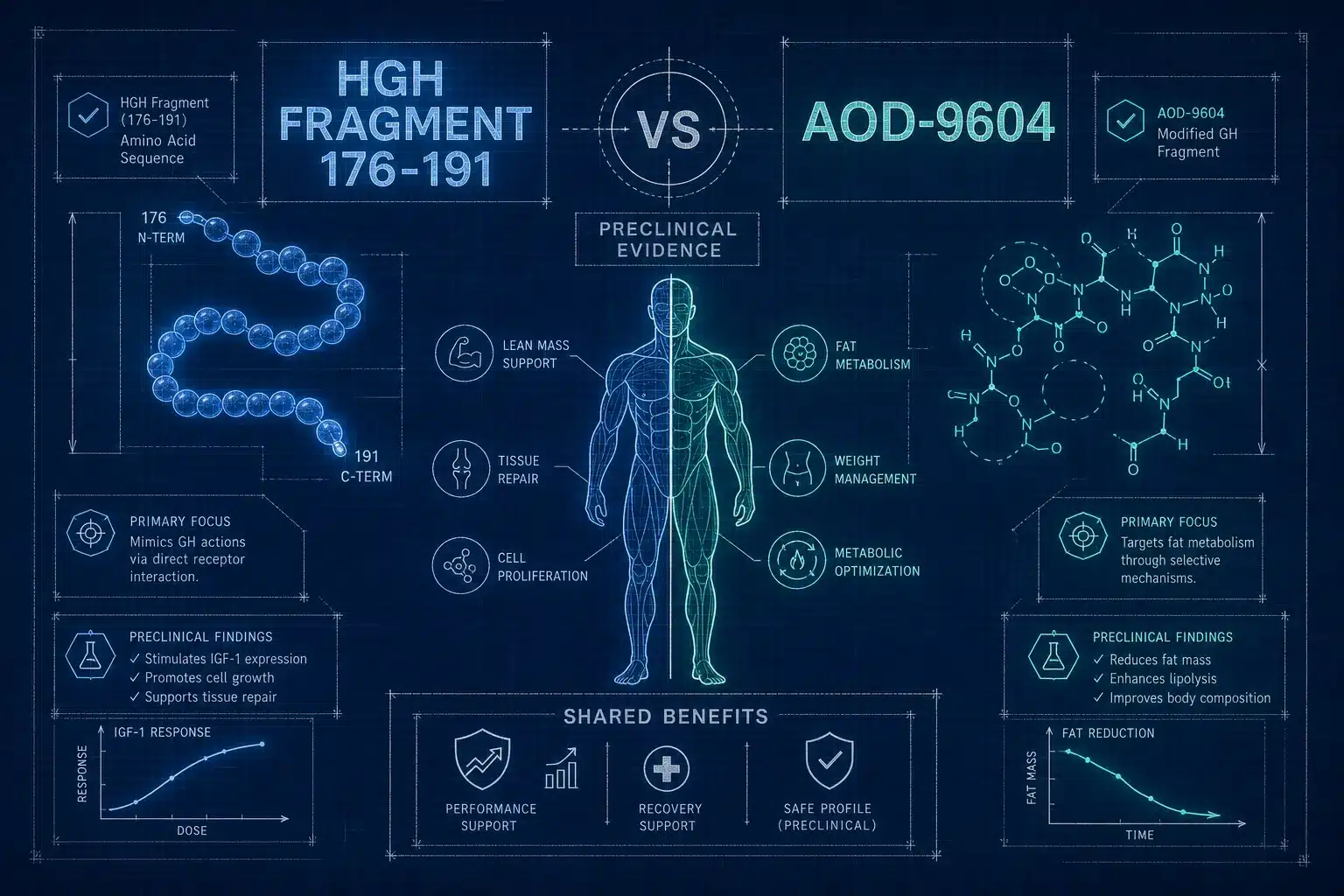
Every researcher who spends time in the peptide literature eventually hits the same wall: a search for “HGH fragment 176-191 vs AOD-9604” returns dozens of pages treating them as two competing compounds, complete with comparison charts and stacked bar graphs. The actual science tells a different story. How does HGH fragment 176-191 compare to AOD-9604 in preclinical fat-loss research? The answer starts with a structural fact that most secondary sources skip entirely: these are not two independent molecules in a head-to-head race. Understanding that distinction is the prerequisite for reading any preclinical evidence correctly, and skipping it produces badly designed studies and badly interpreted results.
This article reviews the preclinical fat-loss evidence for the GH C-terminal fragment family: mechanisms of action, animal model outcomes, safety signals, and pharmacokinetic gaps. Everything here covers in vitro and animal data only. Nothing in this article applies to human use, and all compounds discussed are sold for research purposes only. The structural relationship between the two names is explained in the first section below. Once that relationship is clear, the sourcing note becomes relevant: labs and independent researchers setting up comparative lipid-metabolism protocols can source both HGH Fragment 176-191 and AOD-9604, each with verified Certificates of Analysis, from R-Peptide Supply as a single wholesale supplier, which eliminates lot-to-lot variability from the experimental design from the start.
The Structural Relationship Researchers Often Overlook
What HGH Fragment 176-191 Actually Is
The native HGH Fragment 176-191 is a 16-residue C-terminal peptide sequence: FLRIVQCRSVEGSCGF. The designation “176-191” refers to the residue positions within the full 191-amino-acid human growth hormone sequence, so the name is a map coordinate, not a compound identifier. A defining structural feature is the internal Cys7-Cys14 disulfide bond in the cyclic form, which shapes the peptide’s conformation and is directly relevant to its bioactivity. This region was originally isolated by researchers to probe fat-mobilizing activity that could be separated from GH’s anabolic and IGF-1-stimulating effects.
How AOD-9604 Differs as a Synthetic Analogue
AOD-9604 is the pharmaceutical development name for a stability-optimized version of the same hGH C-terminal fragment. The key modification is an engineered N-terminal tyrosine: where the native fragment begins with phenylalanine, AOD-9604 begins with tyrosine, producing the sequence YLRIVQCRSVEGSCGF. This makes AOD-9604 more accurately labeled as Tyr-hGH 177-191, or GH fragment 177-191, in some nomenclature, which is part of why naming across published sources is inconsistent. The N-terminal tyrosine is reported to improve resistance to proteolytic degradation, which matters considerably for in vivo dosing reproducibility, plasma exposure windows, and any attempt to compare results across animal studies that used different administration routes or durations.
Why This Isn’t a True Head-to-Head Comparison
The peer-reviewed literature does not contain a published study that separately prepares “HGH fragment 176-191” and “AOD-9604 peptide” as two distinct compounds, runs them in a controlled animal model, and compares outcomes with full dosing tables and histopathology. AOD-9604 is the synthetic, marketed designation for the same GH C-terminal fragment region. Researchers designing protocols on the assumption of two independent compounds will find the primary literature does not support that framing, and their literature review will reflect it. This structural reality is the essential starting point for any fat-loss peptide comparison between these two names.
Preclinical Fat-Loss Evidence: Receptor Targets and Lipolytic Pathways
What the GH Receptor Signaling Axis Is Not Doing Here
The canonical GH receptor pathway runs through JAK2-STAT5, with additional PLCγ and ERK involvement depending on the tissue context. The 176-191 fragment does not activate this axis in preclinical work, and that is precisely why the fragment was worth isolating as a research tool. The goal was to separate fat-mobilizing activity from the growth-promoting, IGF-1-stimulating effects tied to full-length GH receptor engagement. Published preclinical data consistently show no meaningful IGF-1 elevation with the fragment, which is a central feature of its metabolic profile and the clearest mechanistic distinction from full hGH. For broader context on GH-related modulators, see reviews on growth hormone secretagogues and how different fragments and analogues have been evaluated in metabolic research.
Beta-3 Adrenergic Receptor Involvement: What the Data Say
The 2001 Heffernan et al. study found that AOD-9604 upregulated beta-3 adrenergic receptor (beta-3-AR) RNA expression in wild-type obese mice, and full hGH produced the same effect. The complicating finding is that acute AOD-9604 administration still increased energy expenditure and fat oxidation in beta-3-AR knockout mice, which rules out direct beta-3-AR mediation as the sole mechanism.
The proposed pathway from cell culture work runs through beta-3-AR activation or upregulation driving a cAMP surge, PKA activation, and downstream phosphorylation of Acetyl-CoA carboxylase (ACC), which inhibits lipogenesis. That cascade is plausible and mechanistically coherent, but the knockout mouse data make clear that this pathway is not the only route to the observed metabolic effects. The mechanism should be treated as unsettled. For a detailed discussion of receptor- and pathway-level evidence in metabolic peptide research, consult recent reviews in endocrinology journals that synthesize preclinical signaling data (see the Frontiers in Endocrinology review).
Lipolysis Versus Anti-Lipogenesis: Two Distinct Effects in the Literature
These terms are often used interchangeably in secondary sources, but they describe different processes. Lipolysis is active triglyceride breakdown in existing adipose tissue. Anti-lipogenesis is suppressed formation of new fat, operating through inhibition of lipogenic enzymes and transcription factors including SREBP-1c and PPARγ. Both effects appear in the literature attributed to the C-terminal GH fragment.
The lipolysis evidence is better supported by animal model outcomes in obese rodents. The anti-lipogenesis mechanistic data, particularly the signaling cascade detail, relies more heavily on patent-adjacent or secondary sources, and the primary peer-reviewed signaling pathway evidence is thinner. Researchers should weight these two lines of evidence accordingly.
Animal Model Outcomes: How HGH Fragment 176-191 Compares to AOD-9604 in Published Studies
The Heffernan 2001 Obese Mouse Study: The Key Reference
The most direct and most frequently cited preclinical reference in any comparison of HGH fragment 176-191 and AOD-9604 in preclinical fat-loss research is Heffernan MA et al., Endocrinology (2001). The study used obese wild-type mice and beta-3-AR knockout mice and ran 14 days of chronic intraperitoneal administration. Reported doses were AOD-9604 at 250 μg/kg/day and full hGH at 1 mg/kg/day. Both compounds reduced body weight and body fat in obese wild-type mice, and both increased beta-3-AR RNA expression. The fragment reproduced a substantial portion of full hGH’s fat-mobilizing activity without the anabolic or IGF-1-stimulating effects associated with the full molecule, the central finding the study was designed to demonstrate.
Knockout Model Results and What They Reveal
The knockout arm of the Heffernan study is mechanistically important and often underreported. In beta-3-AR knockout mice, long-term treatment with AOD-9604 did not produce the same body-weight reduction and lipolytic changes seen in wild-type animals. However, acute AOD-9604 administration still drove measurable increases in energy expenditure and fat oxidation in those same knockout mice. The implication is that beta-3-AR upregulation contributes to sustained efficacy over a chronic dosing window but is not the sole entry point for the compound’s metabolic effects. Researchers building dosing rationale around a single receptor mechanism will encounter this finding and need to account for it.
Gaps in the Direct Comparative Animal Literature
There is no published, peer-reviewed study that runs fragment 176-191 and AOD-9604 as two separately prepared compounds in a controlled animal model with full dosing tables, histopathology, and matched outcome metrics. This is a real gap in the literature, not a semantic one. For any lab trying to characterize differences between the native sequence and the N-terminally modified analogue, that data set does not currently exist in accessible primary form. Researchers will need to generate it, which means the quality and characterization of the reference material they start with determines whether the study is interpretable at all.
Safety and Metabolic Signals from Preclinical Work
What the Data Show on Glucose and Lipid Metabolism
Closely related GH fragment studies and the AOD-9604 literature describe improvements in hepatic steatosis and reductions in fasting blood glucose in obese insulin-resistant rodent models. In vitro work supports this picture: GLUT4 translocation and glucose uptake data from human skeletal muscle cell studies align with the in vivo metabolic findings. A 2000 rat study reported that daily oral AOD-9604 at 500 μg/kg for 19 days reduced weight gain and increased adipose lipolysis, with no adverse effect on insulin sensitivity on euglycemic clamp testing. These are metabolic effects observed in specific research models, not therapeutic claims, and they should be interpreted in that frame. For a broad synthesis of preclinical peptide safety and metabolic outcomes, see the preclinical peptide safety review.
IGF-1 and Anabolic Safety Signals
The consistent finding across the fragment literature is the absence of significant IGF-1 elevation. This is the central safety distinction between the 176-191 fragment and full-length hGH, and it is supported across multiple preclinical studies. In practical terms, the lack of IGF-1 stimulation means the fragment does not carry the same proliferative risk profile as full GH in preclinical models. That is a relevant safety advantage from a study design perspective, but it does not constitute a full toxicological clearance for human translation and should not be treated as one.
What Formal Toxicology Data Are Missing
There is no published GLP toxicology package, no clearly established NOAEL, and no comprehensive organ histopathology panel in the accessible peer-reviewed literature for fragment 176-191 or AOD-9604. A 2024 FDA review noted mild periportal hepatic vacuolation in Cynomolgus monkeys at 10 mg/kg/day in a 9-month oral study, described as possibly indicating liver damage. The same review found that genotoxicity signals were equivocal in both in vitro and in vivo assays, and concluded that available nonclinical data were insufficient to establish a full toxicological profile. Researchers should treat the available safety signals as preliminary and design studies that generate the missing toxicology data rather than inferring clinical tolerability from rodent metabolic readouts.
Pharmacokinetics in Animal Models: What Is Known and What Isn’t
Route of Administration and Dosing in Published Work
The Heffernan 2001 study used intraperitoneal injection at 250 μg/kg/day for AOD-9604 over 14 days. A related AOD-9401 obese mouse study used oral administration over 30 days and demonstrated measurable metabolic effects, which provided part of the rationale for AOD-9604’s early pharmaceutical development as an orally active anti-obesity compound. The fact that oral activity was demonstrated in rodents is relevant for study design decisions, but it does not automatically translate to conclusions about oral bioavailability in other species or in human research contexts. Route selection remains a meaningful experimental variable that affects how results should be compared across studies.
Half-Life, Proteolytic Degradation, and Bioavailability Gaps
Formal pharmacokinetic parameters, including plasma half-life, absolute bioavailability, and identified metabolites, are not reported in the accessible peer-reviewed primary literature for either compound. The expected primary clearance mechanism for a 16-residue peptide is rapid enzymatic degradation; the N-terminal tyrosine in AOD-9604 is specifically intended to slow that process, but quantified half-life data from animal studies are not available in the sources reviewed here. Researchers who need exposure-response relationships in their study designs will need to generate their own PK data, including timed plasma sampling and peptide quantification by LC-MS alongside metabolic endpoints.
Practical Implications for Study Design
PK gaps translate directly into real experimental decisions. Without a defined plasma half-life, dosing interval selection becomes an educated estimate based on peptide class behavior rather than compound-specific data. Short peptides with uncertain half-lives require more frequent blood sampling to build any kind of exposure-response curve, and IP versus SC versus oral routes will produce different absorption kinetics that the current literature cannot fully characterize. Researchers designing new AOD-9604 or fragment 176-191 studies should build PK measurement into the protocol rather than treating it as a secondary endpoint. The mechanistic interpretation of any metabolic outcome depends on knowing what plasma exposure produced it, that relationship cannot be reconstructed after the fact.
What Researchers Need Before Running a Comparative Study
Why Compound Identity and Purity Are the First Variables to Control
Before any comparative protocol makes sense, researchers need to confirm that the fragment 176-191 they are sourcing is sequence-verified as FLRIVQCRSVEGSCGF and that the AOD-9604 peptide is authentically the N-terminally modified analogue YLRIVQCRSVEGSCGF. Without a Certificate of Analysis that includes HPLC purity and sequence confirmation, a comparison study is comparing two unknowns, and no amount of methodological rigor downstream will fix that. This is where sourcing discipline matters more than almost any other methodological decision. Purity variances between lots, undocumented sequence substitutions, and unverified synthesis quality are the most common sources of irreproducible results in peptide research, and they are also the easiest variables to eliminate.
How R-Peptide Supply Positions Researchers to Run Cleaner Studies
R-Peptide Supply (Grey Peptide Shop) stocks both HGH Fragment 176-191 and AOD-9604 as COA-backed research compounds, with HPLC purity documentation and lot traceability available per order. Labs and independent researchers running lipid metabolism protocols or animal model work can source both peptides from a single wholesale supplier, which removes formulation variability from the comparison and simplifies procurement logistics. Bulk and multi-vial formats are available for longer-duration protocols, and ancillary supplies including bacteriostatic water are stocked in the same catalog. For researchers who need verified purity documentation as part of their study records, COAs from a consistent supplier are a baseline requirement, not an optional detail.
The Primary Studies to Consult Next
The reading list for anyone building a fragment 176-191 or AOD-9604 research file is short by necessity. Prioritize in this order:
- Heffernan MA et al., Endocrinology (2001), the primary animal model reference; read the source directly, not a secondary review’s citation of it.
- AOD-9604 preclinical patent literature, contains anti-lipogenesis and anti-adipogenesis evidence that does not appear in the peer-reviewed journal record at the same level of detail.
- GH fragment receptor interaction studies, provide the context for understanding why beta-3-AR upregulation and the absence of IGF-1 induction are mechanistically significant findings.
The preclinical evidence for this compound class is real but sparse, the mechanistic picture is incomplete, and the compound identity overlap between the two names must be understood before any comparative protocol is designed.
Conclusion
The core takeaway from this review is structural: HGH fragment 176-191 and AOD-9604 are the same C-terminal GH sequence in native versus stability-modified form. They are not two independent compounds, and the primary literature does not treat them as such. When researchers ask how HGH fragment 176-191 compares to AOD-9604 in preclinical fat-loss research, the most accurate answer is that the comparison is between a native sequence and its N-terminally modified analogue, not between two unrelated molecules. The strongest preclinical findings are lipolysis and anti-lipogenesis effects in obese rodent models, a consistent absence of IGF-1 stimulation, and beta-3-AR involvement that is real but demonstrably not the sole mechanism responsible for chronic efficacy.
The translational limitations are equally clear: no formal toxicology package, no complete PK dataset, no published head-to-head animal study comparing separately prepared versions of the native and modified sequences. These are gaps the current literature cannot close, and researchers designing new protocols will need to account for them rather than fill them with secondary source citations.
For labs and researchers ready to build on the existing evidence, the next step is primary source review starting with Heffernan 2001, followed by protocol design that controls for compound identity from the start. R-Peptide Supply carries COA-verified HGH Fragment 176-191 and AOD-9604 with HPLC documentation, available in bulk and multi-vial formats for researchers who need consistent, characterized reference material across a full study duration.