


Blog
Wholesale peptide suppliers: how to vet the best ones

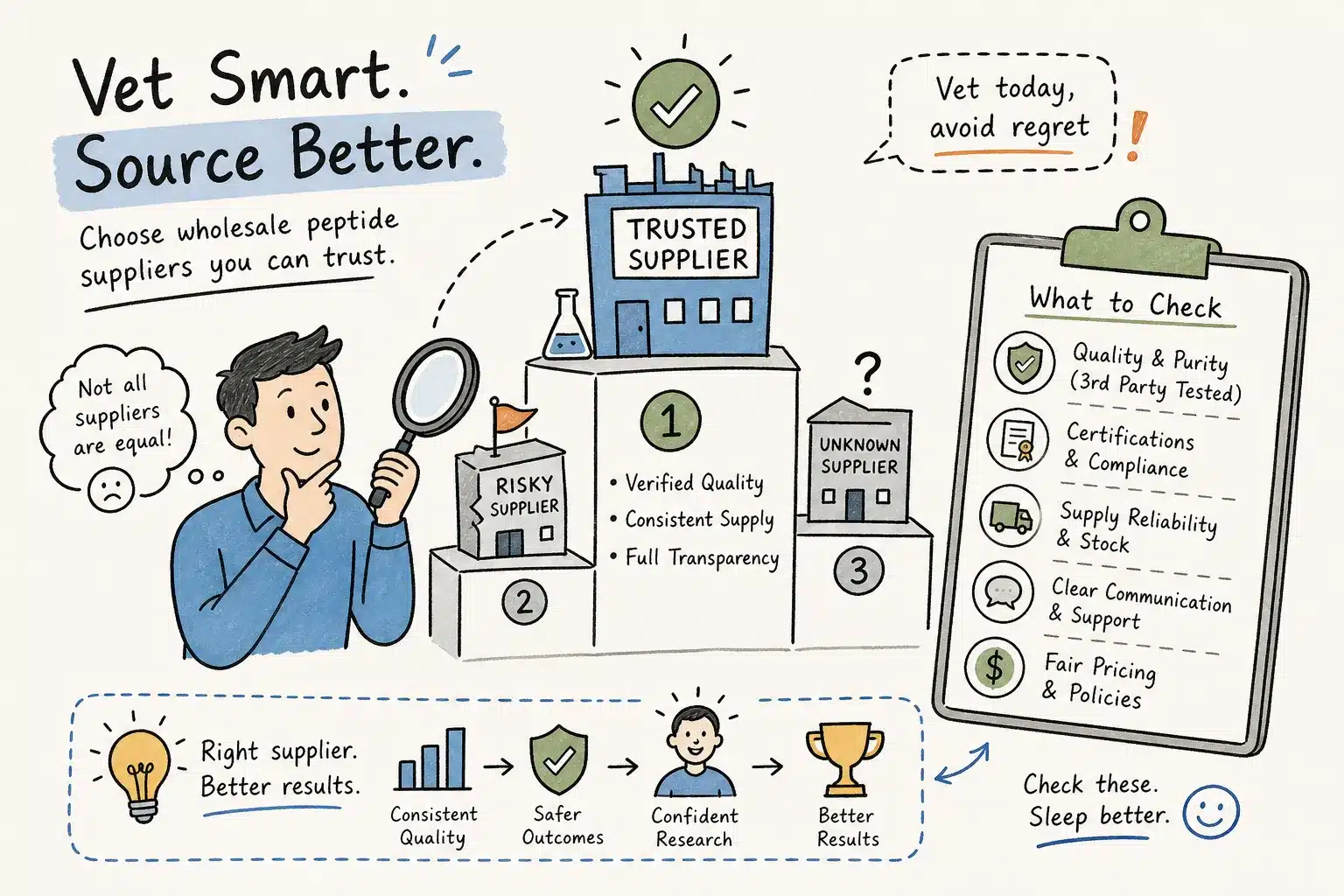
When evaluating a wholesale peptide supplier today, researchers and lab buyers face vendors with wildly different documentation standards, pricing structures, and fulfillment reliability. The grey market research peptide space has grown fast over the past several years, and the quality gap between suppliers has grown right along with it. Some suppliers back every vial with batch-specific analytical data. Others post generic purity claims and hope you don’t ask follow-up questions.
Knowing what to look for in a wholesale peptide supplier gives you a concrete reference point when comparing any vendor in this space. This article walks through the five criteria that matter most: COA transparency, pricing and MOQs, catalog breadth, shipping policies, and customer support.
What separates a reliable wholesale peptide supplier from the rest
The verification gap most buyers miss
Many wholesale peptide vendors advertise purity claims without backing them with traceable, batch-specific documentation. A reliable supplier generates a COA per lot, not per product listing. That distinction alone filters out a significant portion of the market, because a product-level document that applies to no particular shipment gives you no real information about the vials you’re actually receiving.
Independent researchers and labs need more than a percentage on a page. They need an analytical record tied to a specific batch that can be referenced if a result is questioned or a protocol needs to be reproduced. Without that traceability, quality assurance is theoretical rather than real. Identifying where a supplier sits on the documentation spectrum, from generic purity claims to full batch-level COAs with HPLC and MS data, is the first practical step before requesting any quote.
Why research-grade grey market suppliers vary so widely
The supplier landscape runs from research-grade peptide wholesalers all the way to full GMP-certified pharmaceutical CDMOs like Bachem, CPC Scientific, and AmbioPharm, which manufacture peptide APIs for clinical and commercial use. Those two categories serve entirely different buyers. Labs and resellers sourcing at the research-use-only level are not looking for clinical API suppliers with multi-kilogram MOQs and multi-month lead times. They need verified purity, competitive pricing, and fast domestic fulfillment. A bulk peptide supplier that understands this distinction will reflect it in how they structure catalog pricing, documentation, and order fulfillment.
What a trustworthy supplier’s storefront signals
Transparency shows up in the details: whether lot numbers appear on product pages, whether COA downloads are accessible before checkout, whether pricing is published openly or buried behind a quote-request form. These aren’t aesthetic choices, they reflect how a supplier treats documentation discipline across every stage of their operation. A supplier that withholds basic information before purchase is revealing how they treat documentation as an afterthought rather than a standard, which tells you something concrete about post-order service as well.
COA transparency: the baseline quality signal you can’t skip
What a legitimate batch-specific COA contains
A valid COA for a research peptide includes the batch or lot number, the peptide name and sequence, a measured purity percentage, the analytical method used to determine that percentage, HPLC-UV chromatogram data, mass spectrometry data confirming molecular identity, the testing date, and storage conditions. HPLC data and MS data are not optional extras. They are what make a purity claim verifiable rather than simply stated.
When a wholesale peptide supplier provides verified COAs with each product, buyers get a clear audit trail for every compound ordered. That documentation structure is what lets a lab or reseller confirm they received what was listed before the compound ever enters a protocol. R-Peptide Supply structures its documentation this way, COAs tied to specific lots, accessible at the product level before purchase. For an actionable checklist on COAs, consider the guidance in our Buy Peptides in Bulk: Pricing, MOQs, and COA Checklist, Research Peptides Supply resource.
How to tell a real COA from a generic document
A batch-specific COA is tied to a specific production lot. A generic product-level document is not tied to any particular shipment and can be reused indefinitely across multiple batches. The practical test is straightforward: match the lot number on the COA to the lot number on the vial. If those numbers don’t correspond, the document provides no meaningful traceability for your research. LC-MS/MS data showing the molecular weight and fragmentation pattern is meaningfully different from a single purity percentage with no supporting chromatogram.
Red flags in quality documentation
Watch for COAs with no lot number, purity claims that don’t state a testing method, and documents without an HPLC chromatogram. When documents look identical across multiple different product SKUs, that’s a clear warning sign, each batch of each compound should generate its own analytical record. Any supplier that refuses to share COA data before purchase has removed the only objective basis for evaluating what they’re selling.
Wholesale peptide supplier pricing and MOQ structures: what to expect
Typical price ranges by supplier tier
Chinese synthesis houses commonly price bulk custom peptides in the low single-digit dollar-per-mg range at 95% purity for modest 100mg-plus orders, with a clear premium for 98%-plus purity. US-based research-grade wholesalers price higher but offer faster domestic fulfillment, direct customer support, and simpler logistics. For catalogue peptides like BPC-157, Ipamorelin, and Tirzepatide, US grey market wholesalers generally offer per-vial pricing that reflects the added value of domestic sourcing, batch-specific documentation, and in-stock availability, factors that matter when calculating true landed cost per vial. When comparing vendors, request current pricing sheets directly and factor COA inclusion and shipping into the total. Companies such as GenScript illustrate the higher-touch, fully documented US supplier model.
Multi-vial quantities shift the value calculation further in favor of domestic wholesalers, especially when domestic shipping speed and included COA documentation are factored into the true cost per unit.
MOQ structures and lead time expectations
Research-grade catalogue vendors typically carry no formal MOQ per SKU but offer pricing incentives at multi-vial volumes. Custom synthesis MOQs from dedicated synthesis houses often start around 4, 10mg for simple sequences, with standard lead times of 2, 3 weeks and expedited services as fast as 5 business days for shorter peptides. For guidance on custom synthesis providers and contract structures, resources like the custom peptide company guide provide useful context. For grey market wholesalers with pre-synthesized catalogue stock, fulfillment is considerably faster since the synthesis step is already complete.
Multi-vial bundle formats and reseller pricing
Multi-vial bundles and wholesale account pricing reduce per-unit cost without requiring the custom synthesis minimum commitments that complicate smaller research budgets. For resellers and labs running ongoing protocols, multi-vial formats make compound costs predictable and eliminate the need to commit to a full synthesis run just to access a better price tier. R-Peptide Supply offers bulk and multi-vial formats suited to this buyer type; see our Bulk Peptide Wholesale USA: The Lab Procurement Guide, Research Peptides Supply for procurement tips and current volume pricing approaches.
Catalog depth and what it tells you about a wholesale peptide supplier
Why compound variety signals supplier credibility
A wholesale peptide supplier maintaining a broad, current catalog of in-demand research compounds signals ongoing investment in sourcing, QC, and inventory management. A supplier with 8 SKUs and a supplier with 80 SKUs backed by COAs are fundamentally different operations in terms of infrastructure and process discipline. A credible research-grade peptide wholesaler carries not just core compounds but also ancillary supplies, bacteriostatic water, acetic acid water, benzyl alcohol, under the same roof. R-Peptide Supply’s catalog covers a wide range of research categories including growth hormone secretagogues, metabolic compounds, skin and beauty peptides, and recovery compounds, along with ancillary reconstitution supplies.
Peptide blends and ancillary supplies as differentiators
Pre-formulated peptide blends indicate a supplier understands research applications rather than simply listing isolated compounds. For labs and resellers, sourcing ancillary supplies from the same storefront reduces logistical overhead: fewer vendors, fewer separate shipments, fewer accounts to manage. That operational simplicity adds up across a research year. R-Peptide Supply offers combination stack formats for buyers who want pre-assembled compound groupings alongside single-compound catalog options.
Coverage of key research categories
A well-stocked wholesale supplier covers the major peptide research categories: growth hormone secretagogues, metabolic and weight management compounds, skin and beauty peptides, recovery and repair compounds, and women’s health and hormone-related compounds. A supplier covering most of these categories reduces the need to split orders across multiple vendors, which cuts both cost and coordination time. Fragmented sourcing also means fragmented documentation, which complicates audit trails across compounds.
Shipping policies, fulfillment standards, and cold-chain handling
Free shipping thresholds and what they indicate
Shipping costs erode the value of competitive per-unit pricing quickly, especially on multi-compound orders. Factoring true cost-per-vial means including shipping in the calculation, not just the listed price. A supplier whose per-unit price looks competitive but charges $30-plus for shipping on a $150 order often costs more than a supplier with slightly higher catalog prices and a meaningful free shipping threshold. R-Peptide Supply offers free shipping on orders over $200, confirm current terms on their shipping policy page before ordering.
Handling requirements for lyophilized peptides in transit
Lyophilized peptides tolerate ambient temperatures for short domestic transit windows when properly packaged, but the main risk is moisture exposure, not temperature alone. Packaging should be tight, leak-resistant, and include desiccant protection. For longer distances or high-temperature seasonal conditions, cold-chain handling becomes relevant. A supplier that understands these requirements will reflect it in their packaging and can clearly articulate their handling process when asked. For an overview of cold-chain considerations in peptide shipping, consult specialist shipping resources and carrier guidelines when assembling your vendor checklist.
Discreet packaging and fulfillment speed
For research peptide buyers in the grey market space, discreet packaging and prompt dispatch are common baseline expectations among reputable vendors. Reasonable domestic US fulfillment from in-stock catalogue inventory should be measured in days, not weeks. Labs running active research protocols with tight timelines can’t absorb the kind of delay that GMP CDMO production schedules involve. Pre-synthesized, in-stock catalogue inventory is one of the clearest practical advantages of sourcing from a research-grade grey market wholesaler over a custom synthesis house.
Vendor evaluation checklist: vetting a wholesale peptide supplier before placing a bulk order
Key questions to ask before committing to a supplier
Before placing a bulk order, ask these questions directly and evaluate the quality of the responses:
- Can you provide a batch-specific COA with HPLC and MS data for this exact lot?
- What is your purity guarantee and retest policy if a batch fails?
- What are your MOQs and volume pricing tiers?
- What is your average fulfillment time for in-stock items?
- Do you offer reseller accounts or bulk pricing agreements?
A supplier that answers all of these clearly and promptly has demonstrated at least baseline operational transparency. Slow, vague, or defensive responses are data points too.
Documents to request with your bulk peptide quote
A credible wholesale peptide supplier should provide the following without hesitation:
- A batch-specific COA with lot number tied to the specific shipment
- An HPLC chromatogram
- An MS or LC-MS/MS spectrum
- A stated purity percentage with the testing method identified
- Storage and handling instructions
If a supplier can’t produce these documents on request before purchase, that alone disqualifies them from consideration. Documentation isn’t a formality, it’s the only way to confirm what’s in the vial.
Building your final vendor shortlist
Score each candidate against COA transparency, pricing competitiveness, catalog breadth, shipping policy, and support responsiveness. Start with one test order before committing to bulk volume. R-Peptide Supply is worth evaluating as a starting point for US-based researchers and resellers: the catalog covers a broad range of research compounds and ancillary supplies, documentation is available at the product level, and the shipping policy includes a free shipping threshold for qualifying orders. Browse the catalog or reach out directly to request bulk pricing for your specific compound needs. For suppliers that also handle GMP or formal quotation workflows, see examples from established GMP peptide vendors for comparison, such as GMP peptides quotation services.
Putting it all together
Evaluating a wholesale peptide supplier comes down to four things: documentation quality, pricing clarity, catalog depth, and logistics reliability. Researchers and resellers who apply these criteria before placing bulk orders protect both their workflows and their budgets. A supplier that checks all four boxes is genuinely rare in the grey market space, which is exactly what makes that standard worth holding to.
R-Peptide Supply is built around the documentation and pricing transparency that labs and resellers need from a wholesale peptide supplier. Verified COAs, wholesale-friendly multi-vial formats, a broad catalog across research categories, and a free shipping threshold make it a practical option when sourcing research-grade compounds in 2026. Browse the catalog or get in touch to request bulk pricing on your next order.