


Blog
HGH Fragment 176-191 vs AOD9604: What Research Shows

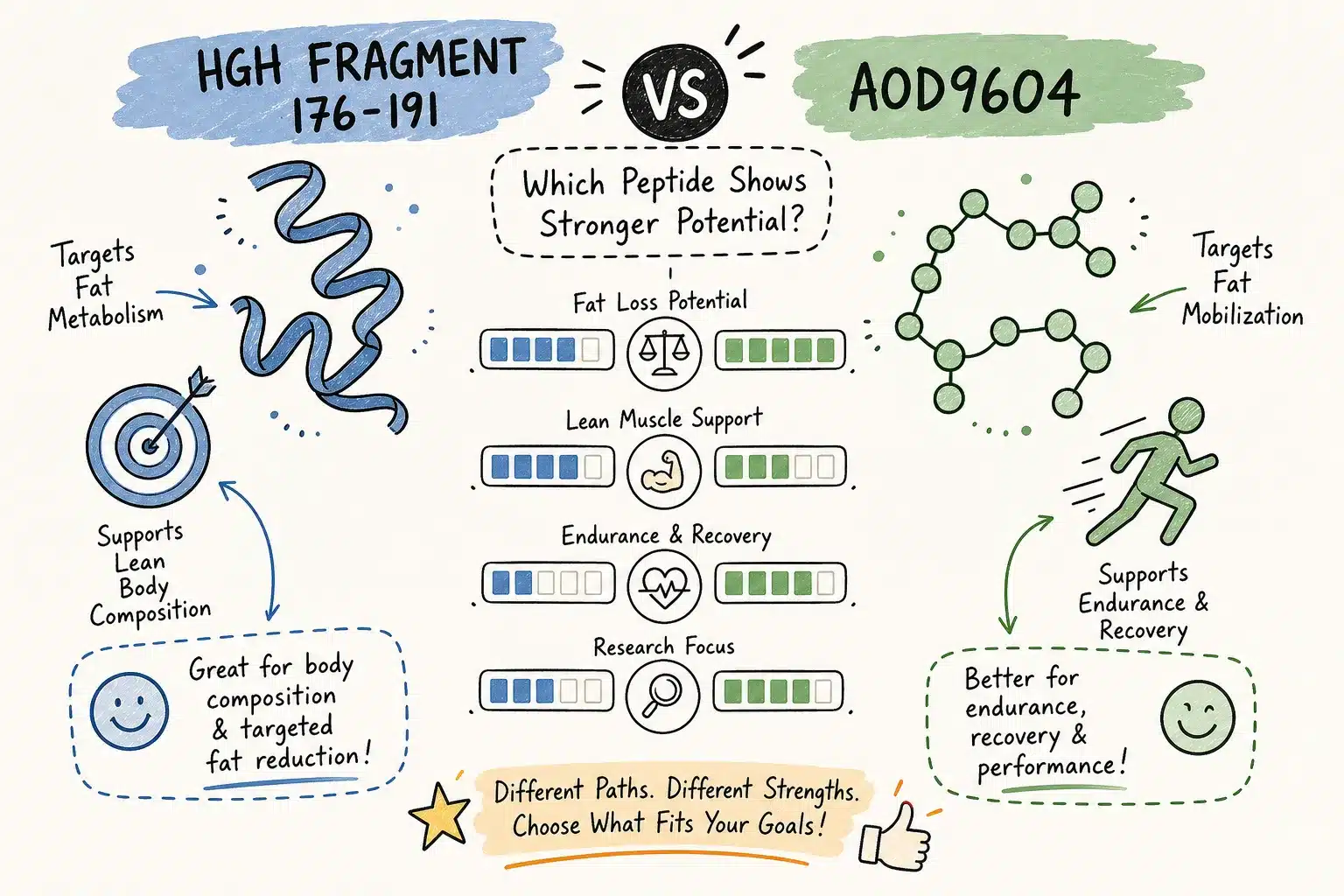
Some researchers sourcing compounds for fat metabolism studies treat HGH Fragment 176-191 and AOD9604 as interchangeable peptides. They are not the same compound, but they are far more structurally connected than most sourcing guides acknowledge. That overlap matters because the published evidence base is split unevenly between them, and conflating the two produces flawed study designs and inflated interpretations of existing data.
This article is a research-focused comparison built around four pillars: structure, mechanism, study evidence, and practical research design. Labs running parallel pre-clinical protocols with both compounds need a clear picture of what is actually established in the literature before drawing any conclusions about lipolytic efficacy. The following sections lay out that picture in full.
Structural origins: one fragment, two research identities
HGH Fragment 176-191 is the C-terminal segment of the 191-amino-acid human growth hormone protein, spanning residues 176 through 191. Early lipolysis research identified this region as the portion of the full GH molecule responsible for fat-metabolizing activity. The rest of the GH structure carries domains that trigger IGF-1 release and produce systemic growth effects. The isolated fragment retains lipolytic signaling without those broader hormonal actions, which is exactly why it attracted research attention as a potentially selective fat-metabolism tool. For a detailed procurement and research guide on the unmodified fragment, see the HGH Fragment 176-191 Peptide Research and Procurement Guide, Research Peptides Supply.
AOD9604 shares the same 176-191 sequence but differs at one critical position: the N-terminal phenylalanine at residue 176 is substituted with tyrosine. Metabolic Pharmaceuticals synthesized AOD9604 with this single-residue modification for clinical development; some sources describe the Phe→Tyr substitution as intended to improve pharmacokinetic properties. That one change makes AOD9604 a synthetic analog, not an identical compound. This distinction has real consequences for how you read the literature, because virtually all published human trial data belongs specifically to AOD9604, not to the unmodified fragment.
The naming problem compounds the structural confusion. The terms “C-terminal HGH fragment” and “hGH 176-191” appear inconsistently across compound databases and supplier listings, and occasionally in published papers as well, sometimes applied to the unmodified sequence, sometimes to the tyrosine-substituted analog. Before citing a study in your protocol design, confirm which compound was actually tested. The difference in evidence quality between the two is significant enough that conflating them constitutes a methodological error.
HGH Fragment 176-191 vs AOD9604: mechanism at the cellular level
The proposed lipolysis mechanism for both compounds centers on adipose tissue signaling. Based on the 2001 obese mouse study and subsequent in vitro work, both the C-terminal fragment and its AOD9604 analog are understood to promote fat breakdown through a pathway involving beta-3 adrenergic receptor sensitization, followed by downstream cAMP elevation, PKA activation, and ultimately increased hormone-sensitive lipase (HSL) activity. The 2001 study added an important nuance: both hGH and AOD9604 increased beta-3 adrenergic receptor expression, but the authors concluded this likely sensitizes the lipolytic response rather than directly mediating it. The receptor upregulation appears to be a facilitating effect, not the primary mechanism.
The anti-lipogenic side of the fat-metabolism profile adds another layer. In rat adipocyte assays, HGH Fragment 176-191 has been shown to inhibit acetyl-CoA carboxylase (ACC), the rate-limiting enzyme in fatty acid synthesis. This creates a dual-action model: accelerating fat breakdown through lipolytic signaling while simultaneously reducing the rate at which new fat is stored by suppressing lipogenic enzyme activity. Whether fatty acid synthase is also directly inhibited is less clearly supported in the available literature than the ACC finding.
Neither compound activates the classical growth hormone receptor pathway in a way that drives IGF-1 production. This is the theoretically important distinction separating them from exogenous GH. Full-length GH use carries well-documented risks of insulin resistance and hyperglycemia through GH receptor-mediated signaling. The C-terminal fragment’s selective action on adipose tissue, without those broader endocrine signals, forms the entire scientific rationale for fat-specific research interest in both compounds.
Preclinical evidence: what animal models actually found
The most-cited pre-clinical comparison is the 2001 obese mouse study, which placed AOD9604, full-length hGH, and saline side by side in ob/ob mice over 14 days of daily intraperitoneal administration. Both hGH and AOD9604 reduced weight gain and increased markers of fat oxidation and lipolysis. AOD9604 produced a 28% decrease in epididymal adipose tissue mass; hGH produced a 40% reduction. No significant fat change appeared in lean mice with either treatment, confirming the effect was specific to the obese model. Critically, AOD9604 did not produce the hyperglycemia observed with hGH, which is consistent with its proposed non-GH-receptor mechanism.
A separate line of evidence documents anti-lipogenic activity of the unmodified HGH fragment in rat adipocyte preparations, using enzyme inhibition assays to assess ACC activity (rat adipocyte assay). This data comes from a different experimental context and species model, which means it cannot be directly cross-compared with the ob/ob mouse study outcomes. The two data sets together build a consistent mechanistic picture, but they represent distinct compounds tested under distinct conditions.
No published animal study has run AOD9604 against unmodified HGH Fragment 176-191 in the same controlled protocol. For labs designing comparative pre-clinical research, this is a genuine opportunity rather than a dead end. A well-controlled rodent study with both compounds, matched dosing routes, and clearly defined fat-mass endpoints would fill a real gap in the published literature and has legitimate publication potential.
HGH Fragment 176-191 vs AOD9604: human trial data
AOD9604 went through six randomized, double-blind, placebo-controlled trials across more than 900 participants. The most informative efficacy signal came from a 12-week trial using 1 mg/day, which produced an average 2.6 kg loss versus 0.8 kg with placebo, a statistically detectable difference, though the clinical significance is modest. The pivotal trial, OPTIONS Phase IIb, enrolled 536 obese adults over 24 weeks using oral daily doses of 0.25 mg, 0.5 mg, and 1 mg. It did not demonstrate statistically significant weight loss at the primary endpoint. Development was discontinued after those results.
What the OPTIONS Phase IIb outcome means for researchers
There is no published human randomized controlled trial for HGH Fragment 176-191 as a distinct compound. AOD9604 was the version taken through clinical development. All human efficacy and safety data in the published record belongs to that analog. Any researcher citing human evidence for the unmodified fragment is drawing from the AOD9604 program by proxy, a meaningful methodological distinction that must be acknowledged clearly in any literature review or protocol rationale.
The regulatory history matters when evaluating marketing claims about either compound. Fat-loss positioning built on “clinical evidence” deserves careful scrutiny against the actual trial record: a modest 12-week signal followed by a 24-week pivotal trial that did not meet its primary endpoint. For context on the broader clinical program and its publication history, see reviews summarizing the development and safety record (peer-reviewed analyses of related GH-fragment work). That outcome does not eliminate the scientific interest in these compounds, but it sets the appropriate evidentiary standard for interpreting vendor claims.
Dosing protocols and study design for pre-clinical research
The AOD9604 clinical program provides the most detailed public dosing record for this compound class. Early single-dose studies used 25 to 400 mcg/kg via subcutaneous or intravenous routes. Multi-dose oral studies tested 1, 5, 10, 20, and 30 mg/day over 12-week periods, with the later clinical program settling on 0.25, 0.5, and 1 mg/day as the relevant human dose range. Subcutaneous protocols derived from this literature generally converge on 250 to 500 mcg once daily as a benchmark for pre-clinical extrapolation, based on allometric scaling from the published human dose-finding data.
Choosing an administration route
Three administration routes appear in the AOD9604 literature: subcutaneous injection, intravenous, and oral. Bioavailability and pharmacokinetic profiles differ meaningfully across these routes, which affects how results from one delivery method translate to another. For rodent pre-clinical work, subcutaneous delivery is the most directly comparable to the well-documented human protocols, and the most commonly used route in the published dose-finding studies, making it the practical default for studies intended to build on the existing literature.
Labs interested in running AOD9604 alongside HGH Fragment 176-191 in a comparative design should anchor their protocols in matched dosing routes, treatment windows of 12 to 24 weeks based on the published human data, and clearly defined fat-mass endpoints including body weight, fat pad weight, and lipolysis markers. Blinding procedures and matched vehicle controls are non-negotiable for data integrity. Because no direct head-to-head pre-clinical comparison exists in the literature, a well-executed study here has genuine scientific value beyond internal protocol use. For broader peptide procurement and methodology context, consult comparative guides such as our Ipamorelin vs Hexarelin: A Researcher’s Comparison Guide, Research Peptides Supply.
Sourcing both compounds for comparative research
Research-grade documentation for either compound should include HPLC-confirmed purity at 98% or higher, mass spectrometry verification of the correct molecular identity, a lot number for full traceability, and documented storage conditions. These are not optional quality markers for a comparative study design. If the compounds in your experimental arms were sourced with different documentation standards, purity variability becomes an uncontrolled confound that undermines the entire comparison.
Single-source procurement eliminates one of the most common sources of between-compound variability in pre-clinical research. When both the AOD9604 analog and the unmodified fragment come from the same supplier within the same procurement cycle, with matched lot documentation, you can rule out sourcing differences as a factor in any observed outcome differences. That is cleaner experimental design, and it simplifies reporting.
R-Peptide Supply stocks both HGH Fragment 176-191 and AOD9604 with Certificates of Analysis, making it a practical single-source option for labs setting up comparative fat metabolism research. Bulk and multi-vial formats are available to support multi-cohort study designs without mid-study resourcing gaps. COA documentation is available for review before purchase, which means purity specifications and lot details can be confirmed during protocol planning rather than after compounds are already on the bench, a practical advantage that belongs in your sourcing workflow from the start.
What researchers should take away
The evidence reviewed here points to several conclusions that matter for research design. AOD9604 is structurally derived from HGH Fragment 176-191 through a single N-terminal residue substitution, but it is not the same compound. Virtually all published human evidence belongs specifically to the AOD9604 analog, and treating the two as equivalent in a literature review is a methodological error with real consequences for how conclusions are drawn. For general background on IGF-1 and its relationship to GH signaling, see resources that summarize IGF-1 physiology and clinical relevance (IGF-1 overview).
Pre-clinical animal data supports fat metabolism effects for both compounds separately, but no published study has compared them directly in the same protocol. That gap represents a legitimate research opportunity. A well-designed head-to-head rodent study with matched dosing routes and defined fat-mass endpoints would contribute something the existing literature does not currently offer.
The human AOD9604 trial record produced modest early signals but failed at the 24-week pivotal endpoint, and the program was discontinued. Any fat-loss claim referencing “clinical evidence” for either compound requires evaluation against that full record, not just the favorable 12-week results. Researchers approaching this area of hgh fragment 176 191 vs aod9604 for fat loss research should begin with verified, lot-documented compounds and design protocols anchored in the dose ranges and administration routes documented in the published literature. The mechanistic foundation is established; the direct comparison data is not. That is the current limitation, and the clearest path forward for labs aiming to contribute something new.