


Blog
Grey market vs pharmaceutical grade peptides explained

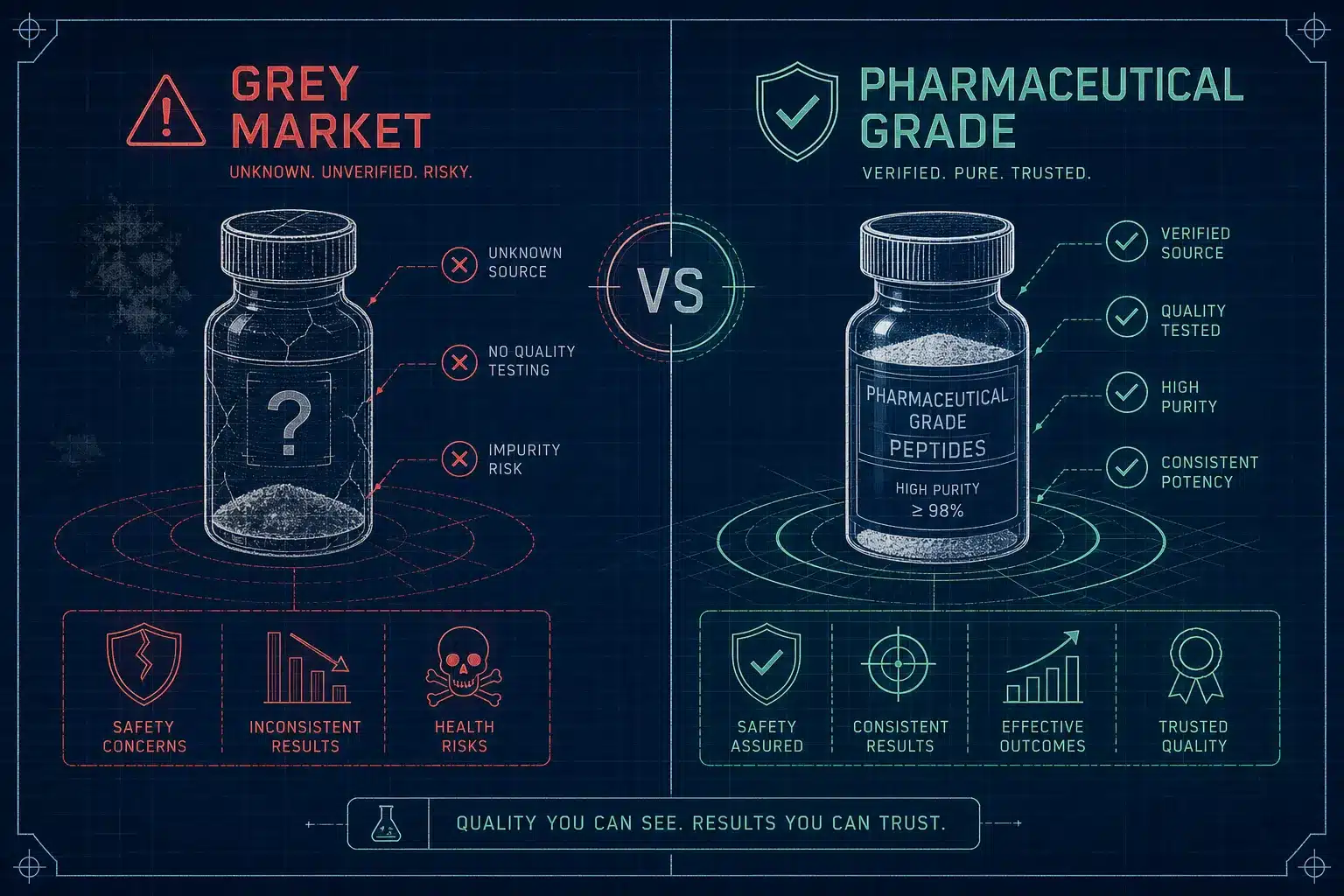
Grey market vs pharmaceutical grade peptides explained for researchers starts with a single question: what actually sits behind a purity claim? A pharmaceutical-grade peptide vial can cost several times more than a grey market equivalent, yet both may carry an identical “≥98% purity” label. That number sounds reassuring until you ask which analytical methods were used, who ran the tests, and whether the documentation connects to the specific lot you’re holding. For researchers making sourcing decisions, closing that gap in understanding is more valuable than any marketing label.
R-Peptide Supply, operating as Grey Peptide Shop, has built its sourcing model around exactly this question, because researchers who know what documentation to demand push better transparency across the entire supply chain. This article walks through the regulatory definitions, manufacturing controls, analytical testing standards, COA evaluation criteria, and cost tradeoffs that actually determine whether a peptide purchase is defensible, or just cheap.
What “grey market,” “research grade,” and “pharmaceutical grade” actually mean in the U.S.
None of these three terms are formal FDA legal categories. The FDA distinguishes approved drugs, compounded preparations, and research chemicals. “Grey market,” “research grade,” and “pharmaceutical grade” are industry shorthand, and understanding what they signal, and what they don’t, is where a sound procurement decision starts.
The RUO label: a use restriction, not a quality guarantee
“Research use only” tells you the vendor’s claimed intended use, not that the product passed any clinical-level review. Grey market and research-grade peptides are sold legally in the U.S. under this framing, but the label provides no FDA oversight of manufacturing controls, sterility, or purity methods. A vial stamped RUO could have been produced in a tightly controlled environment with full batch documentation, or it could have been synthesized and packaged with minimal analytical verification. The label itself tells you nothing about which scenario applies.
What “pharmaceutical grade” actually requires in practice
In everyday U.S. usage, “pharmaceutical grade” describes a peptide produced under recognized quality systems appropriate for human medicine: GMP manufacturing, ICH Q7-aligned controls for API production, batch traceability, validated analytical methods, and documentation suitable for a licensed compounding pharmacy or regulated drug product. It is a set of controls, not a single certificate. Importantly, “pharmaceutical grade” is also not a precise statutory term in FDA law. The legal status of any specific peptide depends on whether it is an FDA-approved drug, a compounded preparation, or something else entirely.
The practical contrast across the three designations breaks down as follows:
- Grey market products occupy a legal space that bypasses standard medical channels with minimal manufacturing oversight.
- Research-grade products carry use restrictions but no guarantee of clinical-level quality review.
- Pharmaceutical-grade products are subject to the documentation, sterility, and quality controls appropriate for human medicine.
Each carries a different risk profile, and matching that profile to the experimental context is the researcher’s responsibility.
Grey market vs pharmaceutical grade peptides explained for researchers: manufacturing controls
The single biggest gap between these two categories is not the peptide itself. It is the environment it was made in and the documentation trail that followed it from synthesis to vial. That distinction matters more than any purity percentage printed on the label.
GMP manufacturing: what it requires and why it matters
GMP-compliant peptide production operates under controlled facilities, validated equipment, trained personnel, environmental monitoring, and process documentation. ICH Q7 governs APIs produced this way. The common purity target for a first GMP lot is greater than 97% by HPLC, with no single impurity exceeding 1%. These aren’t arbitrary targets. They exist because injectable or clinically administered compounds have very low tolerance for structural variants or microbial contamination. The GMP framework also requires batch traceability, validated analytical methods, and quality-unit independence from production, so rejection decisions aren’t influenced by manufacturing pressure.
How grey market peptides are typically synthesized and tested
Most grey market research peptides, including research chemicals peptides sold through online storefronts, are synthesized by overseas contract manufacturers in lower-cost jurisdictions and often lack the same validated process documentation chain as GMP facilities. That doesn’t automatically mean lower quality, but it does mean the buyer carries more of the verification burden. Without batch-specific testing from an independent lab, there is no way to confirm what a “99% purity” claim actually measured or how the impurity profile was characterized. The absence of GMP controls doesn’t make a peptide unusable for research. It does mean the researcher needs to treat the COA as a starting point rather than a conclusion.
Sterility and endotoxin: the dimension HPLC doesn’t cover
A peptide can be chromatographically pure and still present a sterility or endotoxin risk. Pharmaceutical-grade injectables require sterility testing and bacterial endotoxin testing as separate, independent controls. Sterility and endotoxin data are commonly missing from grey market peptide COAs, which matters significantly if the research protocol involves injection. Purity testing alone does not establish that a product is safe to inject. This is the most frequently absent field in grey market documentation, and it carries the highest safety consequence of any omission.
The analytical tests that define peptide quality
Knowing which tests a supplier ran, and which ones they skipped, is how you interpret any purity claim. HPLC alone is not a complete quality picture, and a COA that only reports a single purity percentage is telling you less than it appears to.
HPLC purity: what the percentage tells you (and what it doesn’t)
Reversed-phase HPLC separates a peptide from related impurities and quantifies them by peak area. It is the standard first-line method for relative purity, and a minimum threshold of ≥98% is the common supplier benchmark, with ≥99% increasingly preferred for higher-confidence research workflows. What HPLC cannot do is confirm molecular identity. A structurally incorrect peptide can still return 99% purity on an HPLC trace. That’s why HPLC must be paired with a complementary identity method to mean anything reliable. A purity number without an identity confirmation is an incomplete answer. For a peer-reviewed discussion of orthogonal analytical approaches that support identity and purity assessments, see this review of peptide analytical methods.
LC-MS and MS/MS: confirming you have the right molecule
Liquid chromatography-mass spectrometry confirms the intact molecular mass and, with MS/MS fragmentation, can verify sequence and flag modifications or substitutions. This is the most important identity confirmation method for any research peptide. When a supplier’s COA includes HPLC purity alongside an LC-MS or LC-MS/MS result, that combination covers both the purity and identity dimensions adequately for most standard research applications. Without the mass spectrometry component, the COA leaves identity unconfirmed regardless of what the purity number says. For a focused comparison of HPLC and LC‑MS approaches applied to peptides, see this practical resource on HPLC vs LC‑MS for peptides.
When amino acid analysis and sequencing add value
Amino acid analysis hydrolyzes the peptide and measures molar composition. It is useful for content verification and as an orthogonal check, but it destroys the sample and doesn’t confirm sequence order. Full MS/MS sequencing is most valuable for novel, long, or heavily modified peptides where single-residue substitutions would be invisible by intact mass alone. For most standard research peptides, HPLC plus LC-MS is the practical minimum that supports a defensible sourcing decision.
How to evaluate a COA and spot supplier red flags
A COA is only as useful as the batch-specific data it contains. Generic certificates that don’t tie directly to a lot number tell you almost nothing about the material you actually received.
What a legitimate batch-specific COA includes
A credible COA names the peptide, lists the lot or batch number, states the testing date, identifies the testing laboratory (ideally a named third party), and presents numerical results for at minimum HPLC purity and mass confirmation. The batch number on the COA should match what’s printed on the vial label. If it doesn’t, that’s a rejection trigger, not a minor clerical issue. Supporting chromatograms or spectra data strengthen the COA further, because they allow a researcher to assess whether the analytical work was actually done rather than simply reported.
Red flags that indicate a problematic supplier
Watch for COAs with no named laboratory, a single generic purity number with no supporting chromatogram, certificates reused across multiple batches, vague language like “high purity” without a percentage, or documentation that can’t be traced after purchase. Absence of mass spectrometry results is particularly concerning, it suggests identity was never independently confirmed. A supplier that resists providing batch-specific documentation before purchase is telling you something important about their quality program.
Independent verification: when to test before you trust
For high-value experiments, critical data workflows, or first-time supplier relationships, sending a retained sample to an external analytical lab for HPLC and LC-MS verification before use is the most reliable risk-reduction step available. It adds cost and time upfront, but it eliminates the guesswork that comes with unverified documentation. For research that will generate data used in publications or downstream decisions, that investment is hard to argue against.
Pricing, legal context, and when grey market peptides fit research
The price gap between grey market and pharmaceutical-grade peptides is real and significant. Branded pharmaceutical tirzepatide has carried a U.S. list price in the range of roughly $1,000, $1,400 per month without insurance coverage, figures widely reported in pharmaceutical pricing coverage through 2025. Grey market research peptides for the same compound are available at a fraction of that figure. Understanding what drives that gap, and what risk it transfers to the buyer, makes for a more defensible sourcing decision.
Why pharmaceutical grade costs more and when that premium is justified
GMP manufacturing, validated methods, sterility testing, endotoxin testing, and the documentation chain behind a pharmaceutical-grade peptide all carry real costs. That premium is justified when the research protocol involves human subjects, regulated workflows, or injectable administration where sterility and endotoxin data are non-negotiable requirements. For in-vitro binding studies, early-stage compound screening, or non-sterile research applications, that cost differential may not purchase meaningfully better research data. The question to ask is whether the additional controls are relevant to the specific experimental context, not whether pharmaceutical grade is always better in the abstract.
Legal and data-integrity considerations for grey market sourcing
Grey market peptides sold as “research use only” occupy a legal space that is not straightforwardly illegal in the U.S., but that space depends on the compound, the use, and how purchase decisions are documented internally. Labs should maintain supplier qualification records, lot-specific COAs, and receipt logs for every grey market purchase. That traceability is what separates defensible research sourcing from arbitrary procurement. Without a clear documentation chain, a grey market purchase creates data-integrity exposure that scales directly with how consequential the downstream research becomes.
Grey market suppliers that close the quality gap
Not all grey market suppliers treat documentation the same way. A subset of vendors have built sourcing and testing programs that meaningfully narrow the distance between grey market and pharmaceutical-grade quality expectations, without requiring the cost structure of GMP manufacturing.
What separates a quality-conscious grey market supplier from the rest
The differentiators are straightforward: batch-specific COAs from named third-party labs, HPLC plus mass spectrometry results on each product lot, clear lot number traceability between the COA and the vial, and documentation accessible before and after purchase. These aren’t pharmaceutical-grade controls, but they are the practices that make grey market sourcing auditable. A supplier who can answer “which lab ran this analysis and can I see the original report?” is operating at a different standard than one who can only point to a generic purity claim on a product page.
How R-Peptide Supply approaches COA transparency
high-purity grey market peptides and clear batch documentation are central to R-Peptide Supply’s model. Compounds including BPC-157, TB-500, Tirzepatide, IGF-1 LR3, Ipamorelin, and GHK-Cu are sourced with purity documentation that gives researchers a basis for evaluating what they’re working with before committing the compound to an experiment. For labs and resellers ordering bulk or multi-vial formats, that documentation chain is part of what makes wholesale sourcing from a quality-focused grey market vendor a workable option rather than a liability. Researchers are encouraged to request and review current batch COAs directly to confirm testing scope before purchase.
For teams considering larger purchases, see guidance on Buy Peptides in Bulk: Pricing, MOQs, and COA Checklist, Research Peptides Supply as well as the practical considerations documented in Buy Peptides in Bulk Online: The Complete Sourcing Guide, Research Peptides Supply.
A practical procurement checklist for grey market peptide sourcing
Before any purchase, confirm a named, verifiable supplier with a real business presence and accessible contact information. Require batch-specific COAs before acceptance, and verify that both HPLC purity and mass spectrometry identity confirmation are included in the documentation. Check that the lot number on the COA matches the vial label exactly. Retain documentation per lot for traceability, organized so any specific batch can be pulled and reviewed later. For experiments that generate critical data or feed into regulated workflows, budget for independent external verification of a retained sample. That single added step converts a sourcing decision from a matter of trust into a matter of verification.
The documentation habit that changes everything
Grey market vs pharmaceutical grade peptides explained for researchers comes down to three practical differences: manufacturing controls, documentation depth, and sterility data. The peptide sequence itself may be identical across both categories. For many research applications, a grey market peptide with a rigorous, batch-specific COA covering HPLC purity and LC-MS identity is a defensible sourcing choice, provided the researcher treats documentation evaluation as a required step rather than an optional one. For additional background on what grey market peptides are and common marketplace practices, see this primer on what are grey market peptides.
R-Peptide Supply has built its model around making that verification step easier, not harder. The goal isn’t to compete with pharmaceutical-grade on regulatory standing. It’s to give researchers the documentation they need to make an informed judgment about whether a grey market compound is appropriate for their specific protocol. That transparency is what distinguishes a serious supplier from a storefront that relies on researcher indifference.
When choosing reagents, keep the core framework in mind: grey market vs pharmaceutical grade peptides explained for researchers means verifying COAs, matching lot numbers, confirming analytical methods, and asking who ran the analysis. If the supplier can answer those questions with specifics, you have the foundation for a defensible sourcing decision. If they can’t, that gap in documentation is a signal worth taking seriously before the compound reaches your bench.