


Blog
Top Research Uses of BPC-157 Peptide Explained

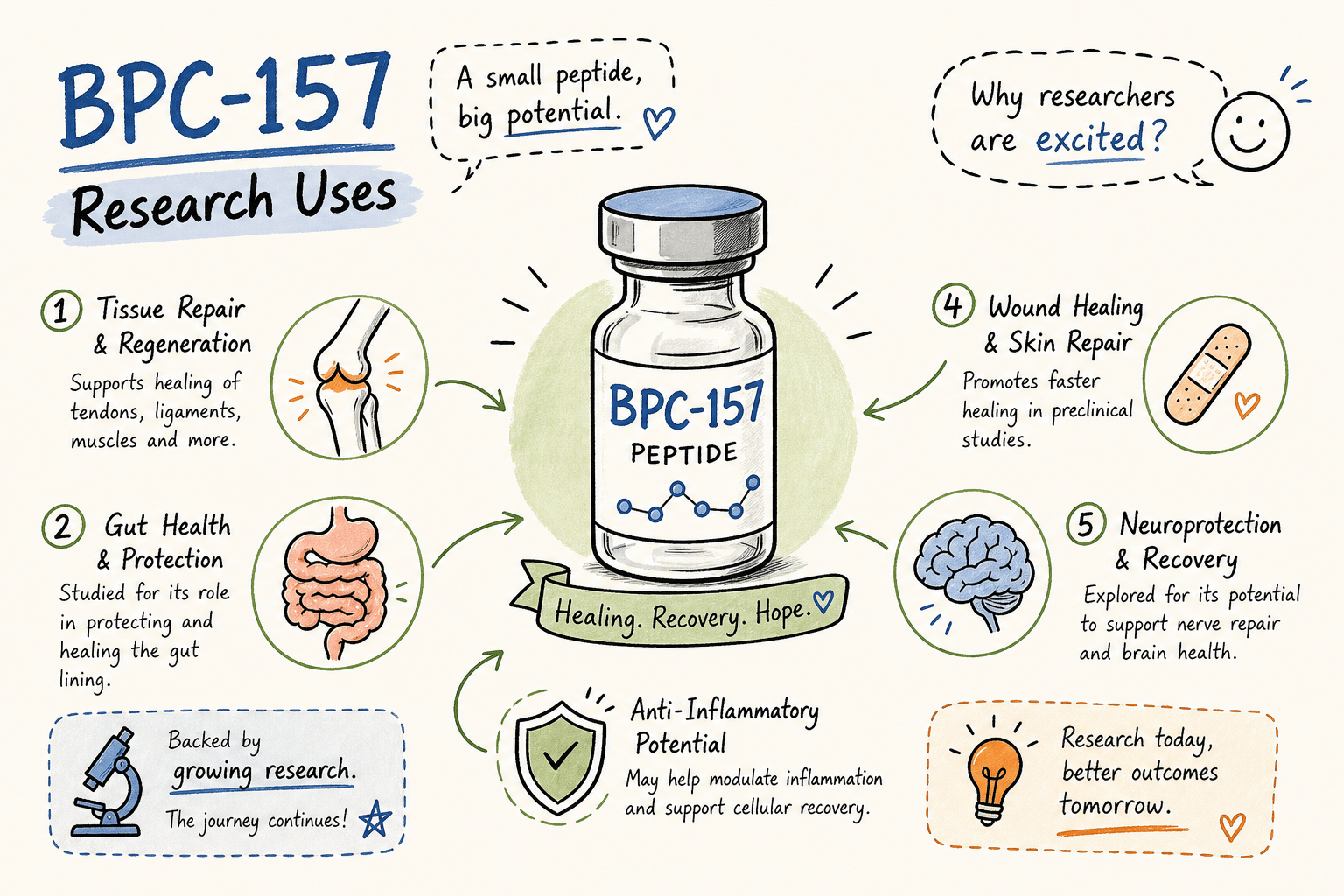
Researchers asking what BPC-157 peptide is used for in research will find an unusually broad answer: peer-reviewed animal studies span musculoskeletal repair, gastrointestinal biology, neuroprotection, and hemodynamic modulation, making this compound more versatile than most peptides still classified as research-use-only across every major jurisdiction. It has accumulated a substantial preclinical citation record, though precise bibliometric rankings vary by database and search parameters. Before designing a protocol around it, researchers need a direct account of which experimental applications have actually been tested and what the evidence says about each. This article provides that account, drawing on peer-reviewed animal model data, proposed biochemical mechanisms, and an honest assessment of where the human evidence falls short.
For biotech labs and preclinical researchers sourcing material for experimental use, compound quality matters as much as protocol design. COA-verified, HPLC-confirmed lyophilized vials are the baseline expectation. Any qualified supplier should meet that documentation standard, and R-Peptide Supply, as one example of a wholesale source operating to those requirements, offers COA-backed, HPLC-verified BPC-157 at bulk pricing. The six sections below cover the peptide’s identity, its main research applications, proposed mechanisms, study design conventions, the current evidence gap, and the regulatory and sourcing considerations every lab needs to account for.
What BPC-157 is and why it draws research attention
Where the peptide comes from structurally
BPC-157 is a synthetic pentadecapeptide composed of 15 amino acids, derived from a portion of the human gastric protein Body Protection Compound, a naturally occurring protein found in gastric juice. Researchers became interested in whether isolating and synthesizing this fragment could amplify the cytoprotective effects observed in the parent compound under controlled experimental conditions. It carries no approved therapeutic indication in the US, EU, or UK, and is sold exclusively as a research-use-only (RUO) compound.
What makes it a compelling research candidate
Several properties make BPC-157 an attractive subject for multi-system preclinical research. It demonstrates biological activity across organ systems in animal models. Oral administration has been used successfully in animal studies, with some researchers attributing this to relative stability in the gastric environment, though primary pharmacokinetic data on this point remain limited. It also presents a favorable preclinical safety profile: no minimum toxic dose has been identified across species in single- or repeated-dose studies to date. That combination of systemic reach, route flexibility, and tolerability data gives researchers more design options than most research peptides offer.
What is BPC-157 peptide used for in research? Main applications studied in animal models
Tendon, ligament, and bone repair studies
The most documented BPC-157 research uses center on musculoskeletal repair. In Achilles tendon transection rat models, including studies using 72 Wistar Albino male rats, BPC-157 treatment produced improved Achilles Functional Index values at all measured time points, reduced myeloperoxidase (MPO) activity, decreased inflammatory cell influx, and increased vascular index compared to controls. Within a 10 to 14-day window, treated animals showed significantly greater failure load and tissue stiffness versus saline controls. The widely cited 2003 Staresinic et al. study in the Journal of Orthopaedic Research documented improvements in load-to-failure, load-to-failure per area, and Young’s modulus of elasticity in treated rats, and remains a primary reference for tendon repair data. Similar outcomes have been reported across IP, SC, IM, and oral gavage administration routes, a finding consistently noted as a practical design flexibility advantage in this literature.
Bone healing models show a parallel pattern. Enhanced osteoblast activity and improved consolidation have been reported in delayed bone union models, with accelerated fracture healing noted at bone-to-tendon junctions, an area typically limited by poor vascular supply. Krivic et al. (2006, 2008) provide supporting data on bone healing outcomes in relevant rodent models.
Gastrointestinal and wound healing models
BPC-157’s gastric origins made GI research an obvious first application. Animal studies have examined its effects on gastric ulcer healing, colocutaneous and gastrocutaneous fistula models, and alkali-burn wound models. A 2024 comprehensive review published in Current Pharmaceutical Design synthesized findings from more than 40 studies and confirmed BPC-157 effectiveness across wound healing applications involving multiple tissue types, including evidence of its ability to counteract bleeding disorders in animal models. The breadth of tissue types showing positive responses is part of what sustains ongoing research interest.
Neurological and systemic models
Animal studies have also examined BPC-157 in Parkinson’s disease-like and Alzheimer’s disease-like disturbance models, as well as hemodynamic collapse and multiorgan failure paradigms. These investigations explore whether the peptide’s systemic effects extend beyond tissue repair into neural and vascular protection. One useful entry point into this area is the work of Sikiric et al., whose group has published across several of these model types. All findings remain strictly preclinical, and the evidence base here is thinner than in the musculoskeletal and GI spaces, but the diversity of models tested reflects the scope of what researchers are actively investigating.
Proposed mechanisms researchers use to explain BPC-157’s effects
Angiogenesis, VEGF upregulation, and the EGR-1 pathway
The strongest mechanistic evidence centers on angiogenesis. A 2009 study in the Journal of Physiology and Pharmacology used crushed and transected muscle and tendon models and demonstrated via immunohistochemical analysis that BPC-157 increased VEGF, CD34, and FVIII-positive vascular elements in treated animals. A 2016 study confirmed VEGFR2 upregulation and activation of the VEGFR2-Akt-eNOS pathway in a rat hind limb ischemia model, with laser Doppler and histological data supporting accelerated blood flow recovery. One critical design note: the 2009 study found no direct angiogenic effect in cell cultures, suggesting the angiogenic mechanism requires an intact tissue environment. This distinction matters when researchers choose between in vitro and in vivo setups.
Nitric oxide modulation and cytoprotection
BPC-157 demonstrates selective effects on nitric oxide levels rather than simple suppression or enhancement. It counteracts NO over-release induced by L-arginine while simultaneously opposing free radical formation, a dual action reported in published preclinical literature, including work indexed in PubMed Central. Fourier transform infrared spectroscopy studies have recorded rapid changes in vessel wall lipid content and protein secondary structure within minutes of administration. This dual NO modulation helps explain both the vascular protective effects and the broader cytoprotective activity observed across tissue types in animal models.
FAK-paxillin signaling and fibroblast behavior
Tendon fibroblast studies provide the clearest cell-level picture of BPC-157’s connective tissue repair effects. These studies show dose-dependent fibroblast migration, increased cell survival under oxidative stress (H2O2 exposure), and upregulation of the focal adhesion kinase (FAK)-paxillin phosphorylation pathway. Increased growth hormone receptor (GHR) expression has also been documented in treated tissue. The FAK-paxillin pathway is now considered a primary driver of the peptide’s connective tissue repair activity and the most actionable mechanistic target for researchers building study rationales.
How preclinical BPC-157 studies are typically designed
Common species, injury models, and in vitro setups
Sprague-Dawley and Wistar Albino rats dominate the BPC-157 research record, with some dog and rabbit models appearing in earlier literature. Injury paradigms include Achilles tendon transection, hamstring strain, alkali-burn wounds, and surgically induced GI fistulas. In vitro setups using tendon fibroblast cultures allow researchers to isolate cell-level behavior, though as noted in the mechanisms section, some of the most important biological effects, particularly angiogenesis, only emerge in whole-tissue in vivo environments.
Administration routes and dose ranges used in studies
The four main administration routes across BPC-157 studies are intraperitoneal (IP) injection (used in most rodent models), subcutaneous (SC), intramuscular (IM), and oral gavage. Standard rodent doses are typically 10 mcg/kg body weight, with some protocols using 20, 40, or 50 mcg/kg for specific effect comparisons. Multi-route consistency in outcomes has been reported across several studies, though pharmacokinetic comparisons between routes remain limited in the published record. The one available human IV pilot study (Lee and Burgess, 2025) used infusions up to 20 mg in two healthy adults, representing the upper boundary of current human data.
What the preclinical data shows and where the human evidence falls short
The preclinical evidence base: what 30+ years of animal studies show
BPC-157 research spans from 1993 through 2026, giving it an unusually long preclinical track record for a peptide still classified as investigational, though the most comprehensive synthesis available remains the 2024 Current Pharmaceutical Design review. Across dozens of rodent studies, findings are broadly consistent: accelerated tissue repair, reduced inflammatory markers, measurable angiogenic activity in vivo, and a favorable safety profile. That 2024 review, covering 40-plus studies, reinforces the strength of the preclinical case for musculoskeletal and GI applications in particular.
The human clinical trial gap
The human data is sparse and methodologically limited. The most frequently referenced human evidence is a retrospective case series of 12 patients with chronic knee pain who received intraarticular BPC-157 injections; seven of the 12 (58%) reported pain relief lasting more than six months. A 2025 IV safety pilot by Lee and Burgess enrolled two healthy adults and documented no adverse effects on cardiac, liver, kidney, or thyroid biomarkers at doses up to 20 mg. No large randomized controlled trials or Phase II/III data exist. A Phase I trial registered as Bepecin in 2015 published no outcomes. Researchers writing grant proposals or ethics applications need to account for this gap directly rather than extrapolating from animal data.
Key research gaps worth flagging
Three unknowns stand out as priorities for future study design. Long-term safety in humans remains completely undocumented. The theoretical oncological risk from chronic angiogenesis promotion has not been observed in animal models but has not been formally ruled out in humans. No standardized dosing protocol for human studies exists, which limits cross-study comparison even as more pilot data accumulates. Integrating at least one of these constraints into a new study rationale is increasingly expected by ethics reviewers.
Safety signals, regulatory classification, and sourcing for lab use
What the toxicology data actually shows
Preclinical toxicology data for BPC-157 is consistently favorable across species. No minimum toxic dose or lethal dose has been identified, and no genotoxicity, teratogenicity, anaphylaxis, or local toxicity has been reported in single-dose or repeated-dose studies (though specific dose ranges and species tested vary across individual publications). A reversible creatinine decrease at high doses resolved after a two-week withdrawal period and was absent at standard experimental doses. In limited human reports, only mild and transient effects, headaches, nausea, injection site reactions, have been noted. The absence of serious signals is encouraging, but the absence of long-term human data means the safety picture remains structurally incomplete.
Regulatory status across jurisdictions
The regulatory picture is consistent across major jurisdictions: BPC-157 is not approved for human therapeutic use anywhere. The FDA added it to the Category 2 bulk drug substance list in late 2023, citing significant potential safety risks and insufficient clinical data, which bars compounding pharmacies from using it. The EMA has issued no marketing authorization, and the UK MHRA classifies it as research-only under the Human Medicines Regulations 2012, without treating it as a controlled substance under the Misuse of Drugs Act. WADA bans it under the S0 class (non-approved substances). The ban applies both in-competition and out-of-competition, with no threshold exemptions. The research-use-only framing is both a legal compliance requirement and an accurate description of where the evidence currently stands.
What labs should prioritize when sourcing BPC-157 vials
For any experiment to produce reproducible, defensible data, the compound sourced must be documented and verified. COA confirmation with lot number traceability, HPLC purity data, and vendor accountability are non-negotiable starting points, and these standards apply to any qualified supplier, not one in particular. Unregulated sourcing introduces contamination and mislabeling risk that directly compromises data integrity. BPC-157 (5mg / 10mg) (10 Vail), Research Peptides Supply BPC-157 Peptide is one example of a COA-backed, HPLC-verified product listing that illustrates the level of documentation labs should demand. For researchers who need consistent, traceable material as the foundation of a valid protocol, meeting that sourcing standard is the practical baseline, not an optional extra. Laboratories planning combination protocols may also consider vendor listings for Buy BPC 157 and TB500, Research Peptides Supply where combo formulations are documented for research use.
Putting it all together
BPC-157 is a structurally stable synthetic pentadecapeptide with broad preclinical activity across musculoskeletal repair, gastrointestinal healing, and neuroprotective models. Its primary documented mechanisms involve angiogenesis through VEGF and VEGFR2 upregulation, dual nitric oxide modulation, and FAK-paxillin-driven fibroblast behavior. The preclinical evidence base is deep and spans more than three decades. The human evidence base is thin, with no randomized controlled trial data and no approved therapeutic indication in any jurisdiction.
Understanding what BPC-157 peptide is used for in research points clearly to a compound with well-documented preclinical activity and an unresolved path to human validation. Researchers who want to contribute meaningfully to that record need two things before anything else: a protocol that accounts for the in vitro limitations of angiogenic mechanisms, and compound material documented to a standard that withstands methodological scrutiny. The more pressing question now is how to design the human studies that close the evidence gap, and that work starts with getting sourcing and documentation right from the beginning. For a concrete example of a bulk supplier listing consistent with these documentation expectations, see the supplier product listing for BPC-157 (5mg / 10mg) (10 Vail), Research Peptides Supply BPC-157 Peptide.