


Blog
BPC-157 Peptide: What It Is and How Researchers Use It

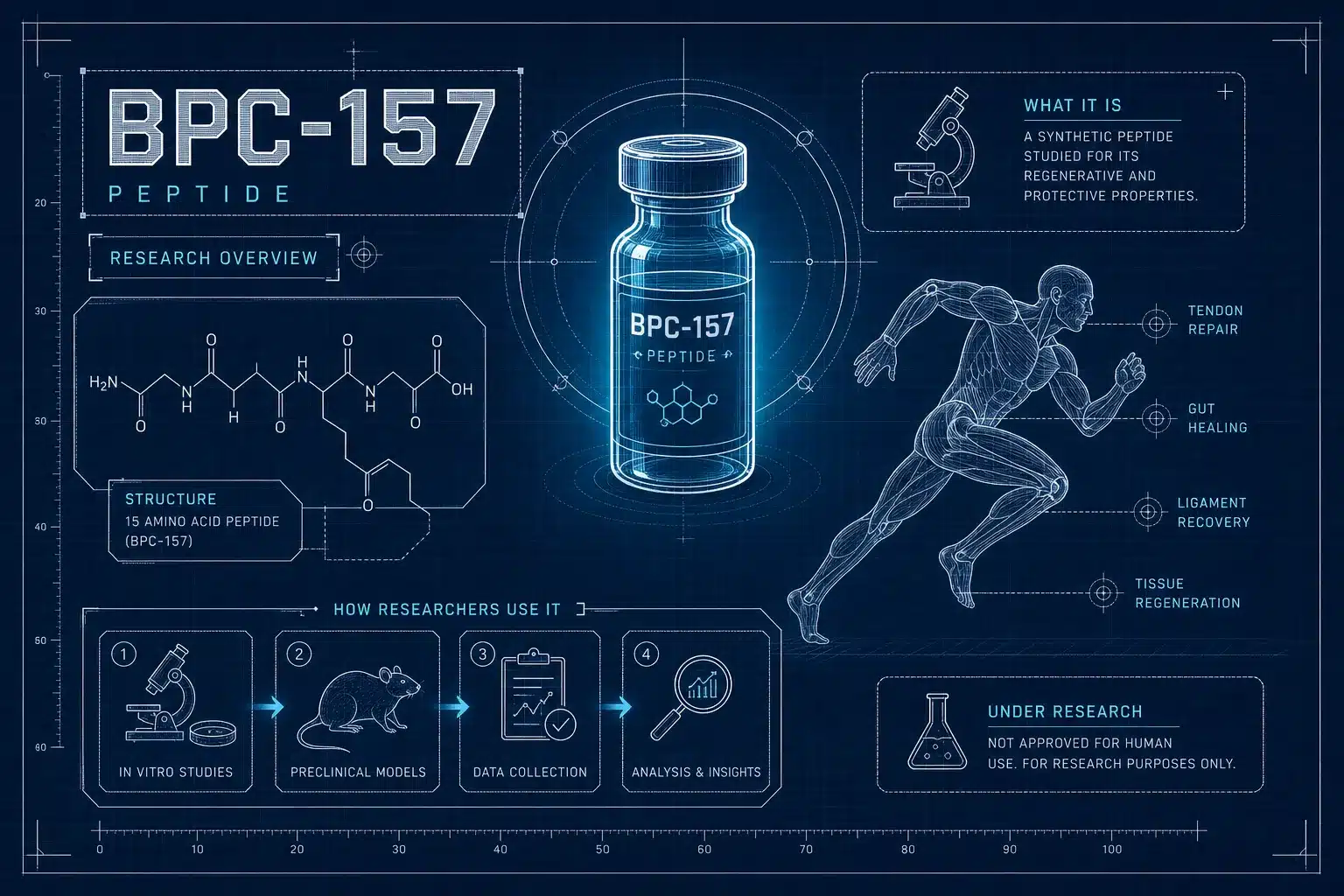
What is BPC-157 peptide and how is it used in scientific research? Those two questions appear together more often in lab procurement discussions than almost any other synthetic peptide, and for a measurable reason: a systematic review of 35 independent animal studies documented consistent improvements across tendon, muscle, ligament, and bone models, an unusual degree of cross-tissue reproducibility for a compound still in preclinical development. That consistency draws attention from researchers working in musculoskeletal repair, regenerative biology, and related fields. Understanding what this compound actually is at the molecular level, how it behaves in controlled experimental settings, and where the evidence genuinely ends is essential before designing any protocol around it.
This is a research-use-only peptide with no FDA-approved human application. It is studied in controlled laboratory settings, not prescribed clinically. Researchers procuring it for experimental work typically source it through wholesale suppliers who provide verified Certificate of Analysis (COA) documentation, and that supply chain integrity matters as much as the science itself. R-Peptide Supply stocks research-grade BPC-157 in multi-vial formats with lot-traceable COAs for research and reseller procurement.
This article covers what BPC-157 is at the molecular level, what the preclinical data actually shows across tissue models, how researchers structure their experiments, and where the translational gaps remain. If you are evaluating this compound for a research protocol, this is the foundation you need.
What Is BPC-157 Peptide and How Is It Used in Scientific Research: An Overview
Before diving into mechanisms and experimental design, it helps to answer the core question directly. BPC-157 is a synthetic 15-amino-acid pentadecapeptide derived from a sequence first identified in human gastric juice. In scientific research, it is used primarily in preclinical animal models to study tissue repair signaling, specifically in tendon, skeletal muscle, ligament, and bone. Researchers administer it via intraperitoneal injection, subcutaneous delivery, oral gavage, or local application, depending on the experimental model. The compound is not approved for human use, so all current research activity occurs under research-use-only (RUO) conditions in laboratory settings.
BPC-157 peptide classification and molecular profile
BPC-157 is a synthetic pentadecapeptide, a 15-amino-acid chain with the sequence Gly-Glu-Pro-Pro-Pro-Gly-Lys-Pro-Ala-Asp-Asp-Ala-Gly-Leu-Val. Its formal designation is Body Protection Compound. Its documented chemical formula is C₆₂H₉₈N₁₆O₂₂, with a molar mass of 1419.556 g/mol and CAS number 137525-51-0. These identifiers are confirmed across PubChem and GenScript’s peptide catalog and serve as the standard reference points for sourcing and documentation.
The discovery timeline starts with Predrag Sikiric, who hypothesized in 1975 that the stomach produces a substance to counteract stress-induced damage. By 1989, his team had formally identified the peptide sequence from human gastric juice. One important caveat circulates in the literature but rarely gets enough attention: the full amino acid sequence of the parent protein was never publicly disclosed, which puts the “natural origin” framing on uncertain ground. Current production is entirely synthetic via solid-phase peptide synthesis, not extracted from any biological source.
How BPC-157 differs from other research peptides
Comparing BPC-157 to other commonly researched peptides helps position it accurately. TB-500 is a thymosin beta-4 fragment with distinct tissue-protective mechanisms; GHK-Cu is a copper-binding tripeptide primarily studied in skin and wound-healing contexts. BPC-157 is longer, fully synthetic, and its primary research focus is musculoskeletal repair signaling. Unlike growth hormone secretagogues such as Ipamorelin or Hexarelin, there is no clear evidence in the preclinical literature that BPC-157 acts as a growth-hormone secretagogue. Its primary reported effects center on direct tissue-level repair cascades rather than pituitary stimulation. For a concise primer on the major laboratory applications and experimental contexts where BPC-157 appears most often, see the overview of Top Research Uses of BPC-157 Peptide Explained.
Regulatory and classification status
The regulatory picture is worth stating directly. BPC-157 is not approved for human use by any drug regulatory agency, including the FDA. It appears on WADA’s S0 “unapproved substances” list, meaning it is prohibited in competitive sport regardless of route or dose. It is sold exclusively as a research-use-only compound. That classification governs how labs document procurement, storage, and experimental use in their internal protocols.
What the preclinical evidence shows across tissue types
The most comprehensive preclinical summary currently available is a systematic review of 35 animal studies (Sikiric et al., all rated at Level IV or V evidence), which documented consistent improvements in functional recovery, biomechanical strength, and tissue organization across four primary tissue categories: tendon, skeletal muscle, ligament, and bone. That cross-model consistency is what keeps this compound on researchers’ procurement lists.
The most cited individual study in this body of literature is Cerovecki et al. (2010), published in the Journal of Orthopaedic Research (Vol. 28, No. 9). That team demonstrated improved MCL healing in rats via intraperitoneal, topical, and oral gavage administration routes, with consistent improvements in biomechanical properties and collagen organization across all three delivery methods. The cross-route efficacy finding is notable because it suggests the compound’s activity is not route-dependent in the way many peptides are; see the original Journal of Orthopaedic Research report for details.
Tendon and musculoskeletal regeneration findings
Tendon transection models, particularly Achilles tendon studies in rats, show the most concentrated evidence base. BPC-157-treated animals demonstrate improved load-to-failure metrics, organized collagen deposition, and faster functional recovery compared to controls. Upregulated VEGF expression is also consistently documented and aligns with the angiogenic mechanism described in the following section. Fibroblast proliferation and survival under oxidative stress conditions are documented in related in vitro work, which tracks with the in vivo histological outcomes. Muscle crush and transection models show comparable patterns: reduced fibrosis, re-established myotendinous junctions, and improved motor function scoring.
It is worth being precise about where the evidence is thicker and where it is not. Gut and nerve data exist in the literature but are less concentrated than the musculoskeletal findings. Researchers designing protocols around BPC-157 will find the most robust preclinical support in tendon, ligament, and muscle applications.
What preclinical evidence does and doesn’t tell you
All 35 studies in the systematic review use animal models, primarily rodents. No human randomized controlled trials have been completed and published. That is the evidence ceiling, and it matters for how you interpret every positive finding. No lethal dose has been reported in preclinical protocols, and no systemic toxicity was observed across the study set, findings documented in the systematic review itself, which is why the compound remains active in research pipelines despite the translational gap. The absence of observed toxicity in rodent models does not, however, establish clinical safety for humans.
How BPC-157 is used in scientific research: proposed mechanisms and molecular evidence
BPC-157 does not operate through a single signaling pathway. Its proposed actions span overlapping repair cascades simultaneously, which is both what makes it mechanistically interesting and what complicates clean attribution of any single effect. Four primary mechanisms have molecular evidence behind them: VEGF-driven angiogenesis, nitric oxide system modulation, growth factor upregulation (EGR-1, FGF), and Type I collagen synthesis via fibroblast activation.
Angiogenesis and the VEGFR2-Akt-eNOS pathway
BPC-157 upregulates VEGFR2 expression at the mRNA and protein level without increasing VEGF-A ligand expression, which sensitizes endothelial cells to angiogenic stimuli. Following VEGFR2 upregulation, the compound triggers VEGFR2 internalization, activating sequential phosphorylation of Akt and eNOS and ultimately producing nitric oxide. In chick chorioallantoic membrane assays, BPC-157 significantly increased vessel density; see experimental angiogenesis methods for analogous assay context in the literature reports. In rat hind limb ischemia models, laser Doppler scanning confirmed accelerated blood flow recovery and increased vessel number in treated tissue.
A mechanistically important finding worth highlighting: BPC-157 shows no direct angiogenic effect in isolated cell culture. The activity appears at the tissue or systemic level in vivo, not through simple receptor binding in a dish. This distinction matters for model selection, researchers running cell-based assays alone will not capture the compound’s angiogenic profile and need to account for that gap in experimental design.
Collagen synthesis, FAK-paxillin, and fibroblast activation
BPC-157 activates the FAK-paxillin cell adhesion pathway and promotes fibroblast survival under the oxidative stress and hypoxic conditions that characterize injured tendons and ligaments. The histological outcomes researchers measure downstream of this activation are consistent: increased Type I collagen deposition, reduced fibrosis, and faster restoration of organized tissue architecture at injury sites. EGR-1 upregulation, a transcription factor associated with tendon cell identity, is also documented in BPC-157-treated tissue and adds specificity to the fibroblast activation picture.
How researchers design BPC-157 experiments: models, routes, doses, and endpoints
The most common administration routes in published BPC-157 animal studies are intraperitoneal injection, subcutaneous delivery, oral gavage, and intravenous bolus or infusion. Local application directly to the injury site has also been used, as in the Cerovecki topical arm. The cross-route consistency documented in that study gives researchers flexibility in protocol design, though IP injection is the most frequently used route in rodent musculoskeletal models. For institutional guidance on procedural categorizations and best practices for different routes of administration, consult standard university research unit policies when designing animal protocols.
Dose ranges in rodent studies typically fall in the microgram-per-kilogram range. The most common reference dose for tendon and ligament healing protocols is 10 µg/kg daily, with published dose-ranging arms running from 0.01 µg/kg at the low end to 100 µg/kg at the high end. The effective injury-study range across mice, rats, and rabbits is broadly cited as 6 to 50 µg/kg. Cerovecki et al. confirmed efficacy at both 10 µg/kg and 10 ng/kg via IP and at lower topical and oral concentrations, supporting the view that BPC-157 maintains activity across a relatively wide dose range.
Treatment duration and endpoint selection
Short-term efficacy trials in published studies typically run 7 to 28 days. Biomechanical endpoints (load-to-failure, tensile strength) are paired with histological endpoints (collagen organization, fibroblast density, vessel count) and functional endpoints (motor testing, weight-bearing) to build a multi-dimensional outcome picture. Regulatory-facing toxicology studies extend to 90 days for Phase I support and up to nine months in non-rodent species for longer regulatory packages. Pre-registration of endpoints before any animal work begins is what separates data that can support translation from data that cannot.
Procuring research-grade BPC-157 for lab use
Before any experimental protocol begins, researchers need lyophilized BPC-157 with HPLC-verified purity and a COA traceable to a specific lot number. That traceability is what keeps procurement records defensible and reproducible across audit or replication scenarios. R-Peptide Supply offers research-grade BPC-157 in multi-vial bulk formats with lot-specific COA documentation, the standard documentation chain labs and resellers need for compliant procurement records.
Reconstitution with bacteriostatic water is the standard preparation step prior to administration, and lyophilized vials require cold-chain storage to maintain peptide integrity. Ancillary supplies, bacteriostatic water and acetic acid water, are stocked alongside peptide vials at R-Peptide Supply so researchers can fulfill the full workflow through one source.
What the human data actually says
The human clinical dataset for BPC-157 is thin, uncontrolled, and not sufficient to draw clinical conclusions in either direction. Three small studies constitute the published human record.
Lee and Padgett’s 2021 retrospective chart review covered 16 knee patients. At six to twelve months following intraarticular injection, 87.5% reported significant pain relief. There was no control group, no blinding, and no objective outcome measures.
Lee et al.’s 2024 intravesicular pilot covered 12 women with interstitial cystitis; 80 to 100% reported symptom resolution at six weeks, again without controls or blinding.
The 2025 IV safety pilot enrolled two healthy adults and reported no adverse events and no clinically meaningful changes in vitals, ECG, or labs, but generated no efficacy data.
An unpublished Phase I trial ran from 2015 to 2016 with 42 volunteers and was registered as completed, but results were never submitted for publication. That transparency gap is a legitimate limitation in assessing the compound’s human safety profile.
What these studies do and don’t establish
The absence of adverse events in a two-person IV pilot does not establish long-term safety, oncological risk profile, or efficacy for any indication. The FDA has stated it lacks sufficient information to determine whether compounded BPC-157 is safe for humans. A Phase II placebo-controlled trial targeting hamstring-strain recovery is registered as NCT07437547 on ClinicalTrials.gov, with enrollment underway as of early 2026 and primary completion expected in 2027. It is the most structured trial currently in the pipeline, but no published results exist as of mid-2026.
Safety concerns, translational gaps, and responsible research framing
Three major concerns define the current safety picture for the research community. First, long-term oncological safety data does not exist; tumor promotion and metastasis risk in humans have not been studied. Second, the FDA’s position is explicit: insufficient data to determine safety for human compounding. Third, unregulated synthesis pipelines introduce manufacturing quality risk that verified-COA sourcing reduces but does not eliminate.
The translation challenge from rodent to human is also unresolved. Allometric scaling from microgram-per-kilogram rodent doses to human equivalent doses involves significant uncertainty, and no validated pharmacokinetic model for BPC-157 in humans has been published. Researchers designing protocols need to hold that uncertainty clearly in their methodology sections.
Where BPC-157 research legitimately stands as of mid-2026: compelling preclinical data across multiple tissue models, a mechanistically interesting multi-pathway profile, and a human evidence base that cannot yet support clinical claims in either direction. That is an honest summary, and it is the frame that keeps research programs credible.
Responsible framing for ongoing research
Responsible preclinical work with this compound starts with verified-purity sourcing, COA traceability by lot number, pre-registered study designs, and clear RUO documentation throughout the research record. The gap between preclinical findings and clinical validation is the defining challenge for BPC-157. Rigorous experimental design is what bridges that gap with any scientific integrity. Researchers who treat sourcing quality as a secondary concern are building on an unstable foundation regardless of how well the downstream assays are designed.
Closing thoughts on BPC-157 as a research compound
BPC-157 is a synthetic pentadecapeptide with a well-documented preclinical profile and a mechanistically plausible multi-pathway repair signature. The consistent findings across tendon, muscle, ligament, and bone models in rodents, captured across a 35-study systematic review, represent a genuine body of evidence. The human data, by contrast, is not yet sufficient to draw clinical conclusions, and honest engagement with that gap is what separates rigorous research from unfounded claims.
Understanding what is BPC-157 peptide and how it is used in scientific research ultimately comes down to holding two things simultaneously: respect for what the preclinical data actually shows, and clarity about where that data stops. For labs and resellers building serious protocols around this compound, that starts with verified sourcing with traceable documentation, proper reconstitution and cold-chain handling, and pre-registered endpoint selection before any animal work begins. R-Peptide Supply stocks research-grade BPC-157 with HPLC-verified purity and lot-specific COA documentation, alongside ancillary supplies for the full reconstitution workflow; see the full research overview for further background on the molecule and its laboratory applications What Is BPC-157 Peptide? A Complete Research Overview.
That foundation, understanding exactly what the compound is, what the current preclinical evidence does and does not support, and what responsible sourcing looks like, is where every credible research program on BPC-157 begins.