


Blog
AOD-9604 Peptide for Sale: Purity, Pricing, and Vendors

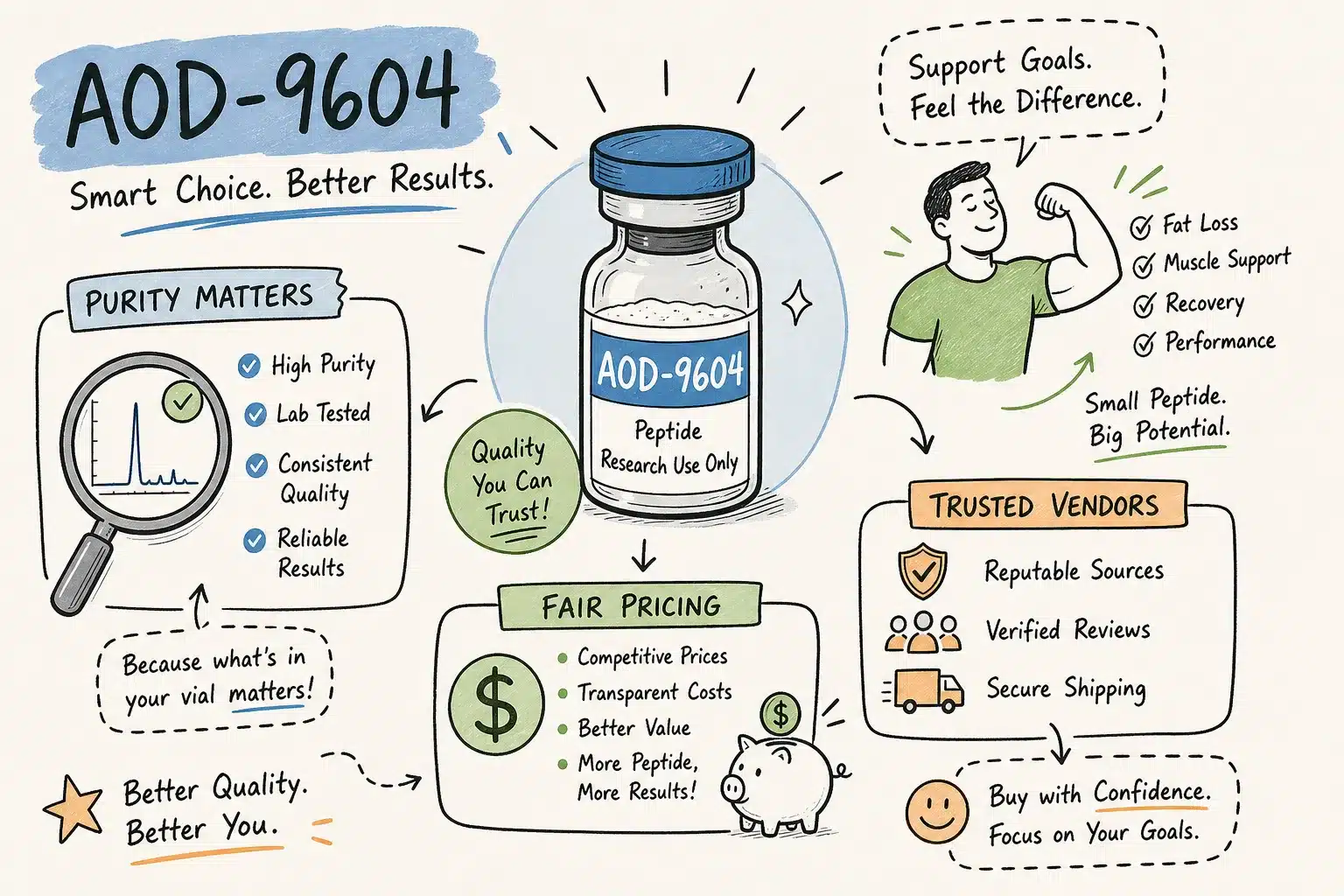
If you’re sourcing aod 9604 peptide for sale for laboratory research, the core question isn’t price, it’s documentation. AOD-9604 keeps showing up on researcher procurement lists for a straightforward reason: it isolates the lipolytic activity of human growth hormone without triggering the metabolic complications tied to full-length HGH. It targets fat metabolism through a mechanism independent of IGF-1 signaling, which makes it a structurally distinct and research-worthy compound. That narrow specificity is exactly what draws scientists to it, and vendor activity in the grey market peptide supply space has expanded considerably in 2026, making careful sourcing more important than ever.
That expansion has made sourcing more complicated. More vendors means more variation in documentation quality, purity standards, and regulatory awareness. Evaluating an AOD-9604 listing today requires the same rigor you bring to any other step in your research workflow. This article walks through the compound’s mechanism, its legal status, what credible product documentation looks like, realistic pricing, and how to identify a vendor worth trusting. R-Peptide Supply maintains lot-traceable COA documentation in this category, which gives researchers a useful baseline for comparison.
What AOD-9604 is actually used for in research
AOD-9604 is a synthetic peptide derived from the C-terminal end of human growth hormone, specifically the 176, 191 amino acid sequence, engineered to isolate the lipolytic domain of HGH. The modification it carries (tyrosine substituted at the N-terminus instead of phenylalanine) improves stability without changing the core function: stimulating fat breakdown and inhibiting fat storage. It does not bind to growth hormone receptors on hepatocytes in a way that activates JAK2/STAT5 signaling, which means it does not drive IGF-1 production or disrupt glucose metabolism.
The lipolytic mechanism researchers are studying
In adipose tissue, AOD-9604 has been reported to interact with beta-3 adrenergic receptors on fat cells, though the precise mechanism, direct agonism versus upregulation of receptor expression, remains under investigation in the literature. This interaction triggers an adenylyl cyclase cascade that raises intracellular cAMP levels, which in turn activates hormone-sensitive lipase and breaks down stored triglycerides into free fatty acids and glycerol. Some research also points to AMPK pathway involvement, which would amplify the lipolytic signal over time. The compound’s functional independence from the GH-IGF-1 axis is what makes it relevant for fat metabolism studies that need to operate outside of growth hormone’s broader systemic effects.
What the human trial data actually shows
The clinical picture is worth understanding clearly before procurement. AOD-9604 completed six randomized, double-blind, placebo-controlled trials involving more than 900 participants, with zero serious adverse events attributed to the compound. Its safety profile was statistically indistinguishable from placebo across all six studies. However, the Phase 2b obesity trial did not meet its primary weight-loss endpoint, and a 12-month fat-loss study also showed no significant difference from placebo. For researchers, the safety data is directly useful for establishing tolerance baselines; the efficacy question remains open in the literature, which is part of why research-use interest in the compound persists. For a concise summary of clinical safety findings, see the AOD-9604 safety profile review from BHR Center AOD-9604 safety profile: what clinical trials show.
How AOD-9604 compares to HGH Fragment 176-191
These two compounds are closely related but not interchangeable, and the distinction matters in practice. HGH Fragment 176-191 represents the raw C-terminal sequence of growth hormone starting with phenylalanine at the N-terminus. AOD-9604 substitutes tyrosine at that same position, which introduces a hydroxyl group on the aromatic ring and improves peptide stability under enzymatic exposure and pH variation. That single substitution may influence stability and handling considerations, though direct pharmacokinetic comparisons remain limited in the published literature.
Structural differences and what they mean in practice
In supplier catalogs and community forums, the two peptides often appear side by side or are described as near-equivalents. They are not. AOD-9604’s tyrosine modification gives it a more stable structure; this substitution also underpins much of the post-2010 research literature that preferentially uses AOD-9604 due to reported stability improvements. HGH Fragment 176-191 has a longer track record in animal model studies but less recent clinical-stage data. If a research protocol specifies one compound, substituting the other requires formal justification, not just convenience.
Which compound fits which research context
Labs focused on current fat metabolism literature will generally work with AOD-9604. Labs referencing older preclinical animal model data may find HGH Fragment 176-191 more directly relevant to their cited methodology, researchers should consult representative studies to confirm which fragment aligns with their protocol. For labs running comparative studies between the two, or maintaining flexibility across multiple active projects, sourcing both from a single verified supplier is the efficient solution. R-Peptide Supply carries both compounds with documented COAs, which matters specifically for researchers who need to confirm distinct lot numbers and purity percentages for each. For broader procurement strategy and documentation expectations, see the guide on research peptides for sale: categories, COAs, and pricing.
The 2026 legal landscape for AOD-9604 in the U.S.
AOD-9604 occupies a genuine regulatory gray zone as of mid-2026, and the details are worth understanding precisely. In April 2026, HHS formally removed AOD-9604 from the FDA’s Category 2 list, which had previously flagged it as a significant safety risk for compounding purposes. That removal is a meaningful regulatory step, but it is not authorization. The compound has not been recategorized to Category 1, which is what would permit licensed compounding pharmacies to work with it under Section 503A. AOD-9604 was not included on the July 2026 PCAC meeting agenda and remains pending further evaluation; final Federal Register publication, the step that actually changes legal compounding status, is not expected before 2027 according to most regulatory analysts.
What “research use only” labeling actually means
RUO labeling is a regulatory designation, not a technicality. A product marked “for research use only, not for human consumption” is explicitly not validated for clinical or diagnostic use, and it must not be administered to patients or used in any patient care context. The FDA does not assess intended use solely based on what a label says; it looks at the full picture of vendor communications, including website copy, customer support messaging, and marketing content. Vendors who frame RUO peptides in therapeutic terms, even casually, create enforcement exposure for themselves and sourcing risk for their buyers. For background on RUO vs. regulated diagnostic designation, see the FDA documentation and guidance materials for how the agency evaluates product use and labeling FDA guidance document.
What this means for where and how you source
WADA has also banned AOD-9604 as a performance-enhancing substance, which is directly relevant for any researcher affiliated with a sports science institution or athletic organization. Sourcing from a vendor who documents lot numbers, publishes current COAs, and maintains RUO-compliant communications reduces your exposure on both the regulatory and institutional compliance sides. Unlicensed vendors operating without proper documentation occupy a higher-risk position, both for themselves and for the researchers they supply. For recent commentary on how FDA peptide policy and advisory meetings are evolving, including the July PCAC discussion, see the OpenLoop Health summary of the July 2026 PCAC peptide meeting FDA PCAC peptide meeting, July 2026 and the Hone Health analysis on shifting FDA peptide enforcement FDA peptide ban analysis.
Where to buy AOD-9604 peptide for sale: quality benchmarks and verification
HPLC-verified purity for research-grade AOD-9604 should be 98% or above, with 99% or higher being the standard among credible suppliers. Verified vendors in this space consistently report batch purity in the 99.2, 99.9% range. Third-party testing, meaning analysis conducted by an independent laboratory rather than the manufacturer’s own facility, adds a meaningful layer of accountability that internal COAs alone cannot provide.
Reading a COA correctly
A credible Certificate of Analysis for AOD-9604 must include five elements:
- An HPLC purity percentage tied to the specific batch
- Mass spectrometry confirmation of molecular identity
- A lot number that traces directly to the tested production run
- The date the analysis was conducted
- The name and accreditation details of the independent testing laboratory
Net peptide content should also be stated explicitly, since raw purity figures don’t always account for water and counterion weight. If a COA lacks a lot number, shows no testing date, or cannot be linked to the vial you’re actually receiving, treat it as unverified regardless of the purity figure printed on it. Generic COAs recycled across product listings are more common than buyers realize, and they’re a clear signal to move on.
Vial formats and storage specs to expect
Reputable research-grade suppliers sell AOD-9604 as lyophilized powder in sealed vials, with 5mg and 10mg being the standard formats. No credible supplier currently offers this compound in capsule form; that format appears in unvetted grey market listings and is a reliable red flag. Lyophilized AOD-9604 is stable at -20°C for up to 24 months. Once reconstituted with bacteriostatic water, typically 2 mL per 5mg vial to achieve a 2.5 mg/mL concentration, the solution should be stored at 2, 8°C and used within 28 days. Suppliers who provide reconstitution specs and storage guidance signal they understand the product they’re selling. Practical, step-by-step reconstitution protocols for lab work are available from independent lab protocol resources if you need method-level guidance step-by-step reconstitution protocols for AOD-9604.
AOD 9604 peptide for sale: pricing and format expectations
Single 5mg vials from verified sources typically run $47 to $80 at retail. Ten-vial packs bring the per-unit cost down to roughly $8.50 to $18 per vial depending on the supplier and order volume. Wholesale pricing for labs and resellers ordering 50 or more vials can reduce costs further. If a listing falls significantly below these ranges, the documentation and purity are almost certainly compromised. The price floor for properly verified AOD-9604 exists because third-party testing, cold-chain handling, and domestic warehousing all carry real costs.
When single vials make sense vs. multi-vial packs
For initial procurement or when vetting a new supplier, starting with a single vial or small pack is the right call. Verify the COA against the lot number on the vial before committing to bulk. Once a supplier’s quality is confirmed across a specific batch, moving to 10-vial formats or larger wholesale orders is where the per-unit economics make practical sense for ongoing research programs. If you plan to scale, consult the Buy Peptides in Bulk: Pricing, MOQs, and COA Checklist for guidance on when bulk purchasing becomes economical.
What drives pricing differences between suppliers
COA rigor, third-party testing fees, proper cold-chain logistics, and domestic warehousing all factor into what a supplier actually charges. A listing at $12 per vial with no lot-traceable COA and no handling guidance isn’t a deal, it’s a documentation gap and a purity risk. Researchers who understand these cost structures can use price as a screening signal rather than just a budget variable.
Why R-Peptide Supply belongs on your vendor shortlist
R-Peptide Supply (Grey Peptide Shop) carries both AOD-9604 and HGH Fragment 176-191 with COAs included for each product, which is directly useful for labs running comparative protocols or maintaining multiple active compound inventories. The catalog extends beyond these two compounds and includes growth hormone secretagogues, weight management peptides, skin and recovery compounds, and peptide blends, making it a practical single-source option for multi-compound research programs. For a general procurement primer and buyer-focused checklist, see the Research peptides for sale online: the complete buyer’s guide.
What the sourcing experience looks like
The multi-vial bundle structure is designed to reduce per-unit cost without requiring a minimum order that prices out smaller research operations. Ancillary supplies including bacteriostatic water, acetic acid water, and benzyl alcohol are stocked in the same storefront, which eliminates a separate procurement step for labs that need end-to-end reconstitution supplies. For resellers and wholesale buyers, the pricing structure scales sensibly across order sizes without sacrificing documentation standards.
How it positions relative to other grey market suppliers
What distinguishes R-Peptide Supply from other vendors in this category is the combination of lot-traceable COAs, a catalog that covers both core research peptides and specialty compounds, and a wholesale pricing structure that scales across order sizes. Vendors who publish purity numbers without lot linkage, or who operate without consistent third-party testing documentation, don’t meet the same standard. R-Peptide Supply offers verified documentation alongside competitive pricing, a combination that holds up to scrutiny from researchers who know what credible sourcing looks like.
Making a confident sourcing decision
AOD-9604 listings vary significantly in documentation quality, purity verification, and regulatory awareness, and those differences matter more than the price per vial. Researchers who prioritize HPLC-verified COAs with lot-level traceability, proper RUO-compliant vendor communications, and transparent reconstitution guidance are better positioned to run reliable studies and avoid sourcing pitfalls that compromise data integrity or institutional standing.
The 2026 regulatory environment adds another layer to this decision. AOD-9604’s removal from Category 2 is a meaningful step, but it does not change the current legal framework for research-use-only sourcing. Choosing a supplier that understands and operates within that framework is not optional, it’s part of responsible procurement. When buying aod 9604 peptide for sale, always confirm COA lot numbers match the vial in hand and verify RUO labeling before committing to volume orders. R-Peptide Supply is a practical starting point for buyers who want verified quality at wholesale-compatible pricing. Review their catalog and request COA samples for the specific lots you’re considering before scaling up.