


Blog
Ipamorelin vs Hexarelin: Potency and Selectivity Compared

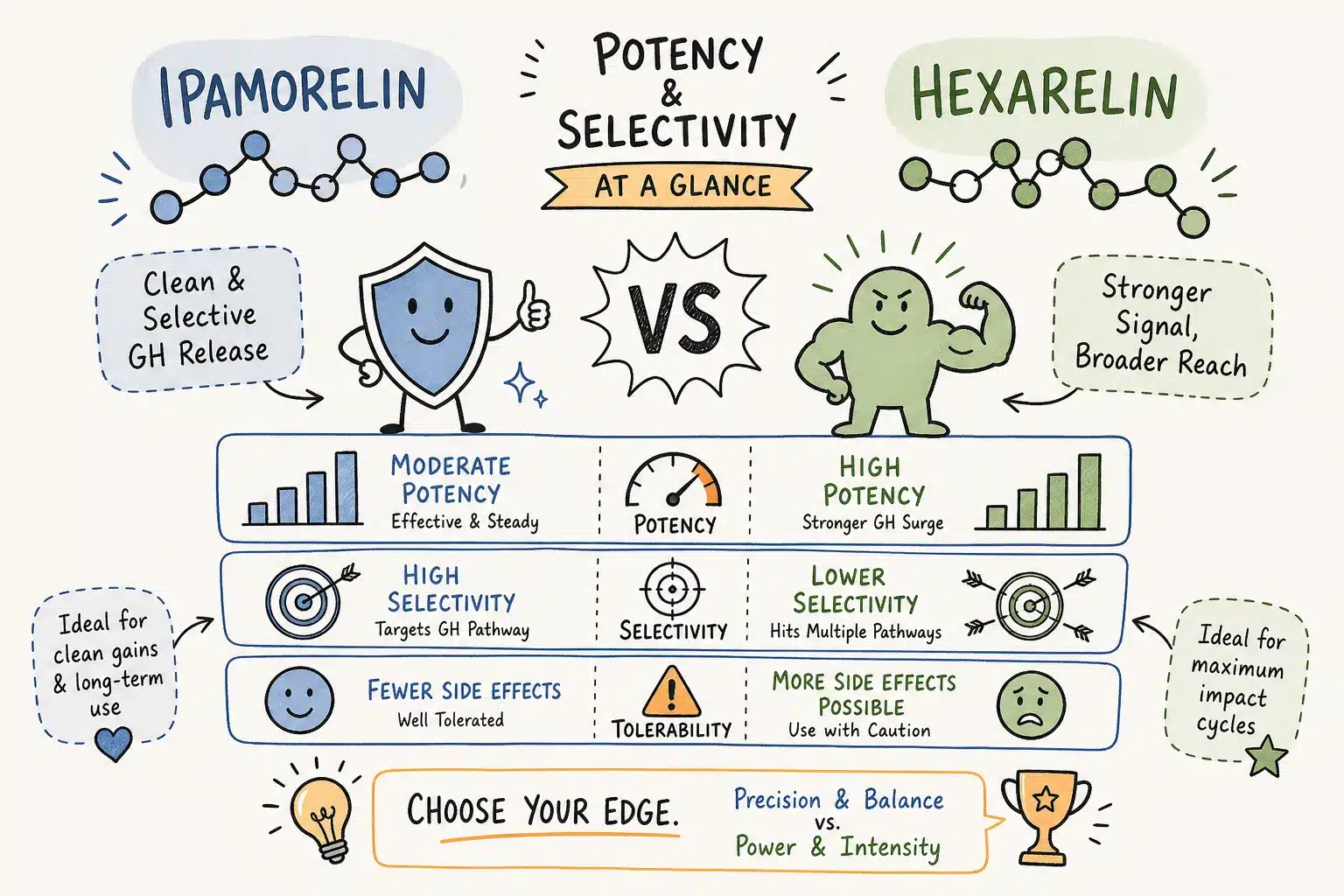
Both ipamorelin and hexarelin activate the same receptor. Both drive pituitary GH release. Both appear in the same pre-clinical literature as growth hormone secretagogues (GHS-R1a agonists). Yet treating them as interchangeable in a research protocol introduces a meaningful design error, one most likely to show up in off-target endocrine readouts, cardiac endpoints mediated by CD36, and any endpoint sensitive to adrenal activation. Understanding ipamorelin vs hexarelin selectivity and potency in research settings is not an academic exercise; it is a prerequisite for building a protocol that produces interpretable data.
The core tension is this: hexarelin delivers a larger GH pulse amplitude based on available pre-clinical data, but it activates a wider set of hormonal and receptor-level targets than its GHS classification implies. Ipamorelin offers a narrower, cleaner pharmacological signal, which is precisely what you need when GH-axis isolation is the experimental objective. This review compares ipamorelin vs hexarelin selectivity and potency in research contexts, walking through the quantitative potency data, receptor selectivity profiles, off-target hormonal evidence, and the CD36 biology that separates these two compounds at the mechanistic level, so you can match the right peptide to the specific demands of your model.
Ipamorelin vs Hexarelin Selectivity and Potency in Research: Receptor Engagement
Ipamorelin’s structure and binding profile
Ipamorelin is a synthetic pentapeptide (Aib-His-D-2-Nal-D-Phe-Lys-NH2) that emerged from optimization work on GHRP-1 with a specific engineering objective: maximize GHS-R1a selectivity while minimizing off-target hormonal activation. It binds GHS-R1a and drives intracellular Ca²⁺ signaling through Gq/11 coupling, which triggers pituitary somatotroph GH release in a pulsatile pattern that mirrors physiological secretion. Published in vitro potency values at the human GHS-R1a receptor report a Ki of 63.4 nM in COS-7 cells and an EC50 of 46.9 nM in BHK cells measuring inositol phosphate accumulation. In rat pituitary cell assays, the in vitro EC50 drops to 1.3 ± 0.4 nmol/L, reflecting the species-level difference in receptor expression systems.
Hexarelin’s mechanism and additional receptor targets
Hexarelin is a synthetic hexapeptide GHRP (His-D-2-MeTrp-Ala-Trp-D-Phe-Lys-NH2) with strong GHS-R1a affinity, but its pharmacological profile does not stop there. Hexarelin also binds CD36, a scavenger receptor expressed in cardiac and endothelial tissue, and this dual receptor activity has direct consequences for how you interpret any hexarelin data that extends beyond pituitary endpoints. CD36 binding is not incidental: it has been confirmed as GH-independent in hypophysectomized rat models and drives a distinct downstream signaling program through L-type calcium channels and protein kinase C (PKC). This makes hexarelin a more pharmacologically complex tool than its growth hormone secretagogue label suggests, and that complexity requires explicit accounting in study design.
What the Quantitative Potency Data Actually Shows
Ipamorelin potency in vitro and in vivo
The most cited in vivo ipamorelin potency figures come from a rat and swine dose-response study. In pentobarbital-anesthetized rats, the ED50 was 80 ± 42 nmol/kg with an Emax of 1545 ± 250 ng GH/mL. In conscious swine, the ED50 dropped dramatically to 2.3 ± 0.03 nmol/kg with an Emax of 65 ± 0.2 ng GH/mL. That roughly 35-fold difference in ED50 between anesthetized rats and conscious swine is not a product artifact; it reflects how substantially anesthesia state and species physiology alter the GH-axis response. Any research design that uses anesthetized rodents needs to account for this shift when interpreting dose-response data. The same study reported ipamorelin’s GH efficacy and potency as comparable to GHRP-6 under those conditions. The original rat and swine dose-response figures provide useful experimental benchmarks for dose selection in comparative work and are discussed in depth in the primary literature.
Hexarelin’s GH pulse amplitude and duration profile
A published human study using a 100 µg IV bolus of hexarelin in adults with glucocorticoid excess produced a GH response that exceeded what GHRH alone could achieve, demonstrating hexarelin’s capacity to cut through hormonal suppression. Available pre-clinical data consistently describe hexarelin as generating a larger GH pulse amplitude than ipamorelin, with a rapid peak around 15 minutes post-administration and a return to baseline by approximately 90 to 120 minutes; however, these kinetic figures are derived from separate studies rather than a matched head-to-head assay, and species- and dose-level differences limit direct extrapolation. What the literature does not yet provide is a formal, published head-to-head EC50 or Ki comparison of ipamorelin versus hexarelin at the human GHS-R1a receptor in the same in vitro assay system. Researchers designing comparative GH secretagogue studies should build that gap into their experimental framing rather than treating indirect comparison data as equivalent to a controlled head-to-head trial.
Ipamorelin vs Hexarelin: Off-Target Hormone Profiles
Hexarelin’s documented co-stimulation of prolactin, ACTH, and cortisol
The off-target hormonal data for hexarelin in humans are well-documented across multiple peer-reviewed studies. A dose-response trial in 12 healthy adult males (see the clinical dose-response trial) demonstrated prolactin elevation reaching a plateau of approximately 180% above baseline at 1.0 µg/kg IV, with an ED50 of 0.39 ± 0.02 µg/kg for PRL. Cortisol showed a step increase at 0.5 µg/kg. Bowers et al. and subsequent endocrinology papers concluded that hexarelin lacks full receptor specificity in humans, a finding that carries direct implications for any study where adrenal activation would confound the readout. A sleep-phase study in healthy volunteers confirmed that nocturnal hexarelin administration co-stimulated GH, ACTH, cortisol, and prolactin simultaneously (see sleep-phase study). In a repeated subcutaneous dosing trial, baseline levels of these hormones remained stable, but an IV hexarelin challenge at the end of the dosing period still produced significant rises in all four hormones, confirming that the off-target response persists even after repeated exposure.
Ipamorelin’s selectivity advantage
Ipamorelin’s original pre-clinical characterization reported no statistically significant increase in ACTH or cortisol even at doses exceeding 200 times the GH ED50. Prolactin response was similarly negligible across those same pre-clinical dose ranges. It is worth noting that this selectivity profile is based predominantly on pre-clinical data; researchers should account for species differences when extrapolating to other model systems. The selective profile was the design intent of the compound and sets it apart from GHRP-2, GHRP-6, and hexarelin in any comparative context. For researchers who need an isolated GH-axis signal without adrenal or lactotrophic interference, ipamorelin’s selectivity data is the primary methodological argument for choosing it as your experimental tool. If ACTH or cortisol elevation would invalidate your readout, hexarelin is the wrong compound for the job, regardless of its GH amplitude advantage. For sourcing and research-oriented product information on ipamorelin, see the Ipamorelin peptide for sale research sourcing guide.
Hexarelin’s Non-GH Signaling: Confound or Feature?
Cardioprotective activity through CD36
Pre-clinical cardiac models have produced consistent evidence that hexarelin reduces infarct size, improves left ventricular function, suppresses post-ischemic apoptosis, and enhances coronary perfusion pressure in hypophysectomized rats. The GH-independence of these effects is established: the protective signal runs through CD36 and GHS-R1a expressed in cardiac and endothelial tissue, with downstream effects on oxidative stress, inflammation, and mitochondrial function. CD36 binding affinity for hexarelin has been reported in the low micromolar range (approximately 2.37 µM in competition binding assays), with the binding site mapped to CD36 residues Asn¹³²-Glu¹⁷⁷ and the contact point localized to Met¹⁶⁹. Downstream signaling through L-type calcium channels and PKC has been characterized in rodent cardiac models. A single oral dose has been shown to sustain improved ejection fraction following acute myocardial infarction in rodent models, with no chronotropic or inotropic effects observed in isolated perfused heart experiments. For a detailed review of hexarelin’s cardioprotective literature and proposed mechanisms, see the comprehensive pre-clinical synthesis of cardiac effects (cardioprotective effects of hexarelin).
What this means for your study design
If your research objective is to characterize isolated GH secretagogue activity, hexarelin’s CD36 engagement is a confound you need to control for or eliminate from your interpretation. If your objective involves cardiac biology, ischemia-reperfusion models, or metabolic signaling beyond the somatotropic axis, that same CD36 activity becomes a feature of the model rather than a liability. No peer-reviewed evidence was identified in available search results showing cardioprotective or neuroprotective effects for ipamorelin comparable to those documented for hexarelin, which means the two compounds are not interchangeable in any model that extends beyond pituitary GH output. Choosing hexarelin because it produces higher GH amplitude in a study designed around cardiac endpoints is a different decision from choosing it in a study designed to isolate GHS-R1a-mediated GH release.
Matching the Peptide to Your Research Application
When ipamorelin is the right tool
Ipamorelin fits models that require a clean, quantifiable GH pulse without adrenal or prolactin interference. Its well-documented GHS-R1a selectivity makes it appropriate for dose-response studies of GH secretagogue activity, comparative work against GHRP-6 or GHRP-2, and any protocol where ACTH or cortisol elevation would compromise the endpoint. Its low EC50 in rat pituitary cell assays, predictable Emax across species, and absence of CD36-mediated secondary biology keep the experimental variables tightly controlled. When the research question centers specifically on GH-axis regulation, ipamorelin is the more controlled variable.
When hexarelin fits the model better
Hexarelin is the appropriate choice when your model requires maximum GH pulse amplitude or when the study deliberately investigates pleiotropic GHS receptor activity, including CD36-mediated cardiac signaling or the relationship between GHS-R1a engagement and non-GH downstream biology. It is also well-suited to models examining how glucocorticoid excess modifies GH secretagogue response, where hexarelin’s stronger signal has demonstrated capacity to overcome hormonal suppression that blunts weaker secretagogues. The off-target hormonal activity that makes hexarelin problematic in a clean GH study becomes informative data in a study specifically designed to characterize the full hormonal profile of GHS-R1a agonism.
Sourcing both compounds for comparative work
For any study that directly compares ipamorelin and hexarelin, compound purity must be identical and independently verified across both. A purity difference between vials, even a modest one, introduces a variable that will skew every potency and selectivity conclusion downstream. R-Peptide Supply carries both ipamorelin and hexarelin with full COA documentation and lot-level traceability, providing a consistent quality baseline across both compounds from a single sourcing point, a practical consideration for labs that need verified, matched purity without managing multiple supplier relationships. For pricing and matched-sourcing options, see the Buy Ipamorelin & Hexarelin Online: Bulk Pricing Guide. If you are designing comparative studies, consult the methodological comparison resource at Ipamorelin vs Hexarelin: A Researcher’s Comparison Guide for practical considerations in matched-assay design.
The Bottom Line on Ipamorelin vs Hexarelin Selectivity and Potency in Research
The fundamental tradeoff is clear when the data are laid out side by side. Based on available pre-clinical evidence, hexarelin delivers a larger GH pulse amplitude, but it brings documented off-target co-stimulation of prolactin, ACTH, and cortisol, plus CD36-mediated biology that operates independently of the somatotropic axis. Ipamorelin offers a narrower, more selective GHS-R1a signal across a comparable potency range, with minimal interference from adrenal or lactotrophic pathways and no confirmed CD36 activity. Neither compound is universally superior: the better tool depends entirely on what your model is actually measuring and which variables you need to control. Understanding those differences is what makes a direct comparison of ipamorelin vs hexarelin selectivity and potency in research more than a catalog exercise, it is the foundation of a defensible experimental design.
The other variable you can control from the start is purity. Potency comparisons between two compounds are only valid when both are sourced at verified, matched purity levels. R-Peptide Supply provides both ipamorelin and hexarelin with lot-traceable COA documentation, supporting the kind of precise, reproducible pre-clinical work this comparison demands. Browse the catalog, verify the COAs, and build your comparative protocol on a quality baseline that holds up to scrutiny. For a direct purchasing reference on ipamorelin, consult the Ipamorelin peptide for sale guide to confirm available formats and documentation.