


Blog
GHK-Cu: The complete copper peptide research guide

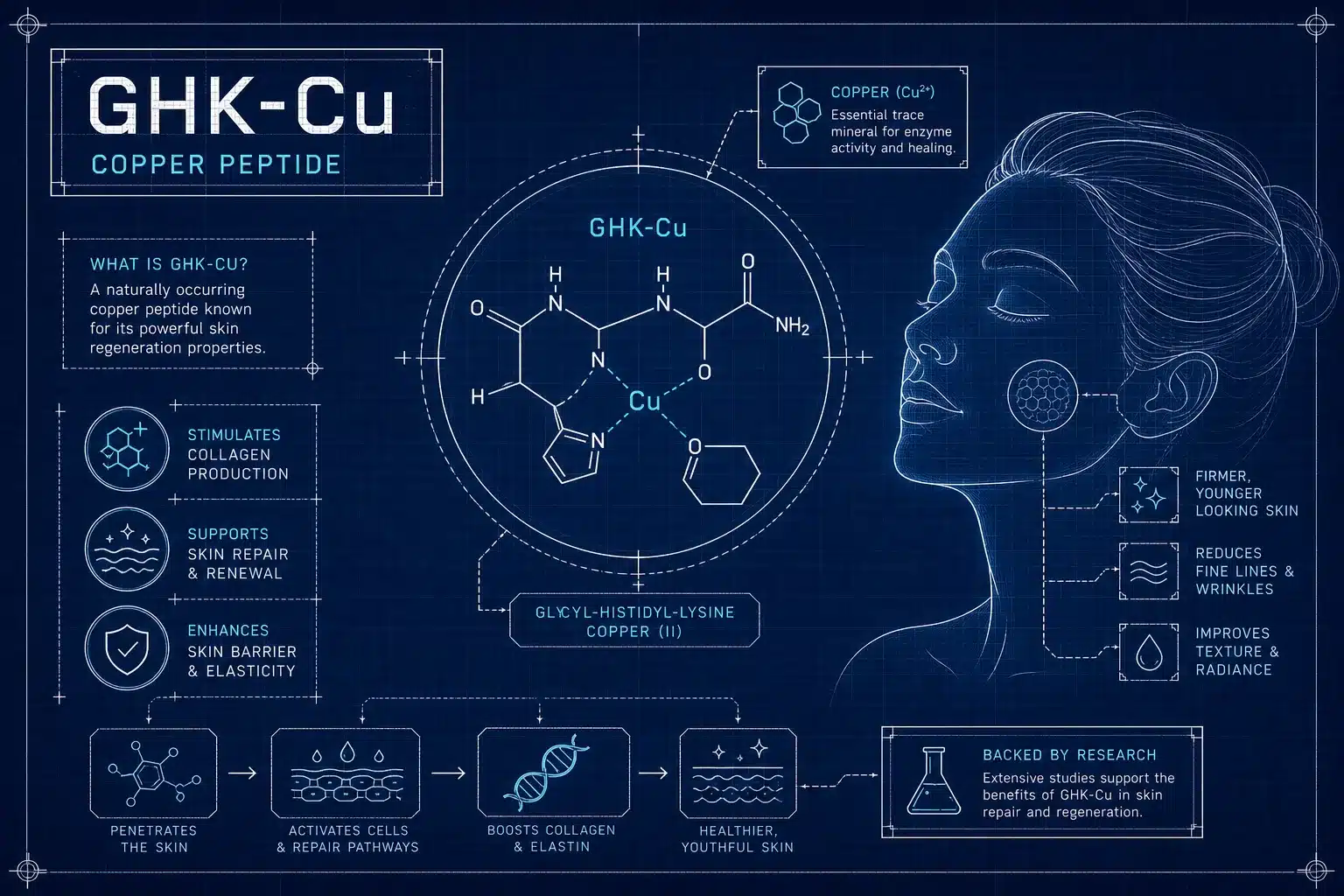
GHK-Cu was first isolated from human plasma in 1973 by Loren Pickart, making it one of the most widely studied naturally occurring copper-binding tripeptides in biomedical research. What Pickart identified was a small plasma-associated factor that caused old liver tissue to behave more like young tissue, specifically by stimulating protein synthesis in aged hepatocytes. That observation launched more than five decades of research across wound healing, dermatology, gene expression biology, and inflammation. This complete guide to GHK-Cu copper peptide research works through each of those areas systematically, from molecular biology through lab protocols and sourcing.
Despite that body of literature, researchers still encounter conflicting information about what GHK-Cu actually does, how solid the evidence is, and how to handle it correctly in a lab setting. Whether you are doing a pre-purchase review or need a bench-side reference for an active protocol, this GHK-Cu research guide covers the molecular biology, gene expression data, clinical trial evidence, reconstitution protocols, safety profile, and quality sourcing considerations for GHK-Cu (glycyl-L-histidyl-L-lysine copper complex) in one place.
What GHK-Cu is and where the research started
GHK-Cu is a naturally occurring tripeptide (Gly-His-Lys) that binds copper(II) ions with high affinity. Circulating GHK-related peptide levels decline with age in humans, and that age-related decline forms the biological rationale for studying exogenous GHK-Cu in research contexts. The naming is straightforward: “GHK” identifies the amino acid sequence; “Cu” denotes the copper(II) complex. GHK-Cu is the form most often studied for biological activity, and effects of the free tripeptide may differ and should be considered separately when evaluating experimental designs.
The structural detail that matters most for researchers is the histidine-copper coordination chemistry. The imidazole group on histidine creates a stable binding site for Cu(II), enabling both redox activity and biological signaling. This is not a cosmetic distinction when evaluating COA documentation. The copper component is central to the mechanism of action, so researchers ordering GHK-Cu vials need to confirm they are receiving the copper complex, not just the free tripeptide. The molecular weight of the GHK-Cu complex is approximately 403, 404 Da (as the parent complex; the acetate salt form is approximately 462 Da), and it is water-soluble, which simplifies reconstitution.
The research arc across five decades helps explain why GHK-Cu literature spans such diverse endpoints. Wound-healing studies dominated the 1980s and 1990s, with cosmetic dermatology taking over in the late 1990s through the 2000s. Broad Institute Connectivity Map analyses then revealed GHK-Cu’s effects on large-scale gene expression programs, broadening research interest into oncology, pulmonology, and inflammation. Researchers new to this compound should understand that some areas of the literature are far better powered than others.
GHK-Cu mechanisms of action: cellular and gene-program effects
The overarching finding from Broad Institute Connectivity Map-based analyses is that GHK-Cu modulates the expression of thousands of genes, and the consistent direction is toward what the GHK-Cu literature characterizes as a “repair and normalize” state. Key upregulated programs include DNA repair genes (ATM) and antioxidant-response genes linked to the Nrf2 pathway. Key downregulated programs include metastatic signaling, drug resistance, and pro-inflammatory cascades including NF-κB, IL-6, IL-1β, and TNF-α. One important caveat: much of this gene expression data comes from cancer cell lines (MCF7 breast cancer, PC3 prostate cancer) and should be interpreted as profile-level associations, not confirmed causal mechanisms in healthy tissue. For a representative mechanistic overview from the literature, see the Broad Institute-style analyses described in the literature review.
The most consistently reported pathway in wound-healing and skin-remodeling research is TGF-β signaling alongside MMP/TIMP balance. GHK-Cu appears to shift TIMP-1 and TIMP-2 toward controlled matrix remodeling rather than unchecked degradation. The same TGF-β pathway normalization has been described in COPD and emphysema models. For researchers studying tissue repair, these ECM effects are the mechanistic backbone of the dermatologic clinical trials and provide the strongest biological grounding for topical GHK-Cu use.
Anti-inflammatory signaling is a second consistently reported category. A 2025 peer-reviewed ulcerative colitis study found that GHK-Cu upregulated SIRT1 and suppressed phosphorylated STAT3. Broader suppression of NF-κB, IL-6, IL-1β, and TNF-α has been reported across multiple study models and cell types. Researchers should not assume uniform effects across their specific model systems without independent validation, since these findings span disease states and cell types that may not translate directly to the model at hand.
What the clinical and preclinical evidence actually shows
Human topical trials form the strongest direct evidence base for GHK-Cu. Abdulghani et al. ran a one-month, biopsy-based study across 20 volunteers, comparing topical GHK-Cu cream against vitamin C, melatonin, and retinoic acid on the opposite thigh. GHK-Cu produced increased procollagen synthesis in 70% of treated volunteers, compared to 50% with vitamin C and 40% with retinoic acid. Leyden et al. conducted a 12-week study in 41 women using a GHK-Cu eye cream, reporting reduced lines, improved skin thickness, and increased skin density versus placebo.
A separate 12-week twice-daily facial cream study across 67 women documented significant epidermal and dermal thickening alongside increased keratinocyte proliferation. A randomized, double-blind eight-week trial compared GHK-Cu in a nano-lipid carrier system applied twice daily against a carrier-alone control and commercially available Matrixyl 3000, reporting beneficial skin effects. Published human studies used topical concentrations ranging from 0.01% to 1%, and researchers should note that these are mostly small trials with varying descriptions of blinding procedures.
Skin penetration data support the rationale for topical delivery. In vitro human skin studies (Hostynek et al.) measured a permeability coefficient of 2.43 ± 0.51 × 10⁻⁴ cm/h through dermatomed skin using a 0.68% aqueous GHK-Cu solution. GHK-Cu does cross the stratum corneum and reaches viable skin layers. Based on published trial concentrations, a research starting range of 0.01% to 0.1% is appropriate for initial tolerability screening, with formulations up to 1% used in more advanced protocols. Liposomal and nano-lipid carrier systems show improved penetration for researchers prioritizing dermal delivery depth.
Injectable GHK-Cu is where the evidence gap sits, and researchers deserve a direct answer. No well-documented peer-reviewed human interventional trials for injectable GHK-Cu currently exist in the literature. The theoretical rationale for injection, bypassing the skin barrier for systemic distribution, is plausible, but it also means the peptide distributes throughout the body rather than concentrating at the skin target. For skin-focused research goals, topical delivery is more directly targeted. For researchers using injectable GHK-Cu, the absence of a clinical evidence base makes COA-verified purity documentation not optional but essential; researchers should consult Buy GHK‑Cu vials online with verified COAs: lab guide, Research Peptides Supply for supply-chain and COA considerations.
Reconstitution, storage, and handling: a practical GHK-Cu research guide
Reconstitution protocol
Bacteriostatic water is the recommended first-choice diluent for multi-dose vials. The benzyl alcohol preservative extends usability across multiple draws, which matters for labs running longer experimental timelines. Sterile water is acceptable for single-use applications where a fresh vial is opened per session. Calculate your target concentration before adding diluent: 3 mL added to a 50 mg vial yields approximately 16.7 mg/mL; 5 mL yields 10 mg/mL. Choosing the volume first based on your experimental dosing need produces a more workable result than reconstituting and then trying to adjust later.
For technique: sanitize the vial stopper with 70% isopropyl alcohol, inject the diluent slowly down the vial wall, and gently swirl until dissolved. Never shake the vial, the solution should appear clear and colorless to faintly blue-tinted from the copper complex after reconstitution. Discard the vial if it is cloudy, contains visible particles, or shows unexpected discoloration. Label every reconstituted vial with the reconstitution date and calculated discard date. This is not optional for traceable research records.
Storage and stability
Lyophilized powder should be held at -20°C in a dry, dark environment. Vendor guidance commonly cites stability of 12 or more months, though this figure has not been validated against pharmacopeial stability standards. Reconstituted solution should be stored at 2 to 8°C, protected from light, and used within 30 days. The 30-day recommendation reflects compounding-standard practice rather than peer-reviewed stability data. Researchers requiring longer post-reconstitution stability should run independent degradation testing, since published guidance ranges from conservative single-day recommendations (Cayman Chemical) to 28-to-30-day practical guidance from peptide vendors, these are not equivalent sources.
Safety profile and documented risk factors
The topical safety profile for GHK-Cu is well characterized by clinical trial standards. Mild local reactions dominate: transient redness, itching, tingling, and dryness. Acne-prone skin may experience breakouts. A temporary blue-green discoloration at the application site has been described in some subjects, attributed to copper content. Allergic reactions including rash and swelling are uncommon but documented. These reactions are generally mild and resolve on discontinuation, making topical GHK-Cu one of the better-tolerated peptides in the dermatologic literature.
For injectable GHK-Cu, the most significant documented concern is product quality rather than a confirmed pattern of severe adverse events. The FDA placed injectable GHK-Cu in Category 2 on the compounding bulk-substance list, indicating significant safety concerns including immunogenicity risk related to peptide aggregation and impurity profiles. This is not a signal of widespread serious adverse outcomes but rather a documented concern about the quality standards achievable for compounded injectables. Researchers working with injectable GHK-Cu must treat HPLC-verified purity and sterility documentation as non-negotiable inputs, not optional extras.
Hard contraindications include known hypersensitivity to copper-based compounds. Pregnancy and breastfeeding warrant avoidance of injectable use pending adequate data. Copper metabolism disorders, specifically Wilson’s disease and Menkes disease, require particular caution for injectable exposure due to the additional copper load. Active skin infection at the application site contraindicates topical use. Avoid combining high-strength topical vitamin C or strong acids with GHK-Cu formulations, since irritation and compatibility concerns, while not a formal contraindication, are documented in dermatologic guidance.
Sourcing quality GHK-Cu vials for research
For any GHK-Cu research to produce reliable, reproducible data, compound purity must be verified before experiments begin. A Certificate of Analysis should confirm identity by HPLC or mass spectrometry, purity percentage (the research-grade standard is 99% or higher by reversed-phase HPLC), lot number, and testing date. Researchers should request lot-specific COAs, not generic documentation, because batch-to-batch variation is a real factor across grey-market suppliers. Without verified purity, every biological result from a GHK-Cu experiment carries an unquantified confounding variable that cannot be controlled for after the fact. For background on structure, mechanism, and research use, see What Is GHK-Cu Peptide? Structure, Science & Research Use, Research Peptides Supply.
For labs, clinics, and resellers running ongoing GHK-Cu research protocols, multi-vial ordering is the practical approach. It reduces per-unit cost, ensures lot continuity for longitudinal experiments, and simplifies inventory management. R-Peptide Supply (Grey Peptide Shop) maintains a COA-verified wholesale catalog with GHK-Cu vials available alongside ancillary supplies including bacteriostatic water, which streamlines procurement into a single workflow.
Where this leaves the working researcher
GHK-Cu is one of the most extensively researched naturally occurring copper peptides, with a decades-long evidence base covering GHK-Cu mechanisms of action, ECM remodeling, anti-inflammatory signaling, and human clinical skin outcomes. Topical use has the strongest direct evidence, supported by multiple human trials and quantified in vitro penetration data. Injectable use remains preclinical in terms of human evidence, with documented quality and immunogenicity concerns that make COA-verified sourcing especially important at every batch. For a concise public summary, see the Copper peptide GHK-Cu entry.
The practical takeaways from this complete guide to GHK-Cu copper peptide research are direct: use bacteriostatic water for multi-dose reconstitution, store lyophilized powder at -20°C, work from lot-specific COAs with HPLC purity confirmation, document reconstitution dates, and discard reconstituted vials at 30 days. Sourcing GHK-Cu vials from a verified wholesale supplier like R-Peptide Supply (Buy GHK-Cu in 2026) removes one significant confounding variable from your experimental design before the first pipette is picked up.