


Blog
GHK-Cu copper peptide: what the research actually shows

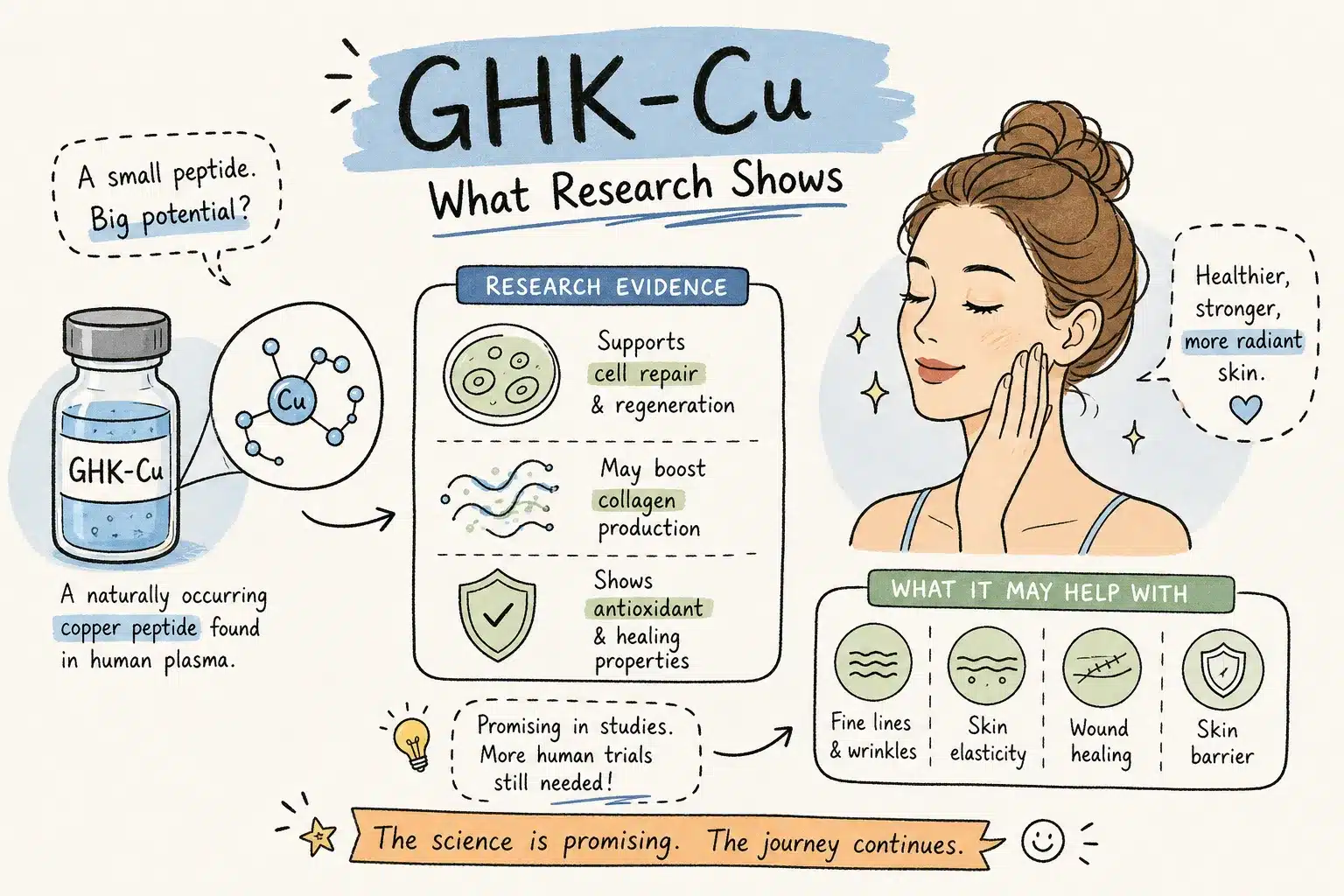
What does GHK-Cu copper peptide do in skin and tissue research studies? That question has accumulated five decades of published answers, enough time for the compound to develop both a serious scientific record and a reputation problem. Formally known as glycyl-L-histidyl-L-lysine copper complex, GHK-Cu (also referred to as copper tripeptide-1) sits at an uncomfortable intersection: cosmetic marketing has borrowed its mechanisms selectively, and skeptics dismiss it as another peptide trend. Neither framing serves researchers well.
This article is a mechanism-level walkthrough of what cell studies, animal models, and human clinical work have actually documented for GHK-Cu copper peptide in skin and tissue research. Three questions come up most in serious research contexts: whether the peptide modulates collagen synthesis in a concentration-dependent way, what the gene expression data really shows, and where the human evidence sits relative to preclinical findings. Each gets a direct answer here. This is not a skincare summary, it is a sourcing-and-design resource for labs evaluating GHK-Cu for study work.
One practical note before the science: researchers setting up replication studies often need COA-verified GHK-Cu vials with confirmed purity documentation. For research use, source material verified by HPLC and ICP-MS from a reputable peptide supplier with full lot traceability. With that noted, the evidence is what this article is about.
What does GHK-Cu copper peptide do in skin and tissue research studies? Mechanisms explained
The tripeptide-copper complex: structure and binding basics
GHK-Cu is a tripeptide (glycine-histidine-lysine) with high-affinity copper(II) binding, typically at a 2:1 GHK-to-copper molar ratio. The intact copper-peptide complex is functionally distinct from free GHK or free copper ions in solution. Bathocuproine studies confirm this directly: chelating the copper out of the complex abolishes downstream biological activity, which means copper binding is not incidental to the GHK-Cu mechanism but central to it. Researchers designing assays should treat GHK and GHK-Cu as different compounds with different activity profiles. For a concise technical overview of the peptide’s structure and research use, see the detailed peptide overview from Research Peptides Supply.
Gene regulation as the core mechanism
The breadth of GHK-Cu’s documented gene effects is what separates it from single-pathway peptides. Research by Pickart and colleagues reports modulation of over 3,000 human genes, covering upregulation of COL1A1, COL3A1, VEGF, FGF-2, SOD, glutathione peroxidase, and multiple stem cell markers including p63, ITGA6, and ITGB1. Mechanistic reviews describe what has been termed an “epigenetic resetting” effect, GHK-Cu appears to shift gene activity patterns toward repair and regeneration states through changes in chromatin accessibility and transcription factor recruitment, rather than activating a single defined receptor pathway. For tissue research, this breadth matters because it means the GHK-Cu copper peptide mechanism coordinates multiple repair cascades simultaneously rather than optimizing one at the expense of others. This is the skin regeneration peptide dynamic that distinguishes GHK-Cu from narrower pro-collagen compounds.
Fibroblast activation and ECM synthesis outputs
At the cellular level, GHK-Cu signals dermal fibroblasts to increase production of collagen types I and III, elastin, and glycosaminoglycans including hyaluronic acid. It also upregulates decorin, worth noting specifically because decorin regulates collagen fibril assembly geometry and carries documented anti-tumor properties in the literature. That puts GHK-Cu research into territory beyond cosmetic endpoints. This fibroblast activation output is the foundation for the collagen synthesis data that follows.
Collagen synthesis and ECM remodeling: the documented data
Concentration-dependent collagen stimulation: how GHK-Cu copper peptide acts in tissue models
Cell studies document non-linear collagen stimulation from GHK-Cu, with effects reported at concentrations as low as 0.01 nM and stimulation confirmed across the 1, 10 nM to 0.1, 10 µM range depending on the assay and cell type. The critical design note: the dose-response curve is non-linear. Higher concentrations do not produce proportionally greater collagen output, and the literature does not support assuming that micromolar concentrations in a cell assay outperform nanomolar ones. Selecting a concentration that matches what published studies actually used is a real experimental variable, not a minor detail. For a thorough review of GHK-Cu’s molecular and cellular effects, see the comprehensive PubMed Central review.
MMP/TIMP balance and why it matters for tissue remodeling
GHK-Cu upregulates both MMP-1 and MMP-2 (ECM breakdown enzymes) and TIMP-1 and TIMP-2 (protease inhibitors) simultaneously. This is not a contradiction in the data. It reflects controlled ECM remodeling, breakdown and synthesis running in parallel under regulation, producing net turnover rather than net degradation or pathological accumulation. This dual-regulation profile is what makes GHK-Cu mechanistically relevant to wound remodeling and scar research, and it distinguishes the compound from simple pro-collagen stimulants that increase synthesis without modulating breakdown.
Glycosaminoglycans and broader matrix effects
Published work also documents increases in hyaluronic acid and broader glycosaminoglycan output from GHK-Cu-treated fibroblasts. The collagen data in the literature is stronger and more replicated than the glycosaminoglycan data, so researchers should weight those findings accordingly. The decorin and GAG findings add meaningful context for studies examining dermal hydration, matrix architecture, and tissue organization beyond collagen fiber structure.
Wound healing and angiogenesis in preclinical models
Animal model evidence: wound closure and granulation tissue
Rabbit, rat, mouse, and pig wound models have documented faster wound contraction, improved granulation tissue formation, stronger collagen deposition in wound beds, and reduced inflammatory markers, including MMP-2, MMP-9, and TNF-related signals, following GHK-Cu treatment in several model types. A collagen dressing study in rats where GHK-Cu was integrated into a matrix scaffold reported markedly increased collagen output compared to controls. The degree of inflammatory marker reduction varies across models and species, so researchers should consult species-specific data when designing protocols. That said, the animal wound healing findings appear across multiple model types and are considered among the more reproducible results in the GHK-Cu preclinical literature; see an accessible review of preclinical wound-healing data for context.
In vitro findings: fibroblast migration and keratinocyte behavior
Cell-based studies show that GHK-Cu enhances fibroblast migration and proliferation in scratch-wound assays, supports keratinocyte stem cell markers (p63, ITGA6, ITGB1), and protects keratinocytes from UV-induced oxidative damage. The UV-protection finding positions GHK-Cu as relevant to photo-damage research beyond mechanical wound models. Keratinocyte behavior data also suggests relevance for re-epithelialization research, since the peptide supports both the proliferative and migratory phases of epidermal repair.
Angiogenic signaling through VEGF and FGF-2
Preclinical models document VEGF and FGF-2 upregulation from GHK-Cu, with downstream effects on capillary formation and nutrient delivery to healing tissue. The research logic here is important: early angiogenesis supports tissue perfusion during the proliferative phase of repair, while GHK-Cu’s later TIMP upregulation is reported to help modulate vascularization during remodeling. This two-phase behavior has been described in preclinical work, though direct time-course studies confirming the full sequence remain limited. Human clinical trials would need to confirm whether the same sequencing occurs in vivo at therapeutic concentrations.
What human clinical evidence actually demonstrates
Topical photoaging studies: skin density, wrinkles, and collagen output
The most-cited topical human studies are small placebo-controlled and comparative trials. A 71-woman facial skin study (Leyden et al.) reported that 70% of GHK-Cu participants showed increased collagen output, compared to 50% for vitamin C and 40% for retinoic acid. A 41-woman eye cream study showed GHK-Cu outperforming both vehicle control and a vitamin K formulation on lines, wrinkles, and skin density. A separate wrinkle volume study reported a 31.6% reduction with GHK-Cu treatment. These results are directionally consistent with the preclinical mechanistic data. However, sample sizes are small, and researchers citing these studies should flag that several were conducted by investigators with affiliation to GHK-Cu’s commercial development, a documented limitation that bears on how the effect sizes should be interpreted.
The wound healing trial and where the human evidence stands
The most rigorously designed human wound healing study for GHK-Cu is NCT07437586, a Phase 2 randomized, double-blind, vehicle-controlled, split-wound trial in healthy adults. The split-wound design gives each participant two standardized acute wounds, one treated with GHK-Cu gel and one with vehicle, which controls for individual variability more effectively than parallel-group designs. The trial began enrollment in February 2026 with an estimated primary completion date of February 2027 and full study completion in early 2028, meaning published results are not yet available. Prior to this trial, human wound healing evidence for GHK-Cu was limited to small retrospective analyses and case reports without controls, which is why this study represents a meaningful advancement in the quality of human evidence being generated.
Systemic and injectable use: where robust data doesn’t yet exist
Systemic GHK-Cu in humans has no robust trial evidence to date. A retrospective scalp infusion study combining GHK-Cu with minoxidil and dutasteride reported some improvement in hair outcomes, but the cohort was very small and lacked a control group. For injectable and compounded formulations, the FDA has raised immunogenicity concerns related to aggregation and peptide-related impurities in regulatory commentary on compounded injectables, researchers should consult the relevant guidance documents directly. Researchers designing GHK-Cu work in 2026 should treat in-vitro and topical study designs as the reproducible territory, with systemic applications remaining an open question pending much larger and better-controlled human work.
Concentration, formulation, and sourcing for lab research
Concentration ranges across study types
Concentration ranges used across study types are not interchangeable, and this is a common source of experimental error. Cell studies have used 1, 10 nM up to 0.1, 10 µM depending on the assay. Animal injection models have used approximately 0.3 mg/mL. Human wound studies have tested 0.03%, 0.3%, and 3% formulations. Cosmetic topical products typically fall in the 0.2, 2% range. Applying a concentration from one study type to a different model without adjustment produces results that won’t replicate and can’t be meaningfully compared to the published literature.
Stability, pH, copper chelation, and delivery considerations
GHK-Cu shows stability in aqueous solution at pH 4.5, 7.4, with published characterization data reporting maintained integrity for at least two weeks at elevated temperatures, though researchers should consult the original stability studies for concentration-specific parameters. Skin permeability increases with pH, making vehicle pH selection a real formulation variable. Competing copper chelators in the same formulation will abolish activity, and the 2:1 GHK-to-copper ratio used in animal studies exists specifically to minimize oxidative effects from free copper ions. GHK-Cu is highly hydrophilic, which means simple water serums penetrate poorly through intact stratum corneum. Liposomal and microemulsion vehicles are reported to show better permeation in animal skin models, with liposomal formats generally offering more sustained delivery to the dermis based on comparative permeation studies; see a formulation study comparing delivery systems for peptide permeation.
Sourcing COA-verified GHK-Cu for replication studies
Replicating published study conditions starts with sourcing GHK-Cu that matches the purity documentation those studies used. The practical standard in the literature is 98, 99% purity by HPLC, with identity confirmation by mass spectrometry and copper stoichiometry verification by ICP-MS alongside the HPLC data. HPLC purity alone does not confirm the copper is correctly complexed, so COA documentation should cover all three. For guidance on metallomic verification and copper stoichiometry in peptide complexes, consult a recent metallomics characterization. When selecting suppliers, R-Peptide Supply (Grey Peptide Shop) provides research-grade GHK-Cu with HPLC data and lot traceability for labs running replication or multi-compound tissue repair protocols. Lot traceability and consistent lyophilization quality are what separate vials that support reproducible work from those that introduce purity as a confounding variable. For purchasing and format/pricing details, see the Buy GHK-Cu in 2026: Purity, COAs, Formats, Pricing, Research Peptides Supply listing.
Safety data and what researchers should document
Topical safety profile and reported adverse reactions
Topical GHK-Cu’s documented adverse effect profile centers on application-site reactions: redness, itching, burning, dryness, scaling, and occasional rash represent the primary reported findings. Manufacturer SDS documentation for research-grade GHK-Cu acetate reports no known sensitizing effects under specified handling conditions, and systemic toxicity from topical application has not been established in the published literature. The important caveat is that no peer-reviewed maximum safe topical concentration exists, no validated duration limit for continuous use has been established, and no systematic adverse-event dataset from human studies is available. The absence of established harm is not the same as established safety, particularly for extended use or application to thin facial and periocular skin.
Injectable and systemic use: a different risk profile
Regulatory commentary has flagged immunogenicity concerns for compounded injectable GHK-Cu, citing aggregation and peptide-related impurities as primary issues. Research-grade SDS documentation lists an oral rat LD50 of 500 mg/kg, but this figure is not a validated human exposure threshold and should not be interpreted as one. The copper toxicity concern at concentrations used in typical topical applications is considered small in the published literature, but remains theoretically relevant for extended or high-concentration systemic exposure. Injectable and systemic use designs carry substantially higher uncertainty than topical protocols.
What the absence of established limits means for research design
The lack of standardized safety and dosing benchmarks for GHK-Cu means that well-designed studies documenting formulation details, concentration, vehicle, exposure duration, and observed responses contribute directly to the field’s knowledge base. Researchers publishing GHK-Cu work should treat these parameters as mandatory reporting items, not optional methodological footnotes. Purity variability in sourced compounds creates confounding variables that undermine reproducibility, which is why sourcing verified, consistent material with lot traceability is a design consideration, not just a procurement preference.
Where the research stands and what comes next
GHK-Cu has a well-documented preclinical profile relative to other cosmetic and regenerative peptides in the published literature. The in-vitro and animal evidence for collagen synthesis signaling, MMP/TIMP-balanced remodeling, wound closure acceleration, and angiogenesis is credible, replicated across multiple model types, and mechanistically coherent. Human clinical evidence for topical photoaging applications is supportive but limited by small sample sizes and researcher affiliation considerations. For wound healing in humans, the definitive evidence is still being generated; see a targeted review of clinical and preclinical GHK-Cu findings for additional context.
That gap between strong preclinical data and maturing human evidence is where the research opportunity sits right now. Understanding what GHK-Cu copper peptide does in skin and tissue research studies, at the mechanism level, is the foundation for designing studies that will actually close it. Properly controlled work with verified compounds, documented concentrations, appropriate vehicle controls, and systematic outcome reporting is what moves the field forward. More of that is needed, not more selective citations of the same small cohort studies from the early 2000s.
For researchers setting up GHK-Cu assays or replicating published study conditions, the starting point is sourcing material that matches the purity standards the existing literature used. COA-backed, HPLC-verified vials with ICP-MS copper confirmation and lot traceability provide a foundation that keeps compound quality from becoming an experimental variable. R-Peptide Supply (Grey Peptide Shop) carries research-grade GHK-Cu in that format, available for labs running targeted GHK-Cu protocols or broader tissue repair research programs. For labs combining peptides for skin and recovery research, consider the GLOW Stack Peptide Blend: Skin and Recovery Research as an additional research resource.