


Blog
Bulk Peptide Wholesale: Pricing, MOQs, and COA Guide

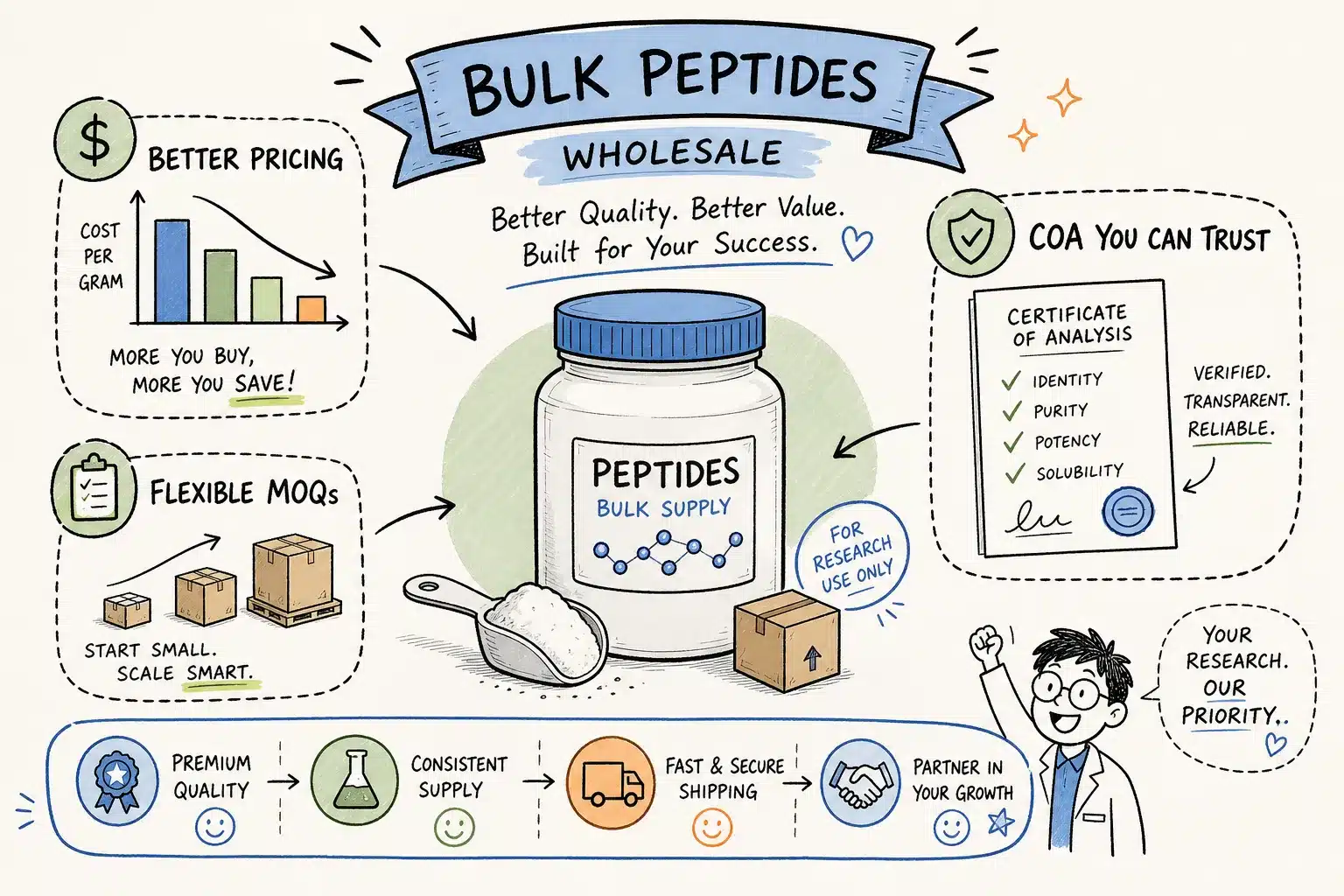
Sourcing research peptides in bulk has shifted from a niche procurement exercise into a genuine operational decision for labs, resellers, and clinic operators. Working with a reliable bulk peptide wholesale supplier means navigating real choices across purity tiers, MOQ structures, and documentation standards, and knowing how to separate legitimate sources from risky ones before committing to a large order. The grey market wholesale space has expanded enough that options exist at every scale, but so have the bad actors.
Some platforms have lowered the barrier to entry for smaller labs that once couldn’t meet the minimum commitments required by large synthesis houses. That’s a genuine development in the market. But lower barriers also mean more suppliers worth scrutinizing carefully. This guide covers the qualifiers that separate legitimate wholesale sources from risky ones, current pricing benchmarks by purity tier, MOQ structures, documentation standards, and how to write a bulk quote request that actually gets useful numbers back.
What separates a trustworthy wholesale peptide supplier from a risky one
Any supplier can claim high purity. What matters is whether they can prove it with batch-specific documentation. The first filter when evaluating any wholesale peptide source is documentation quality, not price. A legitimate quality package includes a Certificate of Analysis tied to a batch number, HPLC chromatograms with an actual purity calculation (not a pass/fail statement), and mass spectrometry data confirming the measured molecular weight against the expected value.
The distinction between in-house testing and accredited third-party testing matters at bulk quantities. In-house QC is a reasonable baseline, but third-party verification from an independently accredited lab carries more weight when you’re placing a 100- or 500-vial order. The reason is simple: a supplier who self-reports their own purity has no external accountability. Third-party verification removes that conflict. For a concise primer on peptide quality expectations and testing, see GenScript’s peptide quality overview.
Core quality documents every bulk order needs
Every serious wholesale peptide purchase requires a COA (Certificate of Analysis) checklist with a matching lot number, an HPLC chromatogram with purity calculation, and mass spectrometry data showing actual measured versus expected molecular weight. GMP certification is a manufacturing-system claim, not a substitute for batch-level analytical proof. It requires separate verification of the certifying body and the site scope before it means anything useful to you as a buyer.
Any supplier who won’t provide COAs in advance of purchase is a red flag, not a negotiation point. Legitimate suppliers share documentation before the order is placed, not after payment clears. If a vendor can’t produce batch-specific paperwork on request, treat that as a disqualifying condition rather than a gap to work around.
How to verify a COA before committing to a bulk purchase
A practical verification workflow starts with matching the lot number on the COA to the vial label exactly. Then confirm the named testing lab and check its accreditation status independently. Look for raw HPLC and MS data, not summarized claims, and check that the certificate is signed, dated, and specifies the analytical methods used. Legitimate third-party labs can be contacted directly to confirm a report is real. This is the step most buyers skip, and it’s exactly the step most fraudulent suppliers count on being skipped.
Bulk Peptide Wholesale Pricing: How It’s Actually Structured
Pricing in the bulk peptide wholesale market is rarely published as a clean, static price list. Most suppliers use tiered, quote-based structures that depend on compound, quantity, purity specification, and packaging format. The working mental model you need: per-mg price drops sharply with volume, and purity grade is the single biggest driver of base cost. Understanding the benchmarks before you enter a pricing conversation puts you in a much stronger position. For a data point on retail and wholesale cost drivers, review the industry overview on how much peptides cost.
Per-mg benchmarks by purity tier
Pricing across peptide manufacturers generally breaks into three tiers. Crude or minimally purified material runs approximately $2 to $10 per mg, primarily in large custom synthesis runs. Research-grade material at 95% purity or above typically sits in the $5 to $25 per mg range for most common peptides at small-to-moderate quantities. Real-world anchors include BPC-157 at roughly $4.40 to $6.38 per mg for 5 mg vials, CJC-1295 around $10 to $20 per mg, and Ipamorelin in the $3.50 to $5.50 per mg range. GMP or clinical-grade material starts at $20 to $100 or more per mg at small quantities and only drops meaningfully at commercial scale.
Retail per-mg rates represent the ceiling. Bulk orders at 100 or more vials can fall meaningfully below these benchmarks for standard peptides with consistent demand. Based on current catalog pricing across domestic wholesale suppliers, BPC-157 at true wholesale volumes (50 to 500 vials) settles near $4.40 to $5.00 per mg, TB-500 around $5.00 to $6.00 per mg, and Ipamorelin near $3.50 to $4.50 per mg.
What packaging and cold-chain requirements do to your cost
The per-mg price is only part of your landed cost. Lyophilized powder ships at room temperature and sidesteps cold-chain fees entirely. Liquid formulations require cold packs or dry ice, which adds directly to freight cost. Custom vials, private-label packaging, and special sequence information all add cost because they require additional labor and documentation steps. For most bulk buyers sourcing standard catalog compounds, lyophilized vials at the right volume tier generally offer the most straightforward path to cost efficiency, though buyers should model their own landed-cost scenarios based on cold-chain requirements and testing overhead.
Bulk Peptide Wholesale MOQs and How Tiered Discounts Work
MOQ is one of the first practical filters when shortlisting wholesale peptides suppliers. Different supplier types structure minimums very differently. Catalog wholesale shops often set a per-compound threshold, with 50 vials being a common published benchmark in the US market. Custom synthesis houses typically work on a quote basis with no fixed published MOQ. Understanding which model you’re dealing with shapes how you should approach the pricing conversation from the start. For a focused procurement primer aimed at US buyers, see the Bulk Peptide Wholesale USA: The Lab Procurement Guide.
Catalog MOQs vs. custom synthesis runs
Catalog wholesale suppliers stock standard compounds and set fixed minimums, often at 50, 100, 250, or 500 vials per compound, with volume pricing at those breakpoints. Custom synthesis suppliers produce to order and handle MOQs through RFQ, with turnaround that varies by sequence complexity and purity specification. For labs or resellers sourcing standard research peptides like BPC-157, Ipamorelin, or TB-500, catalog wholesale is almost always faster and more cost-effective than commissioning a peptide synthesis bulk run. If you need formal synthesis support or service options, many buyers reference established peptide synthesis services when evaluating lead time and scope.
Reading volume discount structures correctly
Tiered discount structures work differently across suppliers. Some use percentage-based discounts that increase with quantity, for example, a retail-style catalog might show 5% at two vials, 10% at three to five vials, 15% at six to nine vials, with inquiry-required pricing at ten or more. These small-quantity examples illustrate how the structure works, but true wholesale tiers typically kick in at 50 vials or above. Other suppliers use flat quote-based pricing at volume breakpoints. The key question to press on before committing: are those discounts per-compound or across an entire order? Does mixing compounds in one order count toward a volume tier? Getting clear answers to both questions before you place a multi-compound order saves real money.
R-Peptide Supply’s wholesale program: a practical model for labs and resellers
Applying the criteria above to a real supplier shows what a well-structured wholesale sourcing option looks like in practice. R-Peptide Supply (Grey Peptide Shop) is built around the framework this guide outlines: accessible MOQ structures, multi-vial bundle formats, and a catalog designed for labs and resellers placing regular peptide supplier bulk orders. That combination suits both small labs managing recurring inventory and active resellers building multi-compound pipelines.
Multi-vial bundles and the free shipping threshold
R-Peptide Supply structures its catalog around multi-vial bundle formats that reduce per-unit cost without requiring large custom synthesis commitments. A free shipping threshold is available for qualifying orders, a meaningful cost lever for resellers placing recurring orders across multiple compounds. For buyers managing ongoing inventory, eliminating variable freight costs on regular orders is a practical advantage worth building into your sourcing model. Confirm current thresholds and pricing directly with the supplier, as catalog pricing and shipping policies are subject to change.
COA-backed catalog and ancillary supply access
R-Peptide Supply offers COA documentation across its catalog, covering compounds including BPC-157, TB-500, GHK-Cu, HGH Fragment 176-191, IGF-1 LR3, Hexarelin, Kisspeptin-10, and specialty blends. The availability of ancillary supplies, bacteriostatic water, acetic acid water, and benzyl alcohol, in the same storefront is a practical advantage for labs that want consolidated sourcing from a single supplier rather than splitting orders across vendors. For buyers managing recurring orders, having direct access to customer support matters more than it might initially appear: fulfillment questions and documentation requests don’t always align with standard business hours.
Lead times and shipping logistics: what to plan for
Lead time is one of the most underestimated variables in bulk peptide sourcing. The gap between a domestic supplier shipping from catalog inventory and an overseas manufacturer running a fresh synthesis batch can span weeks. When labs are working toward protocol timelines, that gap is operationally significant.
Domestic vs. overseas bulk turnaround timelines
Domestic US suppliers shipping from existing catalog inventory typically fulfill orders in three to five business days. Domestic custom synthesis runs land in the one-to-three-week range depending on sequence and purity specification. Overseas manufacturers, primarily China-based, may have comparable synthesis timelines of two to three weeks, but international transit, customs clearance, and cold-chain coordination add time. Total door-to-door delivery of three to five weeks is realistic for overseas orders. For labs sourcing standard catalog peptides rather than custom sequences, domestic catalog wholesale wins on speed by a meaningful margin. If you need a comprehensive sourcing checklist for online bulk purchases, consult the Buy Peptides in Bulk Online guide.
Shipping policy checklist before placing a bulk order
Four things to confirm before any wholesale order:
- Whether free shipping thresholds apply to wholesale quantities
- How temperature-sensitive compounds are packaged for transit (lyophilized vs. liquid)
- Whether tracking and insurance are included at bulk quantities
- What the return or replacement policy is for damaged or compromised shipments
Suppliers who can’t answer these questions clearly before purchase are generally not equipped to handle serious wholesale relationships.
Building a bulk quote request that gets real numbers back
Most buyers send vague inquiries and get vague responses. A well-constructed RFQ signals that you’re a serious buyer and puts the supplier in a position to give you the specific numbers you need to make an actual sourcing decision. The format of your request directly affects the quality of what you get back.
What to include in your peptide RFQ
A practical RFQ for a multi-vial wholesale peptide order should cover all of the following:
- Compound name and catalog reference, if available
- Purity specification required (95% research grade, GMP, etc.)
- Target quantity tiers you want priced (50, 100, 250 vials)
- Vial format in mg per vial and lyophilized
- COA and analytical documentation requirements, including HPLC and MS
- Target delivery timeline and shipping destination
- Whether you want pricing on ancillary supplies or blends alongside the primary compounds
Sending all of this upfront cuts the back-and-forth and signals to the supplier that you know exactly what you’re asking for. For an itemized checklist covering pricing, MOQs, and COA expectations, see Buy Peptides in Bulk: Pricing, MOQs, and COA Checklist, Research Peptides Supply.
Red flags that signal a supplier isn’t worth shortlisting
The most common warning signs are consistent: COAs provided only after payment, no third-party lab named on the documentation, vague purity claims without chromatogram data, no published or quotable MOQ structure, and pricing that appears unusually low without a clear explanation tied to purity grade or batch size. A supplier who can’t provide clear answers on any of these points before you order is not a supplier worth trusting at volume. Price alone is never a sufficient reason to overlook gaps in documentation or transparency.
Putting it all together
Sourcing research peptides through a bulk peptide wholesale supplier isn’t just about finding the lowest per-mg price. It’s about finding the right combination of quality documentation, accessible MOQ structure, reliable lead times, and a supplier relationship that holds up at volume. Request documentation before committing, confirm MOQ and discount structures in writing, and build your RFQ around the specifics that actually drive the quote. That process, done consistently, separates efficient sourcing from expensive mistakes.
R-Peptide Supply (Grey Peptide Shop) is built around the criteria this guide covers: multi-vial bundle formats, a COA-backed compound catalog, ancillary supply access, and pricing structured for labs and resellers placing regular orders. When evaluating any bulk peptide wholesale option, use this framework to stress-test the documentation, the MOQ model, and the lead-time commitments before you commit to volume. The suppliers who hold up under that scrutiny are the ones worth building a long-term sourcing relationship with.