Hexarelin Peptide
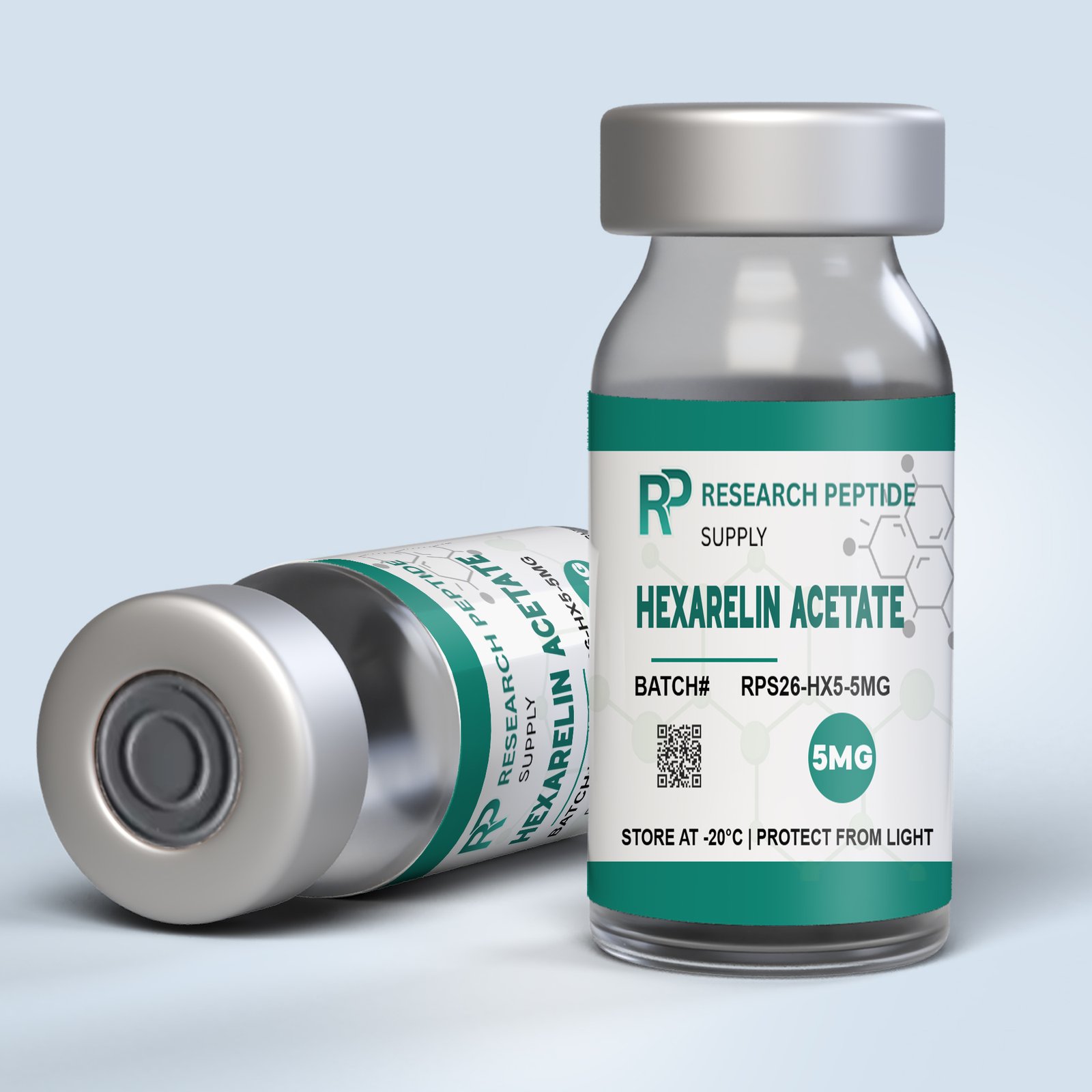
Hexarelin is a growth hormone-releasing peptide (GHRP) that researchers consider may host a potential action parallel tothat of peptide GHRP-6.(1)
Hexarelin, or Examorelin, is a synthetic peptide composed of six amino acids.(2)
Regarding its mechanism of action, Hexarelin is believed to work by mimicking the naturally occurring peptide ghrelin, which contains 28 amino acids and is considered by scientists to stimulate the release of growth hormone (GH) and induce hunger. Several synthetic compounds, including Hexarelin, which appears to exhibit actions similar to those of ghrelin, were developed more than 25 years ago.(3)
Since their development, continuous studies and research have been conducted to fully examine the actions and potential of these peptides.
Overview
Hexarelin is hypothesized to operate by imitating ghrelin’s role in activating ghrelin receptors throughout the organism, notably those within the pituitary gland and hypothalamus. Known as growth hormone secretagogue receptors (GHS-Rs), more specifically the GHSR-1a, their stimulation may lead to the secretion of GH, positioning Hexarelin as a potential growth hormone secretagogue (GHS). This appears to be an alternative mechanism regulating the synthesis of GH by the anterior pituitary cells, compared to the direct stimulation of the hypothalamus via the native growth hormone-releasing hormone (GHRH).
The GHSR-1a is found on the hypothalamus and pituitary gland and across various parts of the nervous system and other tissues. Thus, Hexarelin’s action is posited to encompass both direct and indirect triggers of GH release, potentially impacting GHS-Rs in the pituitary and indirectly affecting the hypothalamus.(4)
When Hexarelin engages GHS-Rs, it is hypothesized that it might cause a structural change, possibly activating intracellular signaling pathways that largely depend on G-proteins, such as the potential activation of protein kinase C (PKC), possibly amplifying the signaling pathway and facilitating GH release from pituitary cells. However, exposure to Hexarelin has also been posited to lead to transient receptor desensitization that may last for days or weeks.(5)
Furthermore, Hexarelin has been posited to be unselective towards the apparent synthesis of GH, and researchers suggest the peptide may also induce the production of other pituitary hormones. Namely, these hormones may include the adrenocorticotropic hormone (ACTH) and prolactin.(6) In general, the upregulation of these hormones in experimental settings is undesired by researchers.
Researchers note that Hexarelin’s potential to activate GHS-Rs also in other nervous system areas might initiate cellular processes that increase the production of hunger-related neuropeptides, such as Neuropeptide Y (NPY) and Agouti-related peptide (AgRP). These are considered critical in managing energy balance and appetite control. Concurrently, Hexarelin might also reduce the secretion of the appetite-suppressing hormone, melanocyte-stimulating hormone (α-MSH), thus tipping the balance towards increased hunger and encouraging food intake.
Hexarelin may also influence the mesolimbic reward system, associated with craving regulation for flavorful food, through potential GHSR-1a activation. This could theoretically amplify the motivation for eating, possibly by activating cyclic adenosine monophosphate (cAMP) pathways, thereby suggesting Hexarelin’s potential role in altering feeding behavior and reward-driven eating practices.(7)
Chemical Makeup
Molecular Formula: C47H58N12O6
Molecular Weight: 887.05 g/mol
Other Known Titles: examorelin