


Blog
How to Choose the Best BPC-157 Online Supplier

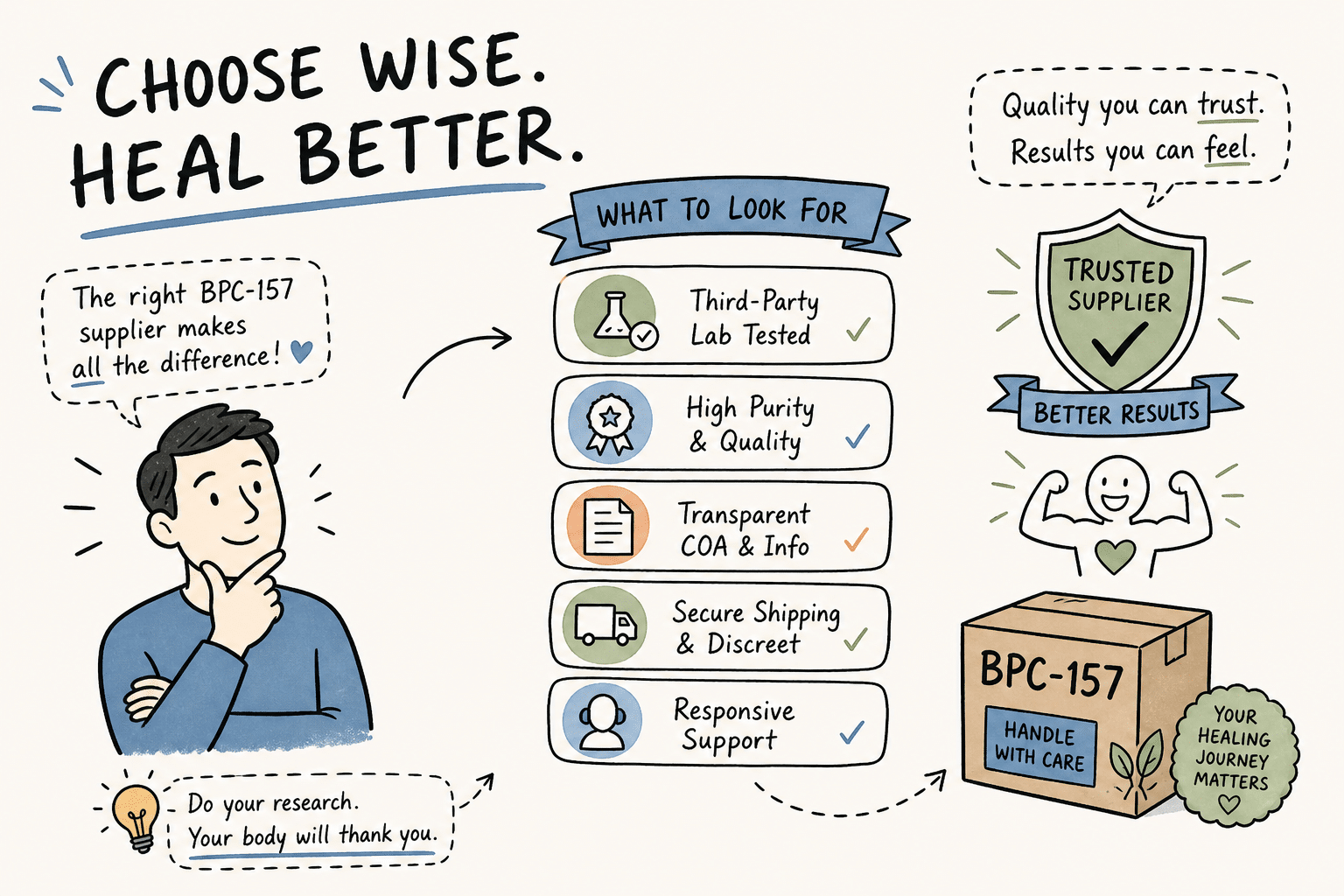
If you’re searching for the best place to buy BPC-157 online, the decision comes down to far more than price. The BPC-157 peptide market has expanded rapidly in recent years, and observable differences between legitimate research suppliers and low-quality vendors have grown with it. Researchers who already know to look for a credible source are ahead of most buyers, but knowing exactly what to verify is what separates a confident purchase from a costly one. Documentation integrity, pricing transparency, vial format options, and shipping reliability are the four criteria that actually matter.
By the end of this guide, you’ll have a working checklist for evaluating any BPC-157 supplier before you commit to an order. R-Peptide Supply (Grey Peptide Shop) meets each of those criteria, wholesale pricing structures, Certificates of Analysis on every listing, and multi-vial bundle formats available from a single storefront, and serves as a practical reference point throughout this comparison.
Important note: BPC-157 is commonly marketed as a research-use-only (RUO) compound in the United States. It is not FDA-approved for human consumption. All references in this article apply to legitimate laboratory and research contexts only.
What separates reliable BPC-157 suppliers from the rest
The non-negotiable baseline: documentation first
Before price or packaging matters, a credible BPC-157 supplier publishes batch-specific Certificates of Analysis. These COAs must come from a third-party laboratory, include HPLC chromatogram data, and reference the exact lot number tied to what you’re ordering. Internal testing and unsourced purity claims tell you nothing. Without a traceable lab document, the number is marketing. Researchers need this paper trail for both quality assurance and institutional accountability, and no serious vendor should ask you to take their word for it.
Transparency across the catalog, not just the flagship product
A reliable vendor applies the same documentation standard to every compound they sell, not just BPC-157. When you see consistent COA coverage across TB-500, Ipamorelin, and other research peptides in the catalog, that signals a supplier with genuine quality controls rather than selective marketing. A vendor who cuts corners on lesser-known compounds almost certainly applies those same shortcuts to their BPC-157 vials. Catalog-wide transparency is one of the strongest signals of a trustworthy peptide vendor in the US market.
How to find the best place to buy BPC-157 online: reading COAs and verifying lab results
What a legitimate COA must include
A trustworthy Certificate of Analysis for BPC-157 contains several specific components. Compound identity confirmation and HPLC purity percentage, ideally 98% or above, with well-documented vendors commonly reporting 99.0 to 99.7% based on published third-party results, should appear alongside mass spectrometry molecular weight verification against BPC-157’s expected MW of approximately 1,419.53 g/mol. The document must also carry a lot number, testing date, and the accredited laboratory’s name. The difference between a COA that states “99% purity” as a marketing claim and one with an actual HPLC chromatogram showing the full peak profile is significant. Only the latter gives you verifiable data. BPC-157 COA lab test results should be downloadable directly from the product page and lot-matched to what ships to your lab. For examples of typical product listings and supplier documentation, see the CorePeptides BPC-157 page.
Matching the lot number to your order
Cross-referencing the lot number on your product vial label against the COA on file is a practical step every researcher should take. Vendors who use lot-tracking systems make this process seamless; suppliers who offer only generic batch documentation make it impossible to verify what’s actually in the vial. Some suppliers maintain a centralized COA library accessible by lot number, a positive signal for researchers managing documentation for institutional or protocol records. If a vendor can’t connect your specific vial to a specific test result, that gap warrants serious consideration before you place an order.
Pricing benchmarks and vial formats worth comparing
What high-purity BPC-157 actually costs per mg in 2026
High-purity BPC-157 from credible suppliers generally falls in the $9.70 to $10.40 per mg range at retail, translating to roughly $50 to $100 for standard 5mg to 10mg vials. Wholesale or bulk pricing at nine or more units typically reduces that cost by around 10%, which adds up quickly across a multi-protocol research cycle. Splitting orders across multiple unknown vendors to chase marginal savings introduces documentation inconsistency and fulfillment risk that outweighs the price difference. One verified bulk supplier with consistent COA documentation is smarter than four cheaper unknowns. Current retail and bulk listing examples can be found at suppliers such as BulkPeptideSupply’s 10mg listing to help benchmark pricing.
Vial formats and what they signal about a supplier’s research focus
A supplier worth buying from stocks BPC-157 in multiple formats, typically 5mg and 10mg lyophilized powder vials, with supporting ancillary supplies like bacteriostatic water available in the same storefront. This end-to-end catalog design reflects a vendor who understands how researchers actually work, not just someone moving single units. Multi-vial bundles and blends, such as BPC 157 Peptide + TB‑500, Research Peptides Supply, may indicate a research-focused catalog when those products are backed by full COA documentation for each compound. When the vendor stocks the compound and the reconstitution supplies together, that’s a reasonable indicator of a research-oriented operation rather than a general reseller. For a supplier catalog example showing product-format variety, see Biotech Peptides’ BPC-157 page.
Shipping, fulfillment, and customer support that holds up
Speed and discretion for US-based research orders
For researchers in the US, domestic shipping with a clear timeline is a baseline expectation. Credible US-based peptide vendors typically deliver within 2 to 5 business days, though ranges vary by supplier and order volume. Free shipping thresholds on larger orders reduce the friction of repeat purchasing, worth confirming directly with any vendor before you order. Discreet packaging matters for researchers who want to maintain professional discretion on incoming lab supplies, and a vendor who handles this well is signaling operational attention to detail across the board.
Customer support that actually responds
Evaluate a potential BPC-157 supplier’s support infrastructure the same way you’d evaluate any research tool vendor. Check whether support is reachable during your working hours and whether the vendor provides guidance on reconstitution, storage conditions, and handling for lyophilized peptides. These details reflect technical competence, not just logistics. A vendor who can walk you through bacteriostatic water ratios and storage temperature ranges knows their product. A vendor who can’t is selling something they don’t fully understand.
Red flags that tell you to walk away
Documentation gaps that expose low-quality vendors
The most common warning signs researchers encounter include COAs that aren’t batch-specific, purity claims without supporting chromatogram data, no traceable lot numbers, and lab results that don’t name an accredited independent testing facility. Any vendor using “FDA-approved” language on a BPC-157 product page is a categorical red flag. BPC-157 has no FDA approval, and a vendor making that claim is either misinformed or deliberately misleading buyers, neither outcome is acceptable for a research purchase. For regulatory context and the latest advisory updates, see the FDA advisory committee notice.
Pricing and presentation patterns worth being skeptical of
Pricing that falls meaningfully below the $9.70/mg market floor for high-purity BPC-157 is a practical risk signal: the documented retail range for credible suppliers sits between $9.70 and $10.40/mg, and significant undercutting of that floor is worth treating as a prompt to scrutinize documentation more closely. Similarly, vendors with no physical contact information, no verifiable order history, and no responsive support channel create unnecessary institutional risk. The goal isn’t to pay more for the same product, it’s to recognize when a price point can’t plausibly support credible quality documentation and reliable fulfillment.
- No batch-specific COA linked to your vial’s lot number
- “FDA-approved” language on any research peptide product page
- Purity claims with no HPLC chromatogram or third-party lab name
- No contact information, no support channel, no verifiable order history
- Pricing significantly below the $9.70/mg documented floor for high-purity BPC-157
Why R-Peptide Supply works for both individual and bulk BPC-157 orders
Verified documentation, competitive pricing, and a complete research catalog
R-Peptide Supply (Grey Peptide Shop) is structured around the criteria this article has laid out. Every BPC-157 listing comes with COA documentation, the catalog spans single-compound vials through multi-compound blends, including combinations like BPC-157 with GHK-Cu and TB-500, and wholesale pricing makes it a practical choice for labs and resellers sourcing in volume. For individual researchers, access to ancillary supplies including bacteriostatic water and acetic acid water from the same storefront reduces the friction of sourcing from multiple vendors. You get the compound and the tools to work with it from a single source. See the shop ordering reference at How to Order, Research Peptides Supply Grey Peptides if you want a practical example of catalog layout and documentation access.
The wholesale angle most research buyers overlook
For resellers, clinic operators, or labs running continuous protocols, R-Peptide Supply’s wholesale and multi-vial bundle formats provide the cost efficiency and documentation consistency that bulk buying demands. For anyone sourcing BPC-157 in 2026, this is a vendor worth a direct look. The pricing is competitive, the documentation standard is applied across the catalog, and the product range is built around how research workflows actually function, not around one-off transactions. For direct bulk product options and bundle purchasing, see the vendor product page Buy BPC-157 and TB500, Research Peptides Supply.
Your supplier checklist before placing an order
Finding the best place to buy BPC-157 online comes down to five variables: documentation integrity, transparent pricing, practical vial formats, reliable domestic shipping, and a customer support structure that reflects genuine technical knowledge. The market has credible options, but the gap between a supplier who publishes real batch-specific COAs and one who relies on marketing language is not minor. It determines whether you can trust what’s in the vial.
Apply the criteria in this guide as a working checklist before committing to any order. Start with the COA, verify the lot number, confirm the lab is third-party, and check that the chromatogram is present. Then benchmark the pricing against the 2026 market floor, confirm the vial formats match your protocol, and verify that support is reachable before you need it. For researchers and bulk buyers who want that entire checklist met without sourcing from multiple vendors, R-Peptide Supply (Grey Peptide Shop) is built precisely for that use case.
Buy from a supplier that treats documentation as a given, not a selling point. That distinction separates a research supply source from a liability, and it’s the only standard worth using when you’re choosing the best place to buy BPC-157 online.