
Blog
Buy Peptides in Bulk: Pricing, MOQs, and COA Checklist

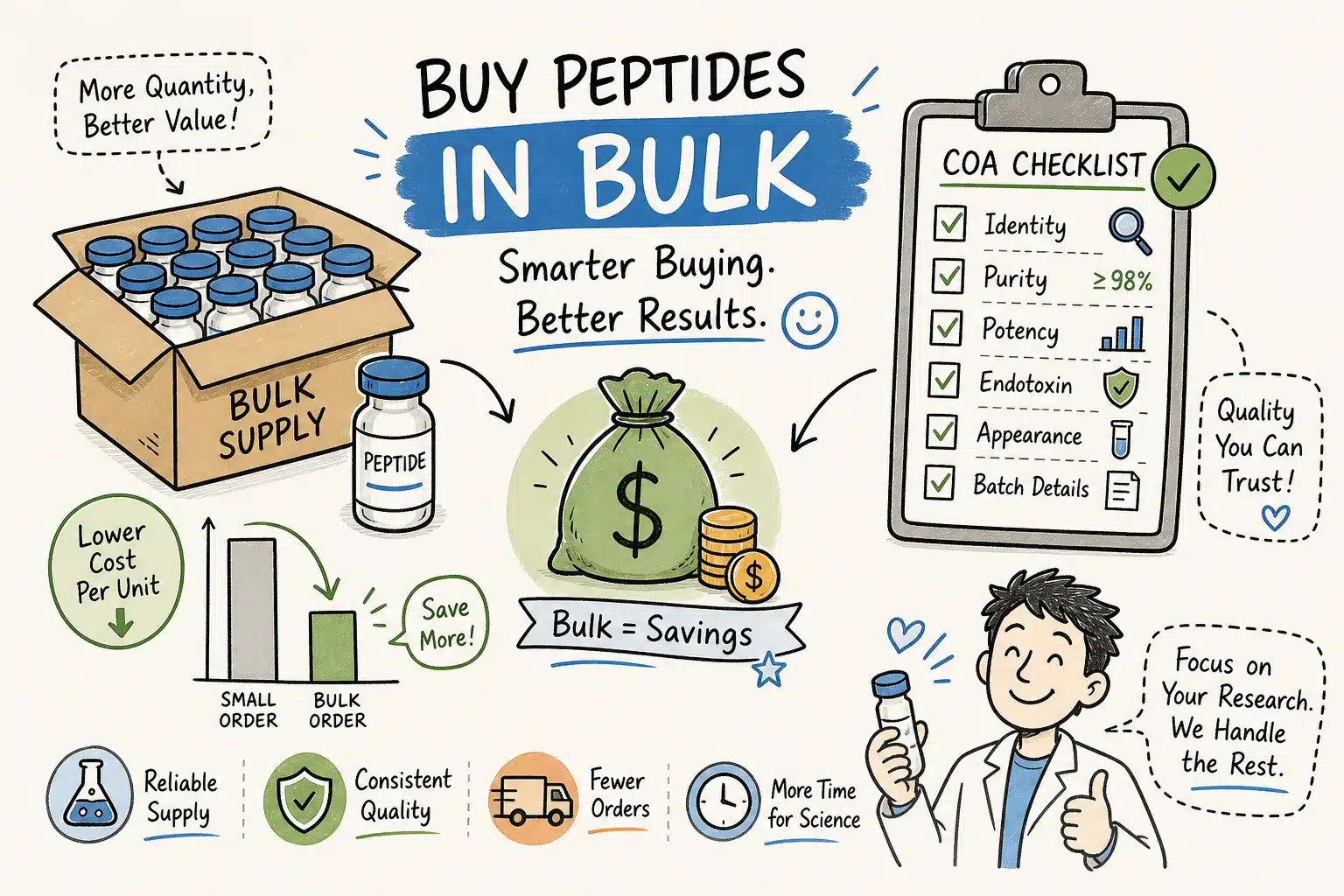
Getting bulk peptide sourcing wrong is expensive in ways that go beyond the invoice. Contaminated or underdosed bulk shipments waste research budgets, corrupt experimental data, and push timelines back by weeks, often with no guarantee the replacement performs any better. Buying in volume only saves money when the supplier, the documentation, and the logistics all hold up under real scrutiny.
If you plan to buy peptides bulk for your lab or reselling operation, knowing what to look for before committing to a large order is the difference between a cost-effective procurement cycle and an expensive mistake. US labs and resellers sourcing at volume have largely shifted toward suppliers that publish verified COAs, tiered pricing, and lot traceability as standard practice. More suppliers now publish COAs and lot traceability upfront, but gaps remain, which is exactly why this guide exists. It covers how to define bulk quantities for your operation, vet a new supplier, read tiered pricing structures, verify documentation line by line, and confirm shipping specs before anything ships.
What “bulk” actually means for different lab sizes
Not every buyer defines bulk the same way, and misunderstanding that threshold is how researchers end up locked into minimum order quantities that don’t fit their actual throughput. A solo researcher running a 90-day protocol has very different volume needs than a med spa restocking Ipamorelin quarterly or a reseller fulfilling orders weekly. Calibrating your expectations before you evaluate a single supplier saves time and avoids costly commitment mistakes.
At catalog vendors, bulk typically means purchasing two to ten or more vials of the same SKU. Gram-scale synthesis orders, by contrast, require quote-based arrangements and operate outside the standard catalog pricing model. Understanding which category your order falls into determines which suppliers you should even be contacting. Sending a gram-scale inquiry to a catalog vendor wastes everyone’s time; sending a ten-vial request to a synthesis-only operation gets you a pricing structure you can’t actually use.
Four buyer profiles map to illustrative bulk starting points. Independent researchers typically need around five to ten vials of one or two compounds per quarter as a reasonable starting estimate. Small biotech labs often run multi-compound protocols and benefit most from multi-vial bundle formats. Wellness clinic operators buying for client protocols need consistent restocking cadence, which means price stability matters more than hitting the lowest possible per-mg floor. Peptide resellers need the deepest per-unit pricing and the widest catalog depth available from a single source. These are practical heuristics, not hard rules, your actual volume will depend on protocol scope and throughput.
How to buy peptides bulk from a reliable supplier
Placing a substantial order from a supplier you haven’t vetted is a high-stakes gamble with your research budget. A single contaminated or underdosed bulk shipment costs far more than the order itself once you factor in wasted reagents, lost time, and compromised experimental integrity. Credible wholesale sources are easy to distinguish from risky ones if you know which signals to check.
Green flags worth confirming before you order include:
- Publicly listed COAs with specific lot numbers
- Verifiable HPLC purity data rather than a standalone percentage claim
- Transparent tiered pricing published on the supplier’s site
- Clear research-use-only labeling on all products
- US-based fulfillment or clear customs guidance for international orders
- Responsive pre-sale support that answers technical questions directly
Each of these signals that the supplier has infrastructure, not just a storefront. Pre-sale responsiveness matters especially because it predicts how they handle quality failures after your order ships.
Red flags should stop a bulk order cold. Generic “98% purity” claims with no analytical data behind them, missing or untraceable lot numbers, vague pricing that shifts when you ask for specifics, and absent RUO labeling are all disqualifying. These aren’t minor documentation gaps, they are signs that the supplier can’t verify what they’re selling you. When you encounter any of these issues, document the exchange and move on to the next candidate.
Before placing a first bulk order with any new vendor, send these six questions directly: What analytical method is used to confirm purity, and can I see a sample COA? What is the lot number traceability process? What is your lead time for bulk lots currently in stock versus out-of-stock? What is your policy if a batch fails to meet the stated purity specification? What is the reorder minimum for repeat wholesale pricing? Do you provide third-party testing documentation, and from which labs? How a supplier answers these questions tells you more than their website copy ever will. For additional vendor-vetting steps and purchasing context, consult our complete buyer’s guide for research peptide procurement.
Understanding bulk peptide pricing tiers and MOQ structures
How per-mg cost drops with volume
Price per milligram drops significantly as volume increases, but only if you understand how tiered discount structures actually work at the supplier level. Walking in blind and assuming “bulk means cheaper” leads to cart structures that don’t optimize your actual cost per compound. The math is straightforward once you know the model.
Small catalog packs in the one to ten milligram range run roughly $10 to $80 per mg depending on the compound and sequence length. Mid-size research packs in the ten to twenty milligram range typically fall closer to $4 to $11 per mg. Gram-scale commodity peptides can reach sub-dollar-per-mg territory, but those prices reflect simpler sequences at industrial volume and don’t apply to specialty compounds. GLP-1 receptor agonist analogs and longer-sequence peptides often remain higher-priced even at larger volumes due to synthesis complexity, so factor that into your budget when ordering these specifically. These ranges are consistent with publicly available pricing from research peptide catalog vendors, though exact figures vary by compound and market conditions.
Tiered discount structures and MOQ math
The most common tiered discount model works like a staircase: two vials gets approximately five percent off, three to five vials earns ten percent, six to nine earns fifteen percent, and ten or more units shifts to inquiry-based wholesale pricing. To see what that means in practice: if a five-mg vial retails at $50, a six-vial order at fifteen percent off brings the per-vial cost to $42.50, a $45 total savings on a $300 cart.
Some suppliers define bulk eligibility differently, requiring a purchase of at least five times the largest available pack size before any discount applies. That means if the largest catalog pack is five milligrams, you need to order twenty-five milligrams minimum to access bulk pricing. Flat wholesale pricing from dedicated bulk suppliers often bypasses this complexity entirely and gives you a lower per-unit floor from the first multi-vial order. When you buy peptides bulk wholesale, clarifying the exact discount trigger before building your cart prevents surprises at checkout.
Documentation every bulk peptide order must include
Required identity and purity tests
Purity claims without supporting documentation are marketing, not quality assurance. On a single vial, you might accept the risk. On a large bulk order, inadequate documentation is a liability that compounds across every experiment that uses the material. Know exactly what to request and what to look for when the paperwork arrives.
A complete Certificate of Analysis for a research-grade lyophilized peptide must include these non-negotiable fields:
- Full peptide sequence or chemical identity
- Batch and lot number that matches the vial label
- Date of analysis
- Testing laboratory name and accreditation
- HPLC purity as an area percentage with the chromatogram attached
- Mass spectrometry identity confirmation showing observed mass versus theoretical mass
- Storage conditions for the lyophilized material
For a practical primer on what to expect from supplier COAs and how to read them in the context of research purchases, see this resource on Certificates of Analysis, what researchers need to know.
Moisture, endotoxin, and higher-specification data
For higher-specification work or GMP-grade material, the COA should also show water content by Karl Fischer titration, endotoxin levels, amino acid analysis, counterion profile, and a full impurity profile identifying any synthesis by-products or degradation peaks.
The chromatogram matters as much as the purity number. A clean HPLC profile shows a dominant, well-resolved peak at the correct retention time with minimal flanking impurities. A cluttered baseline with multiple significant peaks tells a different story than a 95% purity figure alone. Always request the chromatogram, not just the summary line.
For third-party verification, reputable US-based analytical labs include ACS Laboratory, Eurofins Scientific, and SGS, all of which appear regularly in supplier documentation for peptide purity and identity testing. When you receive a COA, cross-check the lot number against the vial label directly. Any mismatch between the document and the physical product is a disqualifying issue, regardless of what the purity numbers say.
Shipping, lead times, and packaging for large peptide orders
A bulk order that arrives degraded or significantly delayed is a sunk cost, not a savings. Confirming fulfillment details before you place the order is part of the vetting process. Two variables drive most bulk shipping decisions: the physical form of the compound and the supplier’s current stock status.
Lyophilized peptide powder is the standard format for research vials and ships safely at ambient temperature for short domestic transit, generally up to five days without meaningful degradation risk, provided moisture barrier integrity holds. Stability can vary by peptide and transit conditions, so confirm packaging specs with the supplier before ordering. Liquid or reconstituted peptides require cold-chain packaging at two to eight degrees Celsius for transit under 48 hours, or dry ice for longer shipments or more labile compounds. Confirm the physical form of every compound in your order before checkout. Assuming room-temperature shipping is safe for a liquid-format peptide is how orders arrive compromised. For an industry-focused overview of cold-chain shipping for peptides, consult that supplier’s logistics guidance to set internal receiving standards.
On lead times, domestic stock orders at catalog vendors typically process within a few business days. Custom synthesis or large bulk lots that require production runs need two to three weeks minimum. Wholesale quote responses from established suppliers generally come back within 24 to 72 business hours, based on standard industry turnaround windows. For international orders, customs review adds unpredictable delay on top of transit time, and the shipment must be properly documented as research-use-only material to clear import compliance checks without issues, for practical guidance on import considerations, see this primer on importing research peptides from China to the US.
How R-Peptide Supply works for cost-conscious bulk buyers
R-Peptide Supply (Grey Peptide Shop) is built for the buyer profiles this guide describes: independent researchers, lab professionals, clinic operators, and resellers who need competitive wholesale pricing, wide catalog depth, and documentation that holds up to scrutiny. According to the supplier, products ship with a Certificate of Analysis, and the catalog is designed to cover the compounds that drive multi-vial bulk orders.
Multi-vial bundle formats are available across the catalog. Bundle options, such as combining complementary peptides into a single order, are a practical way for labs running multi-peptide protocols to reduce per-compound cost compared to purchasing each compound separately. The catalog also stocks ancillary supplies including bacteriostatic water, acetic acid water, and benzyl alcohol, which simplifies procurement by keeping everything in a single order rather than sourcing reconstitution supplies from a separate vendor.
A free shipping threshold changes the bulk ordering math directly. On qualifying orders, shipping cost drops to zero, which improves cost-per-vial across every compound in the cart. For labs and resellers ready to buy peptides bulk with verified documentation and competitive per-vial pricing, R-Peptide Supply is a practical starting point, review the available COAs and confirm current pricing and policies directly with the supplier before placing your order. You can begin by browsing their catalog of research peptides for sale.
Sourcing peptides in volume: putting the checklist to work
Buying research peptides bulk saves money reliably only when the supplier clears the reliability bar. Volume discounts are real, but they’re irrelevant if the documentation is incomplete, the lot numbers don’t trace, or the shipment arrives in the wrong physical form. The checklist this guide builds toward is straightforward: define your quantity needs by buyer profile, vet any new supplier with specific pre-sale questions, understand tiered pricing structures before you build your cart, request complete COA documentation including the HPLC chromatogram and MS data, and confirm shipping format and lead time before you commit.
For researchers and resellers ready to buy peptides bulk with verified documentation and competitive per-vial pricing, start by reviewing R-Peptide Supply’s catalog, requesting COA samples for your target compounds, and confirming current wholesale ordering options directly. Structure your order with confidence, but let the documentation and direct supplier responses, not marketing copy, drive the decision.