


Blog
Buy Ipamorelin & Hexarelin Online: Bulk Pricing Guide

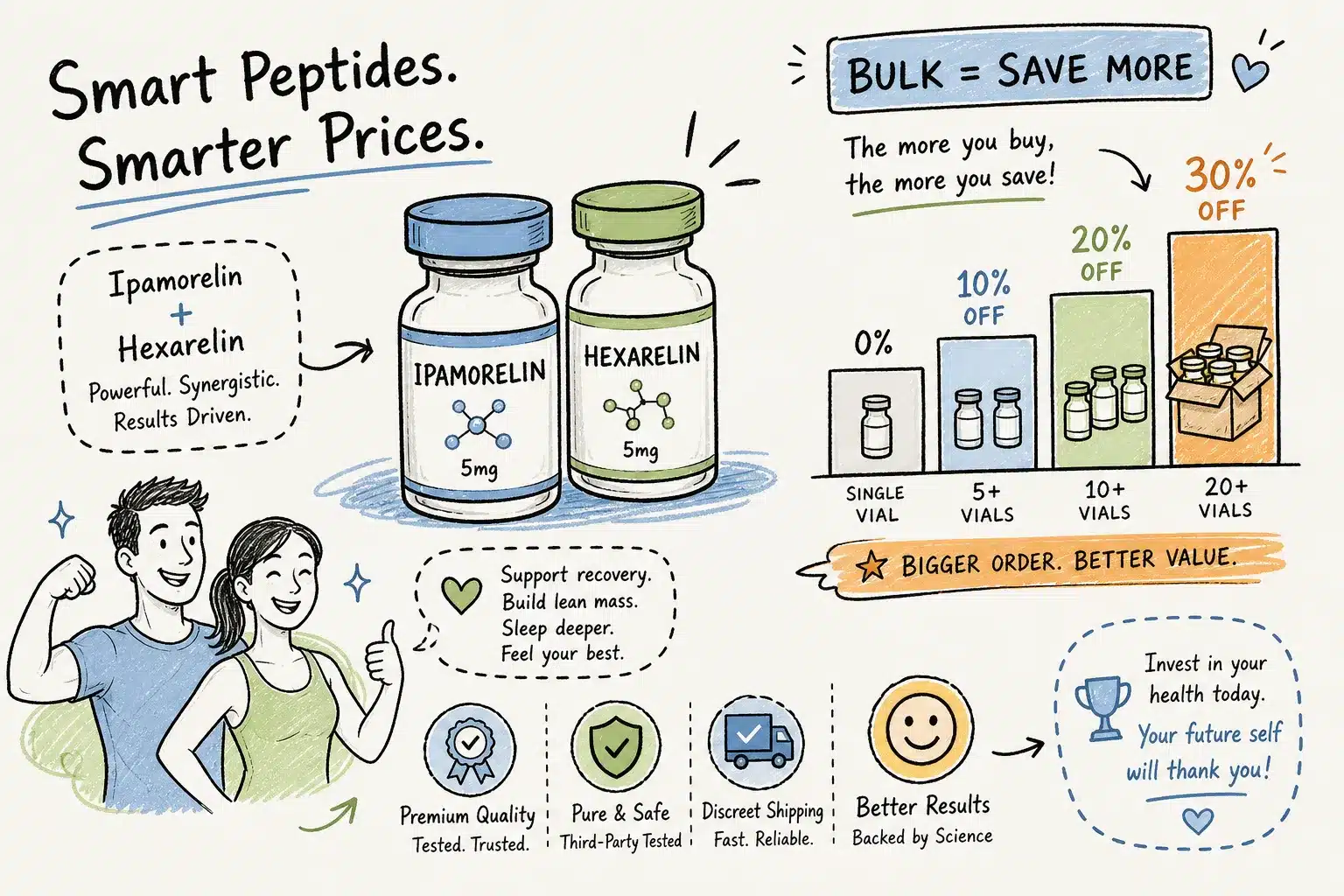
If you are planning a multi-week study with Ipamorelin and Hexarelin, the fastest way to blow your budget is to shop by sticker price per vial. Buy ipamorelin and hexarelin online bulk pricing only makes sense once you normalize everything to price per milligram, verify the peptide COA (certificate of analysis), and then account for shipping and supplies. That is how you compare providers cleanly and protect your research timeline.
Bulk peptide pricing shifts dramatically between single vials and multi-vial bundles. The steepest savings often begin at the 5, 9-unit tier and deepen again at 10, 19 units, with custom quotes kicking in around 20 or more. The catch is quality and logistics: a weak COA or slow, unprotected shipping can erase any discount you thought you won.
Below is a field-tested approach I use at R‑Peptide Supply (Grey Peptide Shop) to evaluate offers for Ipamorelin and Hexarelin. You will learn how to calculate true landed cost, read a COA, spot red flags, and choose a supplier that backs your work with reliable stock and documentation.
Start smart: what to check before you buy Ipamorelin and Hexarelin online in bulk
Clarify your research plan, total milligrams, and timeline
Start by sizing the study, then convert to a total milligram requirement with a cushion for repeats and outliers. Break that total into weekly or batch needs so you can map buy sizes to your bench schedule. Know your total milligrams and timeline before you even open a product page; quantity and cadence drive every downstream decision.
Build a short risk register. Include lead time, lot continuity needs, storage constraints, and resupply windows. If your work is sensitive to lot changes, plan to source from a supplier that can reserve or hold a consistent lot across phases.
Choose vial sizes and bundle formats that fit your workflow
Ipamorelin commonly ships in 10 mg vials, while Hexarelin is frequently offered in small vials (often 2 mg or 5 mg in market listings), verify current sizes with suppliers. Align vial size to your reconstitution plan and handling limits to avoid excess freeze, thaw cycles. Multi-vial bundles cut price and simplify replenishment, especially when you need consistent lots for repeat runs.
If your methods favor smaller aliquots, consider more units of a smaller vial size to reduce waste. For larger batch work, larger vial sizes can reduce per‑mg cost, as long as storage and handling remain controlled.
Quick note: R‑Peptide Supply (Grey Peptide Shop), how to verify current policies
Before checkout, confirm any supplier’s posted policies directly on their site or by request: recent, batch‑specific COAs; current shipping thresholds; and support availability. At R‑Peptide Supply, contact support to obtain sample documentation, confirm lot dates, and review shipping options for your timeline.
Buy Ipamorelin and Hexarelin online: bulk pricing math and true landed cost
Understand standard volume discounts: 5, 9, 10, 19, and 20+ units
Current tiered pricing in 2026 commonly shows 5, 9 units at roughly 5, 10% off, 10, 19 units at roughly 10, 15% off, and custom pricing for 20 or more. Some vendors add a bigger step at 25+ units. Plan your cart around the next price break if it lowers total spend without creating storage or handling risk.
Wholesale requests typically start around 20, 50, and 100+ units. Expect a quote instead of a fixed webpage price at those levels. Quote requests should specify total milligrams, required vial sizes, and whether you need single‑lot continuity.
Calculate price per mg vs. per vial for Ipamorelin and Hexarelin
Always reduce to price per milligram. The formula is simple: per‑mg cost equals vial price divided by milligrams per vial. For example, if a 10 mg Ipamorelin vial is listed at $50, that is $5.00 per mg; if a 5 mg Hexarelin vial is $40, that is $8.00 per mg. For broader market context on typical listing prices and how vendors present pricing, see this reference on Ipamorelin cost.
Misleading comparisons often stem from vial size differences. A 2 mg vial with a low sticker price can still be expensive per mg compared to a 5 mg vial. Compare like‑for‑like on a per‑mg basis, then decide which vial size best suits your lab workflow. When you evaluate price per mg vials across suppliers, you eliminate most of the confusion.
Include shipping, taxes, payment fees, and ancillary supplies in your total
Your landing page price is not your landed cost. Add up every dollar that touches the order so you can compare suppliers fairly. At minimum, include the following items in your spreadsheet:
- Shipping and cold‑pack fees, noting any free‑shipping thresholds
- Sales tax based on your ship‑to state or exemption status
- Payment or processing fees if applicable
- Ancillary supplies: bacteriostatic water or acetic acid water, sterile syringes for handling, sterile filtration if your SOP requires it, and extra vials for aliquoting
The output you want is a landed cost per mg. That is the only number that lets you compare vendors and vial sizes without bias.
Worked example: 10 vials vs. 20 vials, plus per 100 mg equivalents
Example A, based on a common published ladder: Ipamorelin 10 mg vials have a base of $53. At 10, 19 units, a 15% discount applies, so the vial price is $45.05. Buy 10 vials and you pay $450.50 for 100 mg. Add a 3% card fee ($13.52) and $12 in supplies, with free shipping over $200. Your landed total is $476.02 or $4.76 per mg.
Buy 20 vials at the same 15% discount and you pay $901.00 for 200 mg. With a 3% fee ($27.03) and $15 in supplies, your landed total is $943.03 or $4.72 per mg. The per‑mg improvement is small because the discount tier is unchanged, although fees and supplies amortize better.
Transitioning to a negotiated case makes the effect clearer.
Example B, negotiated bulk: suppose a supplier offers 20% off at 20+ units for the same item. The 20‑vial price becomes $42.40 each, or $848.00 for 200 mg. Add a 3% fee ($25.44) and $15 in supplies. Landed total is $888.44 or $4.44 per mg. That is a 6, 7% improvement over the 15% tier and a 6, 8% improvement over the 10‑vial purchase.
Repeat this math for Hexarelin by normalizing vial sizes. If a 2 mg vial is $18 and a 5 mg vial is $40 at the same discount tier, the 2 mg option is $9.00 per mg and the 5 mg option is $8.00 per mg before fees. When you reach for volume discounts, calculate per 100 mg equivalents to keep quotes consistent across both peptides.
COA essentials: verifying Ipamorelin and Hexarelin quality
What a real peptide COA must include: HPLC, MS, method details, and test date
A credible peptide COA includes purity by HPLC with the chromatogram, identity by mass spectrometry, the analytical method parameters, a recent test date, and the testing lab’s name. A single percentage without a chromatogram is not enough. Look for a dominant peak and a matching mass alongside clear method notes. For a practical walkthrough on how to read those COA elements, this guide on how to read a peptide COA is useful.
For routine peptide analytics, you should see RP‑HPLC on a C18 column with water and acetonitrile plus an acid modifier, usually TFA, and UV detection near 214 nm. Identity should show the observed molecular weight matching the theoretical mass for the exact salt form.
Match product name, lot number, and lab info for traceability
The COA must be batch‑specific with a lot number that exactly matches your vial. The product name and salt form should align. The testing lab should be named and contactable for verification, not just a generic “third‑party” stamp. Lot‑to‑vial matching is non‑negotiable if you care about reproducibility.
Save the COA PDF to your records along with the order invoice and shipping confirmation. This creates a clean paper trail if you need to audit results later.
How to read the chromatogram and evaluate a 98, 99 percent purity claim
In a clean chromatogram, your target analyte appears as one sharp, dominant peak. Minor peaks indicate small impurities or related species. A 98, 99 percent claim should be consistent with the integration shown on the trace; if multiple peaks approach similar size, the claim is weak. For a broader discussion of certificates of analysis and what researchers need to know, consult this overview on certificates of analysis.
Remember that purity does not equal sterility or the absence of every possible contaminant. HPLC purity reflects UV‑absorbing species at the chosen wavelength. Separate documentation is needed for sterility, endotoxin, or residual solvent if those factors are relevant to your protocol.
COA red flags: generic PDFs, missing identity data, or stale batches
Be cautious with COAs that lack a chromatogram, do not disclose the analytical lab, or present as a single percentage on a template PDF used across products. Outdated test dates indicate a stale batch rather than current stock. Mismatched molecular weight on MS is a hard stop since Ipamorelin and Hexarelin have distinct masses and sequences.
If a seller cannot provide a batch‑specific COA that ties to an actual lot on the shelf, move on. Your time is more valuable than a low sticker price with weak documentation.
Supplier credibility in 2026: policies that protect your budget
R‑Peptide Supply: documentation‑first workflows for bulk orders
Use the same standard for any supplier you consider: request batch‑specific COAs before purchase, confirm visible volume discounts, and ask whether consistent lots can be reserved for multi‑phase work. At R‑Peptide Supply (Grey Peptide Shop), contact us for current documentation and quotes aligned to your per‑mg or per‑100 mg targets.
Your account contact should be able to share lot availability, recent test dates, and example COAs before purchase. If you have a specific target price, discuss it openly so they can advise on vial sizes, discount tiers, and shipping options that fit your schedule. For suppliers that emphasize third‑party testing and published QA practices, review vendors that publish their testing approach, such as third‑party testing summaries on third‑party tested peptides.
Shipping speed, cold packs, and damage replacement terms to insist on
Ask for same‑day shipping cutoff times and carriers used. In hot months, request cold packs or heat‑shield mailers for lyophilized material, plus expedited transit to reduce thermal exposure. Require a clear DOA and damage‑replacement policy in writing: a 24, 48 hour reporting window from delivery, required photo evidence (outer box, inner packaging, vial label with lot number, and seal), and whether the remedy is replacement or refund. Note if a prepaid return label is issued for damaged goods.
When your vials arrive, photograph box condition, inner packaging, and seals. If something is off, you will have an immediate record to trigger a replacement.
Clear contact info, support hours, secure payments, and transparent pricing
A credible supplier posts a physical address, support hours, and responsive contact channels. Payment pages should be secure and list fees transparently. Price tiers must be visible or quickly quotable with no surprise surcharges. If time is critical, confirm live support hours and escalation paths before you place an order.
For formal purchasing, ask whether POs are accepted and whether invoices can map line items to lot numbers for your records. Verify these details in writing.
Wholesale quotes for 50, 100+ units and consistent lot availability
High‑volume work benefits from consolidated lots. Ask whether the supplier can allocate a single lot for the entire order or stagger releases from the same lot. For 50 and 100+ units, confirm restock cadence and lead times.
R‑Peptide Supply can provide quotes for 20, 50, or 100+ units and discuss lot holds and scheduling on request. If you need a detailed procurement playbook for larger purchases, see this Bulk Peptide Wholesale USA: The Lab Procurement Guide, Research Peptides Supply for specific purchasing considerations.
Red flags when you buy Ipamorelin and Hexarelin online, bulk pricing pitfalls
Prices far below market and bait‑and‑switch vial sizes
If a price looks unreal, it probably is. Extremely low vials often mask a smaller milligram amount, so the per‑mg cost turns out higher than standard offerings. Always normalize to per mg and confirm vial size on the label and COA.
Watch for listings that toggle between 2 mg and 5 mg presentations without changing the SKU or images. That creates confusion and misleads on cost and handling.
No batch‑specific COA, stock photos, or unverifiable third‑party labs
A vendor that will not show a batch‑specific COA before purchase is not a safe bulk partner. Stock photography, redacted lab names, or vague “independent testing” language are soft red flags that usually lead to harder ones.
Ask for a redacted COA with all analytics visible and the lot number intact. If that cannot be shared, you have your answer.
Marketplace‑only sellers with no address or return process
Generic marketplace storefronts often lack a return policy, address, or support channel. This makes damage, loss, or substitution nearly impossible to resolve. Avoid any seller that will not state policies and identity clearly.
A research budget depends on predictable fulfillment. Keep your procurement with suppliers that stand behind shipments in writing, specifying return authorization steps and timelines.
Poor packaging, broken seals, clumping, or heat exposure in transit
Inspect every delivery. Lyophilized peptides should present as a dry, intact cake with an unbroken flip cap and stopper. Heavy clumping, discoloration, or obvious heat damage call for immediate replacement.
Photograph issues on arrival and contact support the same day. A credible supplier will replace or refund promptly under their DOA policy.
Where to source with confidence: shortlist, compliance, and next steps
How to build a shortlist and request proofs before you buy
Identify three to five suppliers with visible pricing tiers and a documented COA process. Request a current, batch‑specific COA for Ipamorelin and Hexarelin, a photo of the actual vial labels, and a written note on shipping method, cold packs, and DOA terms. Ask for per‑mg quotes at your target quantities, including fees and shipping. For local procurement considerations and vendor screening, see this guide on Peptides for sale near you: how to find trusted vendors, Research Peptides Supply.
Compare per‑100 mg equivalents to keep quotes aligned. Favor vendors that respond quickly, provide unambiguous documents, and confirm lot availability on your dates.
RUO compliance basics for the United States and what to document
Order only research‑use‑only peptides, not for human consumption or clinical use. Keep on file: the invoice, batch‑specific COA, RUO labeling, and any import or tax documentation that applies to your institution. This protects your team and keeps procurement clean.
If you ship across state lines or to third‑party facilities, align on chain‑of‑custody handling and storage guidance. The COA test date and lot number should remain visible at every handoff.
Decision checklist: 8 items to confirm before checkout
- Per‑mg price at your exact quantity, plus a per‑100 mg equivalent
- Clear discount tiers for 5, 9 and 10, 19 units, and whether 20+ is quote‑based
- Batch‑specific COA with HPLC chromatogram, MS identity, method, and test date
- Lot number on vial matches the COA and will be in stock for your timeline
- RUO labeling, storage guidance, and packaging details in writing
- Shipping speed, cold‑pack policy in warm months, and DOA/damage terms
- Final landed cost including shipping, taxes, fees, and ancillary supplies
- Supplier identity: address, support hours, and secure payment options
Why R‑Peptide Supply is a practical starting point for bulk orders
We built our process around the procurement steps above. If you want documentation before you buy, ask us for batch‑specific COAs, example labels, and a per‑mg or per‑100 mg quote at your quantities. We will align timing and packaging to match your protocol.
If you need a side‑by‑side landed‑cost comparison or a COA review before purchase, message support. We will run the math with you and confirm the documentation and scheduling details in writing. For a broader primer on buying research peptides online and evaluating vendors, see our complete buyer’s guide: Research peptides for sale online: the complete buyer’s guide, Research Peptides Supply.
Make your bulk purchase with precision
Comparing Ipamorelin and Hexarelin offers is straightforward when you normalize to price per mg, verify the COA, and include shipping and supplies in the math. That clarity unlocks real savings at 10, 20, and 50+ units without sacrificing quality or logistics.
Ready to source? Build your shortlist, request proofs, and run a per‑100 mg tally for each quote. Use this checklist whenever you evaluate buy ipamorelin and hexarelin online bulk pricing. Place your order online or contact R‑Peptide Supply for a volume quote. Clean math and verified documentation are what protect your timeline and your budget.