


Blog
BPC-157, GHK-Cu, TB-500 stack research: benefits explained

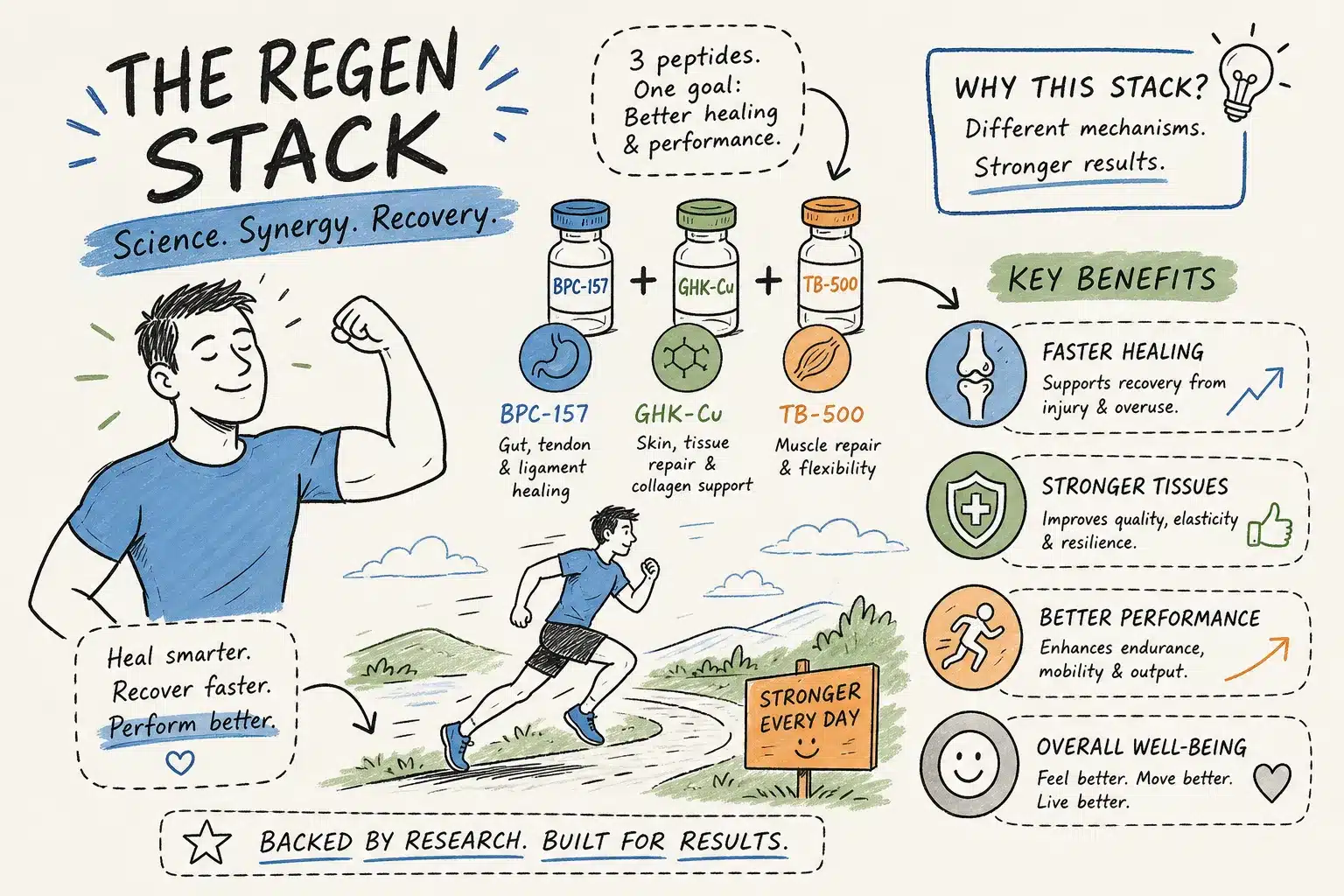
Research on stacks combining BPC-157, GHK-Cu, and TB-500 consistently points to complementary effects on tissue repair. These three peptides appear together in lab SOPs because they map to distinct, non-overlapping axes: signal initiation, cell migration and angiogenesis, and extracellular matrix rebuilding. The preclinical story is strong across tendon, muscle, skin, and gut models, while human data remain narrow and early-stage. All use is research use only (RUO) and not for human consumption.
For labs that need COA-verified materials aligned with these models, R-Peptide Supply (Grey Peptide Shop) offers the GLOW stack with lot-level documentation. The focus is on reproducibility: clear labeling, matched lots, multi-vial bundles, and third-party HPLC reports attached to every order. The sections below summarize mechanisms, evidence strength, practical protocols, and compliance guardrails so your team can plan clean, measurable work.
BPC-157, GHK-Cu, and TB-500 stack research: what the data show
Across animal and in vitro studies, researchers consistently observe faster tissue repair, better collagen architecture, more organized angiogenesis, and lower inflammatory markers when these regenerative peptides are studied individually and in combination. Human studies exist but are small, indication-specific, and not powered to establish dosing standards. The overall picture is one of strong preclinical signals alongside limited clinical proof.
Effects are most consistent in tendon and ligament repair, skeletal muscle recovery, cutaneous wound closure and matrix quality, and protection of gut mucosa. Endpoints that recur across studies include re-epithelialization speed, tensile strength, collagen deposition and alignment, and shifts in MMP and TNF profiles. Labs that measure these readouts with blinded scoring typically report cleaner data and less systematic bias.
What remains unproven in humans are broad systemic, performance, or generalized anti-aging claims. There are no large randomized trials establishing peptide stack dosing standards. Protocols circulating in forums or clinical write-ups reflect reported practice, not evidence-based guidelines. A practical stance for any lab is to align each peptide to a mechanistic endpoint, pre-register timepoints, and document handling with COA-verified lots.
Mechanisms behind BPC-157, GHK-Cu, and TB-500 synergy
BPC-157 engages repair signaling across tendon, muscle, and gut models. It promotes tendon fibroblast migration and outgrowth, one in vitro report describes roughly 2.3-fold greater tendon fibroblast migration at 2 µg/mL, and supports angiogenic cues while demonstrating gastroprotective effects in animal models, including NSAID-ulcer protection and acceleration of mucosal healing.
TB-500 is the research-market peptide related to thymosin beta-4 (Tβ4), and much of the published mechanistic literature concerns native Tβ4. Mechanistically, Tβ4 interacts with G-actin to enable cell motility, supports keratinocyte migration, and drives pro-angiogenic signaling. This actin-centric mobility program manifests as faster wound closure, richer capillary beds, and more organized tissue remodeling in preclinical models.
GHK-Cu is a copper-peptide complex that modulates extracellular matrix remodeling. It upregulates collagen and decorin synthesis, influences fibroblast and keratinocyte activity, and tunes MMP-2 and MMP-9 alongside inflammatory mediators. In human skin studies using topical formulations, investigators report improvements in firmness, elasticity, and dermal density, supported by biopsy and ultrasound readouts (epigenetic mechanisms activated by GHK‑Cu).
When stacked, the rationale is a division of labor among complementary pathways: BPC-157 cues repair initiation and supports angiogenic signaling; TB-500 drives the cell migration machinery that physically mobilizes reparative cells; GHK-Cu rebuilds and organizes the matrix while dampening inflammatory noise. Overlapping but nonredundant pathways are precisely what supports the trio’s logic in BPC-157/GHK-Cu/TB-500 stack research.
Why pathway diversity matters for study design
Because each peptide targets a different phase of the repair cascade, combining them theoretically reduces redundancy and increases the range of measurable endpoints. This also means that poorly designed studies risk confounding readouts if timing and dosing windows are not aligned to each compound’s mechanism. Design your assay around the pathway, not the peptide name.
What studies report: outcomes and endpoints to track
For BPC-157, animal studies of tendon and ligament commonly show improved biomechanical strength, better collagen organization, and faster tendon-to-bone integration. The in vitro tendon fibroblast migration effect (~2.3-fold at 2 µg/mL) aligns with these repair signals. In gut models, researchers report NSAID-ulcer protection and accelerated healing across gastric, esophageal, and colonic mucosa. Cutaneous and muscle wounds trend toward faster closure and reduced fibrosis in animal subjects.
For TB-500 and native Tβ4, a classic rat full-thickness wound model reported re-epithelialization increases of approximately 42% at day 4 and up to 61% at day 7, along with increased collagen deposition and angiogenesis. Small human dermatologic and ocular trials suggest faster healing and better corneal metrics, one study cited a 35.1% reduction in ocular discomfort and a 59.1% reduction in total corneal fluorescein staining versus vehicle. The human evidence remains early-stage, and effect sizes vary by indication and formulation.
For GHK-Cu, placebo-controlled topical studies report improvements in firmness, elasticity, and wrinkle metrics, with biopsy data showing higher collagen deposition. A comparative outcome cited in several reviews notes collagen deposition improvements in 70% of women using GHK-Cu versus 50% with vitamin C and 40% with retinoic acid over one to three months. A 2023 ultrasound report described an average 28% rise in subdermal echogenic density after three months with a stable GHK-Cu gel, a finding that correlates with collagen and elastin structures.
These findings translate into protocol design most effectively when you lock in assays and timepoints before procurement, align each compound to the readout it most plausibly influences, and choose objective measurement tools over subjective scores wherever possible. Define endpoints up front; that discipline keeps your GLOW stack study honest and defensible.
- Tendon and ligament: tensile testing, blinded histology with collagen alignment scoring, fibroblast migration assays
- Cutaneous wounds: re-epithelialization percentage by day, capillary density, hydroxyproline content
- Muscle: fiber cross-sectional area, fibrosis indices, functional strength testing
- Matrix and inflammation: MMP-2/9 panels, TNF profiles, decorin and collagen I/III ratios
- Skin structure: high-resolution ultrasound echogenicity, biopsy-based collagen density when feasible
Stack dosing and protocols for the BPC-157/GHK-Cu/TB-500 stack
Select vial formats that match your study arms and replicates to avoid mid-study lot changes. For injection-oriented work, bacteriostatic water is the default diluent unless stability data indicate another solvent. Standardizing concentrations across peptides in the stack simplifies arithmetic and reduces pipetting error. Label all vials and working aliquots with molecule, concentration, and expiration before use.
Reconstitution procedure
Reconstitute peptides using a single, sterile workflow and record traceability at each step. Handle vials gently throughout to protect the peptide backbone and prevent aggregation.
- Bring the vial and diluent to room temperature.
- Disinfect the stopper, then add solvent slowly along the glass wall, not directly onto the lyophilized cake.
- Gently swirl or roll the vial; do not shake or vortex.
- Confirm clarity, then label with concentration, date, time, handler, and lot number.
- Enter the same details in a shared log for chain-of-custody documentation.
Storage and stability
Store reconstituted solutions at 2, 8 °C, protected from light and heat, and avoid freezing once in solution. Define a conservative use window based on available stability data and your internal QA, typically 24 to 30 days for bacteriostatic preparations unless your validation supports a longer period. Working aliquots require a secondary clock that never exceeds the parent vial’s window.
Administration formats in studies vary by tissue target and formulation. Animal models commonly use injection routes for BPC-157 and Tβ4-related peptides, while topical routes dominate GHK-Cu skin protocols; some animal work has also explored oral or topical BPC-157. Peptide stack dosing patterns circulated in clinical write-ups, such as daily subcutaneous BPC-157 in the 250, 500 µg range, should be treated as reported practice rather than evidence-based guidance. Always align route and timing to the assay you plan to measure.
Safety, compliance, and quality control in RUO labs
Human safety data for these compounds is limited. A small 2025 pilot in two healthy adults reported no adverse effects with 10 mg then 20 mg of intravenous BPC-157 delivered over one-hour infusions, with no changes in basic organ-function markers. That sample size cannot define long-term safety, and systemic human safety datasets for TB-500 and GHK-Cu remain sparse outside topical skin research. Claims about peptide therapy safety should stay anchored to available data, and systemic assertions warrant a higher evidentiary bar. For a concise summary of available clinical reports and early-stage trials, see a recent review of BPC‑157 clinical evidence.
Quality control matters as much as dosing arithmetic. Require third-party HPLC reports that include purity percentage, identity confirmation, and lot numbers matching both vial labels and COA. Maintain a clean chain-of-custody from receipt to disposal. Contamination and poor documentation introduce more experimental noise than most mechanistic variables discussed in the literature.
In the United States, these materials are sold RUO and labeled not for human consumption. Anti-doping bodies maintain strict positions: WADA lists BPC-157 as an S0 non-approved substance and names thymosin beta-4 and its derivatives, including TB-500, on the 2026 Prohibited List. Clinics and athletes should seek independent compliance counsel; research labs should keep RUO procurement and bench work distinctly separate from patient care or performance contexts.
Escalate oversight when moving beyond bench assays. IRB or institutional review is appropriate for protocols involving animals or human tissues under governance. Consult toxicology and biosafety officers on dose ranges, disposal, and escalation triggers, and document deviations and adverse observations even in exploratory RUO settings.
Sourcing the stack: one order, verified documentation
Bundling all three compounds simplifies study logistics and strengthens your audit trail. A single vendor with consistent labeling and matched lots reduces variability across arms, shortens reorders, and tightens traceability when reviewers request documentation. One vendor, one paper trail, fewer uncontrolled variables.
The GLOW stack from R-Peptide Supply delivers COA-verified BPC-157 with verified COA, GHK-Cu, and TB-500 in one order. Wholesale pricing, multi-vial bundles for parallel arms, and precise lot traceability connect every vial to its COA. Orders over $200 ship free within the United States, and the support team is available 24/7 for documentation requests.
R-Peptide Supply also stocks ancillary supplies for validated workflows, including bacteriostatic water, acetic acid water, and benzyl alcohol, with fast, discreet fulfillment. Aligning receipt dates with your study start keeps stability clocks and sampling windows intact. Regardless of vendor, evaluate any supplier against the documentation standards below before committing to a lot.
- Insist on real third-party COAs tied to your exact lot number, not a generic sample report.
- Verify consistent, legible labeling with molecule, concentration, and lot on every vial.
- Avoid bundles that mix lots or rebrand without traceability, and decline vendors who refuse identity or purity data.
Closing thoughts
The BPC-157/GHK-Cu/TB-500 stack makes mechanistic sense because it covers three distinct repair axes: BPC-157 for repair signaling, TB-500 for actin-driven migration and angiogenesis, and GHK-Cu for matrix remodeling with an anti-inflammatory balance. Design assays that mirror those axes, choose objective endpoints, and protect your experiment with tight documentation and COA-verified materials.
The summary of current GLOW stack research is direct: compelling preclinical signals from multiple tissue models, early human data in narrow indications, and a clear mandate for measured, well-documented work. Broad systemic or performance claims outpace the available evidence. For a single, documented procurement path that keeps your paper trail intact, the COA-verified GLOW stack from R-Peptide Supply (Grey Peptide Shop) consolidates sourcing without adding variability. RUO only, not for human consumption.