


Blog
Buy With Confidence: Premium BPC 157 Vials for Sale Lab Tested for Quality

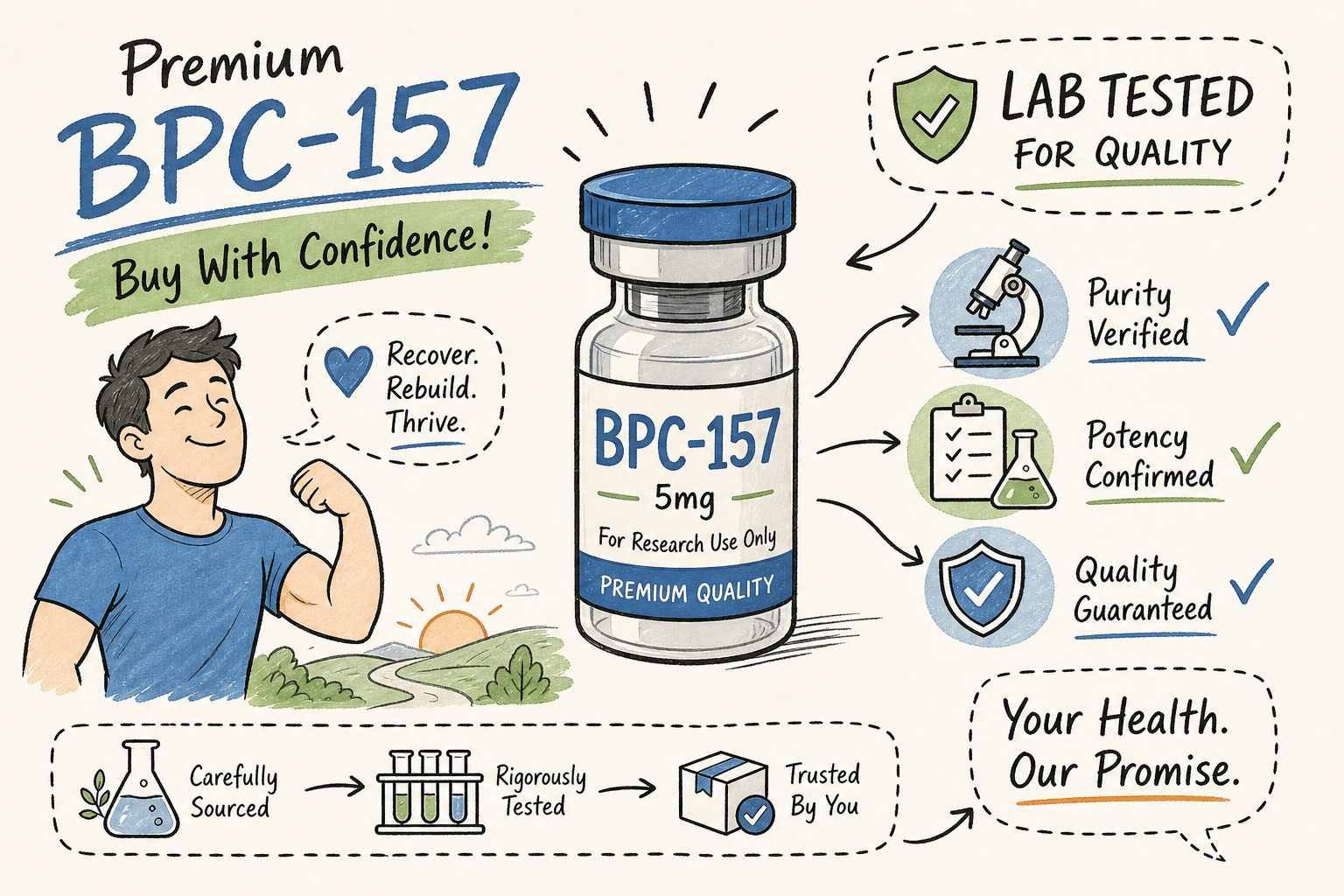
When searching for BPC 157 vials for sale lab tested to research-grade standards, the phrase “lab-tested” itself is nearly meaningless without context. The peptide market is flooded with vendors using it as a marketing badge, yet the term carries wildly different weight depending on who ran the test, how results are reported, and whether any of it can actually be verified. BPC-157 vials for sale lab tested is among the most-researched compounds in the grey market peptide space and, by most accounts from independent re-testing programs, among the most frequently misrepresented. Buyers deserve a concrete framework for evaluating BPC-157 vials for sale lab tested before placing an order, not a supplier’s word and a logo.
This guide is built around what real documentation looks like. By the time you finish reading, you’ll know exactly what to check, what to skip, and how to source with full confidence, whether you’re ordering a single 5mg vial or scaling up across a multi-experiment protocol.
What “lab-tested” actually means for a BPC-157 peptide vial
Seeing “lab-tested” on a product page tells you almost nothing on its own. The critical distinction is who ran the test. In-house testing means the vendor analyzed their own product using their own equipment. Third-party testing means an independent, accredited laboratory performed the analysis with no financial stake in the result. Those two scenarios are not equivalent, and treating them as such is one of the most common sourcing mistakes researchers make.
A legitimate COA for BPC-157 comes from an independent lab operating under ISO/IEC 17025 accreditation. That standard requires calibrated equipment, validated methods, and auditable records, and it means the lab can be contacted directly to confirm a report was actually issued. If a supplier cannot name the testing lab or provide contact information for it, the COA is unverified by definition.
Third-party vs. in-house testing: why the distinction matters
Consider what in-house testing actually means in practice: the vendor controls the equipment, the method, and the report. There is no external check on the result. An ISO/IEC 17025-accredited independent lab removes that conflict entirely. Standardized calibration, validated analytical methods, and externally auditable records mean results can be independently confirmed rather than simply trusted. The rule is straightforward: if the COA doesn’t name a specific third-party lab with verifiable contact information, treat it as unverified.
HPLC and mass spectrometry: the two tests that validate a vial
Two analytical methods define research-grade BPC-157 documentation. High-Performance Liquid Chromatography (HPLC) separates the target compound from all other detected material and expresses the BPC-157 peak as a percentage of total detected area, that percentage is your purity number. Mass spectrometry (MS) serves a different purpose: it confirms the compound’s identity by matching the observed molecular weight against the theoretical value, approximately 1419.53 Da for BPC-157, within a tolerance of ±1, 2 Da.
Both tests are necessary. HPLC alone cannot confirm the amino acid sequence. MS alone doesn’t tell you how pure the sample is. A COA that includes both methods with a chromatogram attached to the HPLC result is the baseline documentation standard for any BPC-157 vial worth ordering.
How to read a BPC-157 COA the right way
A Certificate of Analysis is a structured document, and each field exists for a specific reason. Reading one correctly means knowing what each field should say, and recognizing what a suspicious entry looks like. Start with the basics: the compound name should appear alongside CAS number 137201-92-6 to confirm you’re reviewing documentation for BPC-157 specifically, not a generic peptide entry. The MS result should show an observed molecular weight that falls within the ±1, 2 Da tolerance window against the theoretical value. For a practical walkthrough on interpreting COA fields, see this how to read peptide COA guide.
Pre-purchase COA accessibility is the baseline you should expect from any serious vendor. If documentation is only provided after payment, that’s a structural red flag regardless of what the purity figure says.
The fields every legitimate COA must include
Every legitimate BPC 157 vials for sale lab tested should come with a detailed COA to establish credibility. This verification is essential to avoid issues in research using BPC 157 vials for sale lab tested.
Work through the document systematically rather than scanning for a purity percentage and stopping there. Each of these fields must be present and internally consistent:
Compound name and CAS number confirm the document is specific to BPC-157. MS molecular weight result must align with the theoretical value within tolerance. HPLC purity must come with an attached chromatogram showing actual instrument-generated peak data, not a typed percentage alone. Batch or lot ID must match the label on the vial you received. Test date must fall within a plausible production window. Lab name, accreditation details, and direct contact information must all be present so the report can be independently confirmed. For an expanded perspective on COA quality and what each field implies, the how to read peptide COA quality resource is helpful.
Purity benchmarks and how to interpret the numbers
Real HPLC results look like instrument output: 98.4%, 96.567%, 99.1%. These are irregular values produced by a chromatography system comparing peak areas. A perfectly round figure, exactly 99.00% or 98.00%, is worth pausing on. Typed values rather than instrument-generated outputs are a documented pattern in fabricated reports, and round numbers are one of the clearest signatures. For research applications, 95% is the floor for acceptable purity. 98% represents solid documentation. 99%+ is the premium tier. Below 95%, the proportion of uncharacterized impurities in the sample directly compromises experimental reproducibility.
Be vigilant for red flags when sourcing BPC 157 vials for sale lab tested to avoid falling victim to fraudulent offers. Always verify your supplier’s claims.
Red flags that expose a fake or recycled lab report
Fabricated COAs are more common in the grey market peptide space than most buyers expect. Community-driven independent testing programs have documented failure rates reaching 50% for online peptide products, meaning roughly one in two vials tested failed to match label claims. Fraudulent documents tend to share recognizable patterns, and knowing those patterns gives you a reliable filter before any order is placed.
Patterns found on fabricated COAs
The clearest red flags include perfectly round purity percentages, chromatogram images that appear identical across different products or batches, missing or generic batch IDs, and test dates that are absent or implausibly old. Watch also for COAs provided only after purchase rather than accessible upfront, documents listing a compound name without a CAS number or sequence confirmation, and any report issued by an unnamed “internal lab” with no external verification pathway. When a chromatogram image shows up on multiple product pages, that single observation eliminates the document’s credibility entirely, a real instrument generates a unique output for each sample run.
How to verify a COA directly with the testing lab
To ensure the integrity of your results, always verify the COA for BPC 157 vials for sale lab tested. This step is vital in maintaining the quality of your research protocols.
Verification takes three steps. Pull the batch or lot ID from the COA. Contact the named third-party lab using the contact information listed on the document itself, not the supplier’s website. Ask the lab to confirm the report was issued for that specific batch. Legitimate accredited labs with public verification portals allow report number lookups directly in their database. If the lab cannot confirm the document, the COA is invalid regardless of what the purity figure says. QR codes that link to a live verification portal are an additional positive signal worth noting. For more on why third-party validation matters and how vendors demonstrate it, see this discussion of third-party validation.
Buying guide: BPC 157 vials for sale lab tested, 5mg vs 10mg formats
For those considering BPC 157 vials for sale lab tested, understanding the importance of sourcing quality peptides is crucial. The integrity of research results hinges on using BPC 157 vials for sale lab tested that meet strict documentation standards.
When deciding between BPC 157 vials for sale lab tested in 5mg and 10mg formats, consider how this choice affects your research outcomes. Selecting BPC 157 vials for sale lab tested ensures you’re working with verified products.
If you’re new to purchasing, choosing BPC 157 vials for sale lab tested can help mitigate risks associated with inconsistent quality. It’s key to validate the supplier before making a decision on BPC 157 vials for sale lab tested.
Both formats contain the same compound at the same purity. The decision between a 5mg and a 10mg lyophilized BPC-157 vial is primarily economic and logistical, not chemical. Both sizes maintain stability under the same storage conditions. What differs is how far each vial stretches across a research timeline and what the effective cost per milligram looks like.
When 5mg vials make practical sense
Take a specific scenario: a researcher sourcing from a vendor for the first time. A 5mg vial limits exposure if compound quality turns out to be inconsistent. Beyond that, the 5mg format suits short-duration studies, lower-frequency dosing protocols, initial protocol development, and any situation where the priority is validating compound quality before scaling up. Lower per-unit cost also makes it accessible for individual researchers and smaller labs running targeted experiments.
When 10mg vials offer better research economics
The 10mg format reduces the effective cost per milligram compared to purchasing two separate 5mg vials. For ongoing studies, multi-experiment protocols, and labs running repeated experiments where consistency across a single batch matters, it’s the more practical choice. Bulk pricing tiers compound those savings further, for example, a 5% discount at five or more vials and 10% at ten or more reduces per-milligram cost meaningfully at scale. One caution applies regardless of format: a larger order from an unverified supplier multiplies risk, not just volume. COA verification matters more at scale, not less. For a direct comparison of 5mg vs 10mg formats and practical considerations, see this BPC-157 5mg vs 10mg comparison.
Why sourcing from a verified supplier protects your research integrity
Having access to BPC 157 vials for sale lab tested with a clear documentation trail can significantly enhance the reproducibility of your research data.
The quality of input compounds determines whether experimental data is trustworthy. A BPC-157 vial containing 10, 12% uncharacterized impurities doesn’t produce a clean BPC-157 response, it produces a mixed signal that can’t be accurately attributed to the target compound alone. That’s a reproducibility problem with real downstream costs: wasted reagents, invalid datasets, and experiments that must be rerun entirely with verified material.
The downstream cost of unverified peptides in research
Here’s a concrete example. A researcher runs a cell viability assay using a BPC-157 vial that contains 12% unidentified impurities. Results come back anomalous. The researcher cannot determine whether the response originated from BPC-157 or a contaminant. The entire experiment must be rerun from scratch with a verified compound, at the cost of reagents, time, and full protocol recalibration. Verified sourcing eliminates that scenario before it starts.
Researchers should prioritize finding BPC 157 vials for sale lab tested as part of their sourcing strategy. This commitment to quality is vital for successful research outcomes.
What consistent batch documentation enables
R-Peptide Supply offers BPC 157 vials for sale lab tested to meet rigorous standards, ensuring that researchers have access to reliable peptides.
Lot traceability gives researchers a paper trail. When every vial carries a batch number tied to a specific downloadable COA, the researcher can document exactly which compound specification was used in a given study. That matters for publication, for replication by other labs, and for internal protocol consistency across experiments. A lyophilized BPC-157 vial from a supplier with batch-specific COA documentation isn’t just a sourcing preference, it’s a research infrastructure decision.
When looking at pricing, remember that investing in BPC 157 vials for sale lab tested can yield better long-term value for your research projects.
How to verify BPC 157 vials for sale lab tested at R-Peptide Supply
Every documentation standard this guide has described has a concrete counterpart at R-Peptide Supply (Grey Peptide Shop). COAs are available as downloads directly on the BPC-157 product page, accessible before purchase so researchers can review purity data and lot documentation before committing to an order. HPLC purity results come with chromatogram data. Batch-specific lot numbers tie each vial to its corresponding test report. That pre-purchase accessibility is the structural standard that separates a documentation-first supplier from one relying on marketing language alone.
COA documentation and batch traceability at R-Peptide Supply
The documentation approach at R-Peptide Supply extends across the research peptide catalog, not just BPC-157. Third-party testing documentation, HPLC purity data, and lot-specific traceability are standard features of every listing, for example, see the product-level listing for VIP, Research Peptides Supply Buy VIP5 Online as an illustration of how COAs and batch IDs are surfaced on individual pages. Compare that against the red flags covered earlier, COAs available only after purchase, unnamed labs, missing batch IDs, and the contrast is direct. All compounds are sold strictly for research use only, in compliance with RUO framing.
Pricing, vial formats, and the ordering threshold
BPC-157 is stocked in both 5mg and 10mg lyophilized vial formats. Wholesale pricing tiers support multi-vial ordering for labs and resellers, with orders over $200 qualifying for free shipping. Secure payment processing and accessible customer support round out the operational side of the ordering process. To review the COA for the current BPC-157 batch before placing your order, visit the BPC-157 product page at R-Peptide Supply directly. You can also browse the full Shop, Research Peptides Supply to compare lot documentation across multiple research peptides.
Confidence comes from documentation, not claims
Every purchasing decision for lab-tested BPC-157 vials ultimately comes down to one question: can you independently verify the documentation behind the purity claim? A vendor’s stated percentage is only as reliable as the third-party COA supporting it, and that COA is only as reliable as the accredited lab that issued it. Use the purity benchmarks, batch traceability requirements, and red flag checklist in this guide as your filter before placing any order.
When evaluating BPC 157 vials for sale lab tested to a verifiable standard, the practical checklist is short: pre-purchase COA access, an ISO/IEC 17025-accredited third-party lab named on the document, HPLC chromatogram data, batch-specific lot numbers, and a direct verification pathway to the lab. R-Peptide Supply is structured around exactly that documentation framework, third-party tested, batch-traceable, and accessible before you order. That’s the only configuration worth building a research protocol around. For ongoing updates and related guidance, see the Blog, Research Peptides Supply.