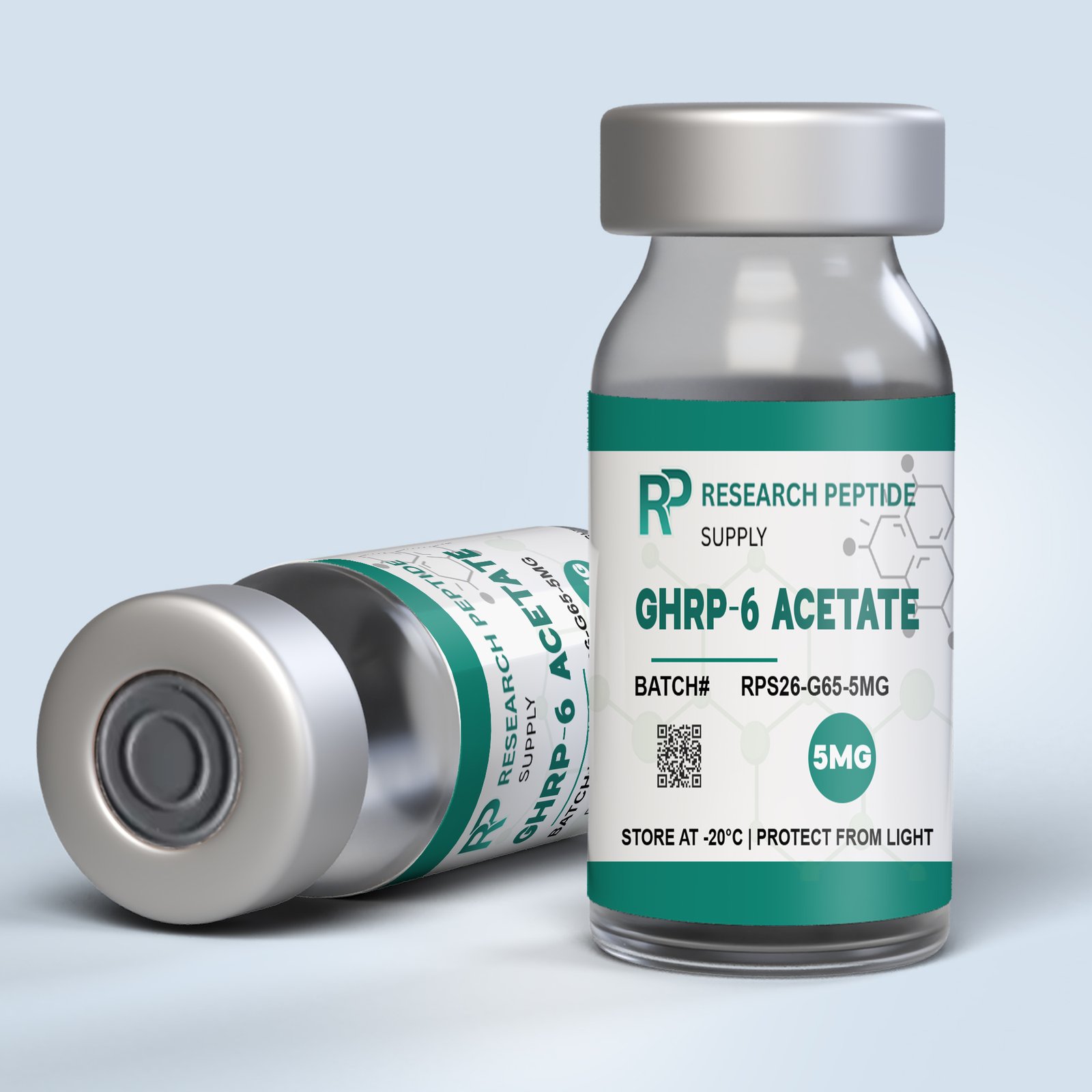
GHRP-6 Peptide | Growth Hormone Releasing Peptide-6 (Research Grade)
GHRP-6 peptide, also known as Growth Hormone Releasing Peptide-6, is one of the most extensively studied synthetic GH secretagogues in peptide research. As a six-amino-acid hexapeptide with the sequence His-D-Trp-Ala-Trp-D-Phe-Lys-NH₂, GHRP-6 works by directly binding to the ghrelin receptor (GHSR1a) in the pituitary gland, triggering a robust and measurable release of endogenous growth hormone (GH). For researchers, biochemists, and laboratory professionals seeking a reliable and well-characterized growth hormone releasing peptide, GHRP-6 represents a cornerstone compound with a decades-long research track record.
What Is GHRP-6 Peptide?
GHRP-6 belongs to a class of synthetic peptides known as growth hormone secretagogues (GHS) — compounds that stimulate the pituitary gland to secrete growth hormone. First developed in the 1980s during research into synthetic analogs of met-enkephalin, scientists discovered that certain peptide sequences could potently stimulate GH release from the anterior pituitary gland. This breakthrough led to the development of a new generation of GH-releasing peptides, including GHRP-2, GHRP-6, and the later-developed Ipamorelin.
Unlike Growth Hormone Releasing Hormone (GHRH) — the naturally occurring hormone that also stimulates GH release — GHRP-6 operates through a distinct receptor pathway, making it a valuable tool for studying dual-pathway GH regulation in laboratory settings. When combined with a GHRH analog such as CJC-1295 or Sermorelin, research has demonstrated synergistic amplification of GH pulses, making GHRP-6 a popular component of multi-peptide research stacks.
Mechanism of Action: How GHRP-6 Works
The primary mechanism of GHRP-6 involves agonism of the GH secretagogue receptor 1a (GHSR1a), which is also the receptor that the endogenous hunger hormone ghrelin binds to. By activating this receptor, GHRP-6 achieves two simultaneous effects in research models:
- Stimulates growth hormone release from the anterior pituitary gland
- Suppresses somatostatin — the hormone responsible for inhibiting GH release — thereby re-opening the GH release window
This dual action makes GHRP-6 particularly effective at producing strong, pulsatile GH secretion in controlled laboratory environments. Research has confirmed that GH release is most pronounced when the peptide is administered in a fasted state, as elevated insulin and blood glucose levels are known to blunt pituitary responsiveness to GHSR1a agonists.
Additionally, GHRP-6 has been shown in preclinical studies to bind to the CD36 receptor, suggesting potential cytoprotective and anti-inflammatory mechanisms beyond its endocrine effects — areas of growing scientific interest.
Key Research Areas for GHRP-6 Peptide
Scientific literature has explored a wide range of potential applications for GHRP-6 in preclinical and in vitro research settings. Below are the primary areas of investigation:
1. Growth Hormone Stimulation & Endocrine Research
GHRP-6 is primarily studied as a potent GH secretagogue. Research consistently demonstrates its ability to trigger significant, dose-dependent GH pulses in animal models. This makes it an essential tool for researchers studying the hypothalamic-pituitary axis, GH deficiency models, and the pharmacology of GH secretagogue receptors.
2. Lean Muscle Tissue & Anabolic Signaling
Increased GH levels triggered by GHRP-6 stimulate the liver to produce Insulin-like Growth Factor 1 (IGF-1), a downstream anabolic hormone. Preclinical studies have reported increases in lean muscle mass in rodent models, positioning GHRP-6 as a compound of interest in research on sarcopenia, muscle-wasting diseases, and anabolic signaling pathways.
3. Fat Metabolism & Body Composition
Elevated GH and IGF-1 levels are associated with enhanced lipolysis — the breakdown of fat cells for energy. Research suggests that GHRP-6 may support improvements in body fat reduction and metabolic rate in research subjects, making it a candidate compound for obesity and metabolic disorder research.
4. Wound Healing & Tissue Repair
Published studies have demonstrated that GHRP-6 exhibits notable anti-fibrotic and wound-healing properties. In preclinical wound models, GHRP-6 administration was associated with improved healing outcomes, reduced fibrotic tissue formation, and better aesthetic results — outcomes attributed to its ability to modulate gene expression involved in mesenchymal cell response to injury.
5. Cardioprotection Research
Emerging research has identified GHRP-6 as a potential cardioprotective agent. Studies have investigated its ability to prevent cardiac cell death, reduce left ventricular failure, and attenuate myocardial damage in chemotherapy-induced cardiomyopathy models. Its activation of pro-survival cellular pathways — including the PI-3K/AKT1 signaling cascade — underpins this area of growing research interest.
6. Organ Protection & Anti-Inflammatory Effects
Research published in peer-reviewed journals has shown GHRP-6 pre-treatment may significantly reduce organ damage caused by ischemia/reperfusion injury, with reductions in hepatic, intestinal, lung, and renal damage markers observed in preclinical studies. Its ability to suppress neutrophilic infiltration and lipid peroxidation positions it as a candidate for multi-organ protection research.
7. Sleep Quality & Recovery
Preclinical investigations have also explored GHRP-6’s potential role in improving sleep architecture, particularly slow-wave (deep) sleep stages. Given that growth hormone is naturally secreted in its greatest quantities during deep sleep, GHRP-6’s influence on sleep-related GH pulsatility is an active area of study.
GHRP-6 vs. Related Peptides: Research Context
| Peptide |
Receptor Target |
Primary Research Focus |
| GHRP-6 |
GHSR1a, CD36 |
GH stimulation, appetite, cytoprotection |
| GHRP-2 |
GHSR1a |
GH stimulation, anti-inflammatory |
| Ipamorelin |
GHSR1a |
GH stimulation (selective, minimal ghrelin effect) |
| CJC-1295 |
GHRH receptor |
Extended GH pulse amplification |
| BPC-157 |
Multiple |
Tissue repair, gut healing |
Researchers frequently stack GHRP-6 with CJC-1295 or Sermorelin to produce synergistic GH release, or combine it with BPC-157 or TB-500 for studies focused on tissue recovery and inflammation reduction.
Quality & Purity Standards
Our research-grade GHRP-6 peptide is synthesized using solid-phase peptide synthesis (SPPS) and subjected to rigorous quality control processes, including:
- High-Performance Liquid Chromatography (HPLC) purity verification
- Mass Spectrometry (MS) for identity confirmation
- Third-party independent laboratory testing
- Certificate of Analysis (CoA) available upon request
Every batch of GHRP-6 is manufactured to meet the precise specifications required for consistent, reproducible experimental results in controlled research environments.
Important Disclaimer
This product is intended for research and laboratory use only. GHRP-6 peptide is not approved by the FDA or any other regulatory authority for human consumption, therapeutic use, or veterinary application. It is not a dietary supplement, drug, or food product. All purchases are made with the understanding that the compound will be used strictly within a licensed research setting by qualified professionals. This product should not be self-administered.