


Blog
Buying weight loss peptides online with lab-verified purity

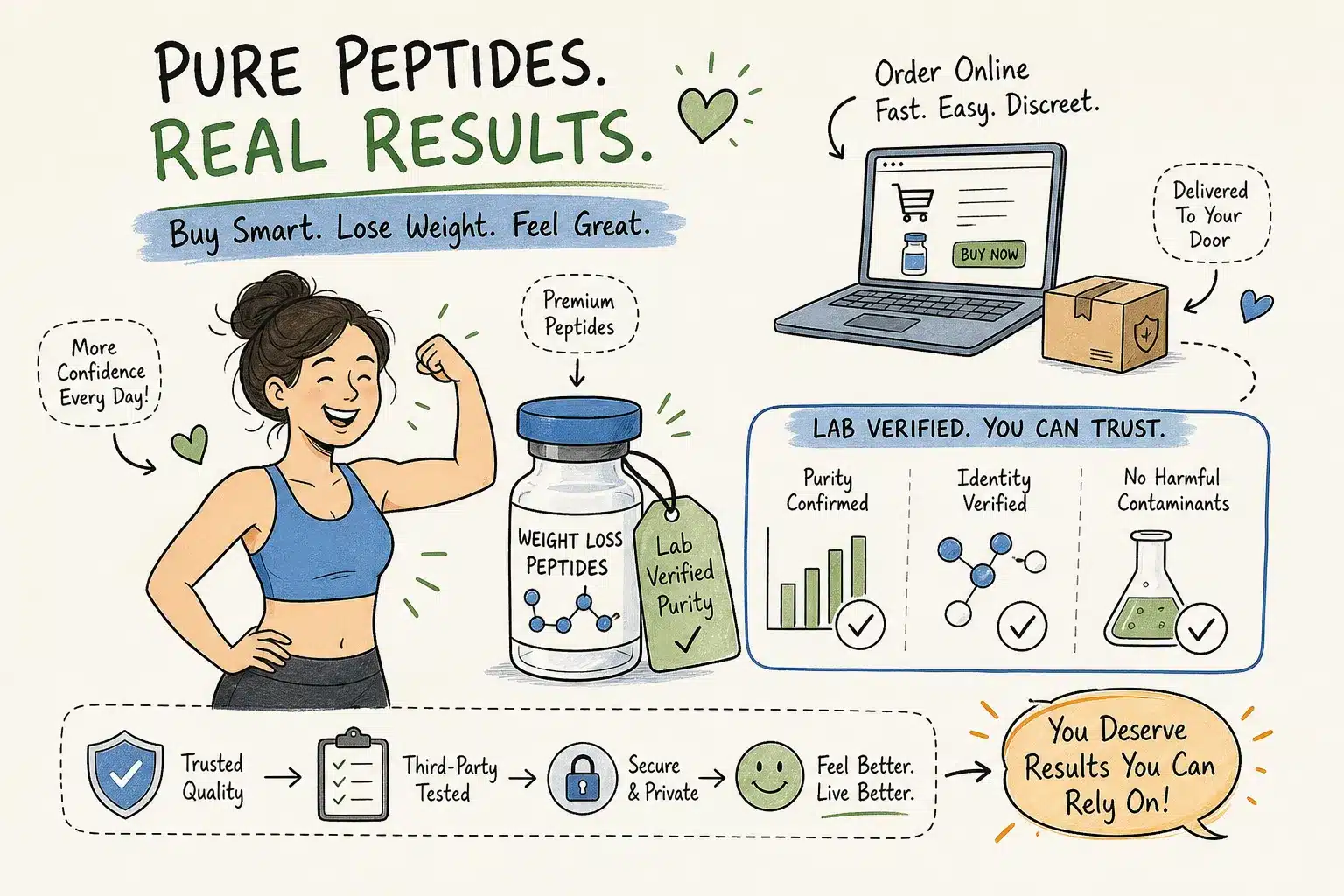
When you need to buy weight loss peptides online with lab verified purity, the difference between a legitimate source and a marketing mirage often comes down to a single document: the COA. You find a supplier listing Tirzepatide vials at a price that undercuts everyone else. The product page says “high purity, lab tested” and the checkout process looks clean. But when you go looking for the actual COA, there is nothing there, just a marketing claim dressed up to look like documentation. This scenario is frequently encountered in the research peptide market, and it is exactly why sourcing weight loss research peptides online requires more than price comparison.
Lab-verified purity is not a marketing tier. It is a specific, traceable claim: a batch was tested by an independent analytical laboratory using HPLC or LC-MS, and the resulting data is published alongside that lot number. R-Peptide Supply (Grey Peptide Shop) builds its catalog around this standard, publishing batch-specific COAs for weight loss peptides including HGH Fragment 176-191 and Tirzepatide. That kind of transparency is what you should be measuring every other supplier against when you buy weight loss peptides online with lab verified purity.
By the time you finish this guide, you will have a concrete framework for evaluating any peptide seller’s documentation, from purity thresholds to chromatogram reading to supplier red flags, no guesswork required.
What lab-verified purity actually means for research peptides
“High purity” on a product page is a marketing phrase. It carries no technical obligation and no traceable data. Lab-verified purity means a specific batch was physically submitted to an analytical laboratory, tested under documented conditions, and the resulting report with the lot number is published where buyers can access it. The distinction is not semantic; it is the difference between a claim and a result.
Research-grade purity tiers follow a standard progression. Crude material below 70% is typically limited to rough screening applications. Functional-grade material in the 85, 90% range handles many biological activity assays and enzyme studies. For weight loss research peptides, the practical floor is 95% area purity by HPLC, and 98, 99%+ is the standard for quantitative or dose-sensitive work where impurity profiles can affect outcomes. Research guidance specifically recommends 99%+ for particularly sensitive sequences like HGH Fragment 176-191 and AOD-9604 used in demanding in vivo or quantitative studies. Suppliers listing these compounds at 99%+ purity are meeting the right target for this category.
Most research peptides sold in the US grey market carry a Research Use Only (RUO) designation. This means they are sold as compounds intended for laboratory research, not for human consumption. A legitimate supplier states the RUO status clearly on each product page and on the COA itself. If that language is absent, the supplier is not operating with full compliance framing, which is reason enough to look elsewhere.
Which weight loss research peptides demand close purity scrutiny
Among the most commonly sourced compounds in this category are HGH Fragment 176-191, AOD-9604, Tirzepatide, Semaglutide, and Ipamorelin. HGH Fragment 176-191 is a truncated analog of growth hormone studied for its relationship to fat metabolism pathways. AOD-9604 shares the same core sequence in most product contexts. Tirzepatide is a dual GIP/GLP-1 receptor agonist that has drawn significant research attention, as has Semaglutide, another GLP-1 receptor agonist. Ipamorelin functions as a growth hormone secretagogue with indirect relevance to metabolic and body composition research.
Synthesis complexity is directly proportional to purity risk. Longer, more structurally involved peptides like Tirzepatide accumulate more truncation byproducts, deletion sequences, and oxidation products during manufacturing than shorter peptides do. This makes COA verification even more critical for these compounds. A buyer who accepts a purity claim without seeing the HPLC trace for Tirzepatide is accepting an unknown impurity profile, which creates real problems for any quantitative research application.
Lyophilized vials are the research standard for this class of compounds. Freeze-dried peptides maintain stability far longer than liquid formulations and are the expected format for wholesale ordering. If you encounter a supplier offering weight loss peptides in pre-mixed liquid form, scrutinize the carrier composition and any sterility documentation alongside the COA. Lyophilized material with a clean COA is the lower-risk option for bulk procurement.
How to read a peptide COA from start to finish
Required fields on every complete COA
A complete COA contains several non-negotiable fields. Any COA that omits these elements is incomplete, and an incomplete COA is not adequate documentation for research use:
- Peptide name and full sequence
- Lot or batch number
- Testing date
- Issuing laboratory name
- HPLC purity percentage expressed as area%
- Observed molecular weight from mass spectrometry
- Analytical method details: column, mobile phase, gradient, and detection wavelength
For a practical walkthrough that expands on these fields and shows example COA images, see this resource on how to read a peptide certificate of analysis (COA).
Reading the HPLC chromatogram
The HPLC purity percentage is calculated as the target peptide peak area divided by the total UV-detected peak areas in the chromatogram. When you look at the chromatogram image itself, you want to see one dominant, sharp, symmetrical peak for the target compound with minor secondary peaks that collectively account for the remaining fraction. Multiple large peaks of comparable size are a meaningful impurity signal, regardless of what the headline purity number states. If the chromatogram is not included on the COA, the purity number has no visual support and cannot be independently interpreted.
Mass spectrometry identity confirmation
The mass spectrometry section serves a different function. It confirms identity by matching the observed molecular weight against the theoretical molecular weight for the peptide. This is the identity check, not the purity check. A compound can pass MS and still carry significant impurities in the HPLC trace. Both HPLC and MS data together constitute a complete verification package for third-party tested peptides. Either one alone is insufficient for confident sourcing. For methods on verifying COA data and cross-checking MS/HPLC results, review guidance on how to verify a peptide COA.
Red flags that signal a supplier is cutting corners on documentation
COA-specific problems are the clearest signal that a supplier should not be trusted. Watch for these issues before placing any order:
- A single COA covering “all batches” with no lot-specific data
- A purity percentage stated without a chromatogram image
- Missing mass spectrometry data or observed molecular weight
- No named third-party laboratory attribution
- A batch number on the COA that does not match the vial labeling
Supplier behavior outside the COA is equally telling. Vendors who do not publish COAs publicly on their product pages, who require you to request documentation after purchase, or who list peptides without lot numbers visible at the product level are not treating transparency as a priority. Transparency is a baseline, not a premium feature in this market. If it is not present before you pay, it is unlikely to improve afterward.
Pricing that sits drastically below market rates for verified material deserves skepticism. Producing high-purity research peptides, submitting batches to independent labs, and publishing accurate HPLC and MS documentation costs money. When a peptide supplier USA buyers rely on undercuts that reality significantly, the most likely explanation is that something in the verification chain has been skipped. The broader point, that independent validation is central to quality, is covered in detail in discussions about why laboratory validation matters in peptide quality.
How R-Peptide Supply approaches COA-verified sourcing for weight loss peptides
R-Peptide Supply (Grey Peptide Shop) publishes batch-specific COAs for its weight loss peptide catalog, including compounds like HGH Fragment 176-191 and Tirzepatide. Each COA includes HPLC purity documentation and mass spectrometry identity confirmation tied to the specific lot. This is what transparent documentation looks like in practice: traceable, batch-specific, and accessible before purchase rather than available only on request, the standard researchers should expect when they buy weight loss peptides online with lab verified purity.
For labs and resellers ordering in volume, the pricing structure is built for wholesale quantities. Multi-vial bundle formats reduce per-compound costs, and the combination of verified quality documentation and wholesale pricing is the value proposition that single-compound vendors rarely match. R-Peptide Supply also stocks the ancillary supplies that complete the reconstitution workflow, bacteriostatic water, acetic acid water, and benzyl alcohol, which shortens procurement lead time and removes one variable from the ordering process. For guidance on procuring in larger quantities and best practices for lab procurement, consult the bulk procurement guide.
Storage and ordering practices that protect purity after purchase
Lyophilized peptides preserve their verified purity longest when stored at -20°C in dry, dark, airtight conditions. For especially labile sequences, -80°C storage is preferred. Desiccant packs inside storage containers add an additional layer of protection against moisture uptake, the primary degradation driver for lyophilized material. Let any vial equilibrate to room temperature before opening so condensation forms on the outside of the vial rather than inside it, which would introduce moisture directly to the peptide. Additional practical tips are available in the peptide storage best practices guidance.
One ordering mistake that costs researchers more than they expect: reconstituting an entire vial when only a portion is needed. Once reconstituted, peptide stability drops significantly compared to the lyophilized state. Plan your reconstitution schedule around what will be used within a few days, not around total volume on hand. For bulk orders, aliquot into smaller sealed portions before any reconstitution to extend the usable shelf life of the remaining material. For deeper storage specifics, see external recommendations on peptide storage best practices.
Lot number recording is a practical quality control step that matters more as order volume increases. When you receive a bulk shipment, note the lot numbers and match them to the supplier’s published COA at the time of receipt. This preserves traceability through your entire workflow, standard practice for any lab operating with documented quality control and essential if you need to correlate experimental outcomes with specific batch data.
Sourcing verified peptides is a process, not a guess
The framework here is repeatable: understand the purity tier your research requires, confirm the COA contains HPLC area% with a chromatogram and MS identity data, check that the lot number matches the documentation, and evaluate the supplier’s transparency before the purchase rather than after. These steps take minutes and filter out the majority of unreliable vendors in this market. For a deeper supplier evaluation walkthrough, consult our complete buyer’s guide.
When you buy weight loss peptides online with lab verified purity, the process is straightforward once you know what the documentation should look like. The compounds are available, the analytical standards are clear, and peptide suppliers USA researchers trust publish the evidence. The job of the buyer is to verify before committing, not after.
R-Peptide Supply (Grey Peptide Shop) is a COA-transparent source for researchers and resellers who need verified weight loss research peptides at wholesale pricing. Explore the catalog, verify the batch-specific documentation, and order knowing exactly what is in the vial before it ships.