


Blog
The GLOW Stack Explained: BPC-157, GHK-Cu & TB-500 Research

Single-compound peptide research has a ceiling. Researchers studying skin regeneration and tissue repair are increasingly moving toward stacked protocols that address multiple phases of the healing cascade simultaneously, rather than optimizing one pathway while leaving others untouched. That shift in research design is exactly what makes the glow peptide stack worth understanding.
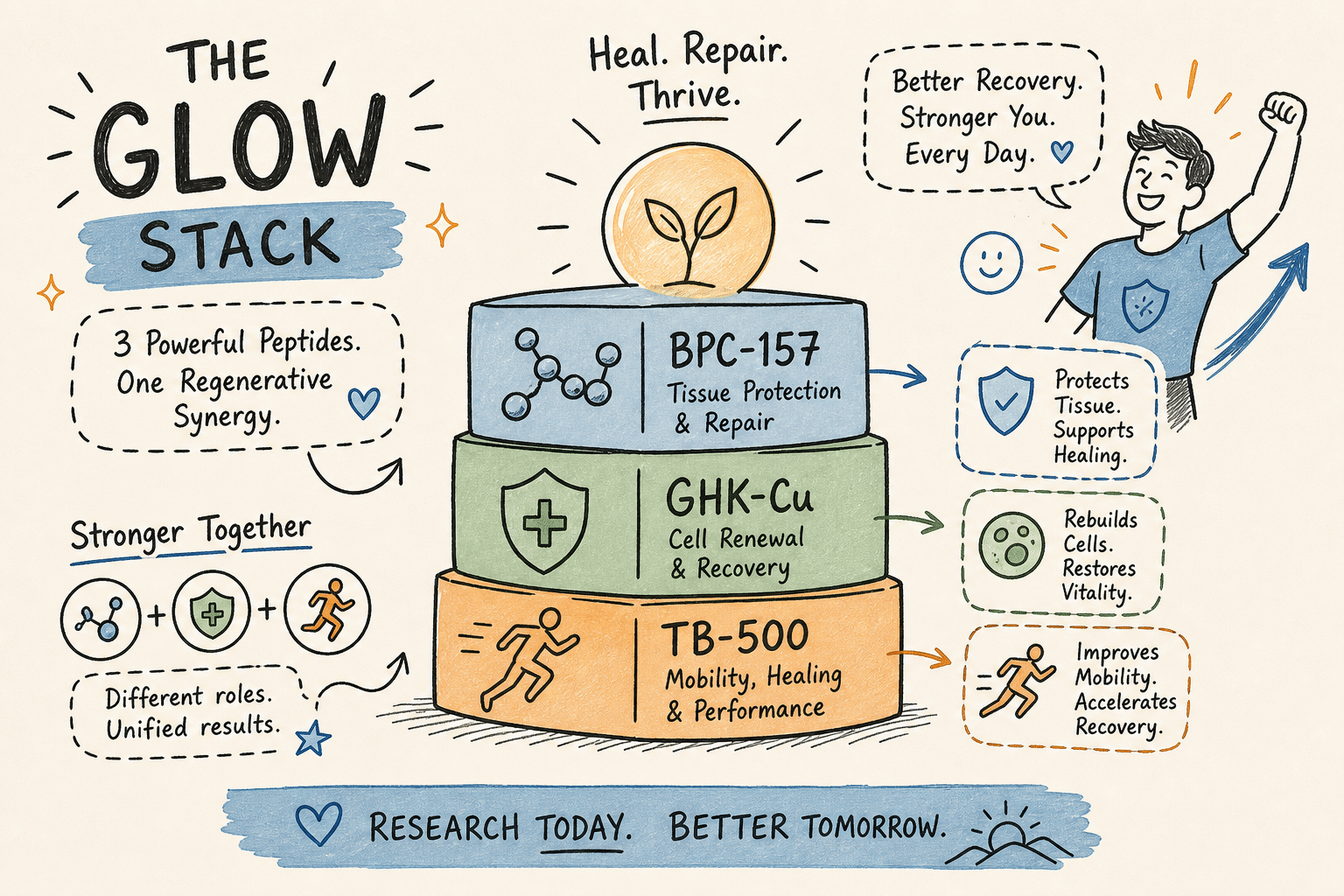
The GLOW peptide stack is a three-compound blend combining BPC-157, GHK-Cu, and TB-500. Each compound targets a distinct mechanism in tissue repair, and together they provide overlapping coverage across collagen synthesis, cell migration, vascular support, and inflammation resolution. The combination has been discussed in preclinical literature and adopted anecdotally by some independent researchers, wellness clinics, and biotech labs working on skin regeneration and recovery protocols. Suppliers like R-Peptide Supply (Grey Peptide Shop) have responded by offering the GLOW stack as a pre-formulated, COA-verified blend so labs can skip the sourcing and blending work on three separate compounds.
This article breaks down what each compound does, what the preclinical and clinical evidence actually shows, how research protocols are structured, and what it costs to source the stack responsibly.
Glow peptide stack: what it is and why researchers combine these three compounds
The GLOW stack is a specific formulation, not a generic label for any peptide trio. The logic behind combining these three compounds is mechanistic: each one engages a different phase or pathway in the tissue repair process. BPC-157 handles early angiogenesis and anti-inflammatory signaling. GHK-Cu operates at the gene-expression level, driving collagen remodeling and extracellular matrix regeneration. TB-500 fills a third lane by promoting keratinocyte and fibroblast migration to wound sites. No single compound covers all three of these functions effectively, which is the core rationale for studying them as a stack.
Structurally, they are entirely different molecules. BPC-157 is a synthetic pentadecapeptide derived from human gastric juice. GHK-Cu is a copper-chelated tripeptide that occurs naturally in human plasma, with plasma concentrations declining sharply with age. TB-500 is a synthetic version of Thymosin Beta-4, a naturally occurring protein that regulates actin dynamics and cellular motility. Because they have distinct structural identities and distinct research profiles, they function as complements rather than substitutes for each other.
How each compound in the glow peptide stack targets skin repair and tissue recovery
BPC-157: angiogenesis, collagen production, and inflammation control
BPC-157 activates the Akt-eNOS pathway to drive nitric oxide signaling and upregulate VEGF and VEGFR2 activity, which promotes new capillary formation and improves oxygen delivery to wound sites. It simultaneously upregulates growth hormone receptors in fibroblasts, accelerating collagen fiber production, granulation tissue formation, and re-epithelialization. Animal studies consistently show it shifts macrophages from the pro-inflammatory M1 phenotype to the reparative M2 phenotype, reducing cytokines including TNF-alpha and IL-6. This anti-inflammatory shift makes it a strong candidate for early-phase intervention in skin repair models, where uncontrolled inflammation slows downstream repair processes. Human clinical use of BPC-157 remains limited and is primarily anecdotal or clinic-reported, with no approved indication as of 2026. For an overview of BPC-157 in dermatologic research, see Use of BPC-157 peptide therapy in skin diseases.
GHK-Cu: gene-level remodeling and antioxidant activity
GHK-Cu operates on a different timescale and at a deeper biological level than BPC-157. Rather than primarily triggering growth factors, it modulates gene expression at scale. A 2010 genomic analysis by Pickart and Margolina identified over 4,000 human genes modulated by GHK-Cu, with expression shifts favoring collagen I and III, elastin, and glycosaminoglycans, while activating fibroblasts through TGF-beta and metalloproteinase pathways for extracellular matrix remodeling. Human trials on photoaged skin have reported measurable wrinkle reduction and faster wound closure, making GHK-Cu the compound in the stack with the most skin-specific human-facing data. Several small published trials, primarily using topical formulations, consistently show improvements in skin density, collagen content, and photodamage markers. One ultrasound imaging study documented a notable increase in subdermal collagen density over three months, though independent replication of that specific figure is still pending. For a broader, peer-reviewed look at peptide mechanisms and tissue repair, consult the review available on PubMed Central: PubMed Central review on peptide mechanisms.
TB-500: cell migration, re-epithelialization, and fibrosis reduction
Actin binding drives keratinocyte and fibroblast migration toward wound sites, the structural mechanism that makes TB-500 distinct within the stack. Without efficient cell migration, even a well-vascularized wound heals slowly because structural repair cells never arrive at the site in sufficient numbers. TB-500 also upregulates VEGF independently and suppresses pro-inflammatory cytokines, supporting cleaner healing outcomes with reduced scar tissue formation. Rodent models from published preclinical data show 42% faster re-epithelialization at day 4 and 61% faster re-epithelialization at day 7 compared to saline controls, with wound contraction running 11% faster. In diabetic mouse models, where healing is characteristically impaired, TB-500-treated subjects showed 40, 55% faster wound closure. For product-level reference and common TB-500 research specifications, see the TB-500 product information at Peptide Biologix: TB-500 product information.
What the existing research actually shows
The evidence base for all three compounds is robust in animal models. BPC-157 in rodent studies consistently outperforms approved wound-healing agents like becaplermin (PDGF-BB) on histological markers including collagen organization, angiogenesis density, and re-epithelialization speed. GHK-Cu has the most translatable human data, with clinical trials demonstrating measurable outcomes in skin aging, photoaging, and burn recovery. TB-500 data is exclusively preclinical, with no published human RCTs available as of 2026. The combined GLOW stack itself has no standalone human clinical trial.
That is the honest picture: strong mechanistic and animal-model support across all three compounds, with GHK-Cu having moved furthest toward human validation, but the synergistic effect of combining all three remains a research hypothesis rather than a clinically validated outcome. For researchers designing studies around this stack, that distinction matters. The current evidence level makes the stack appropriate for studying combined healing mechanisms in preclinical models and for exploratory clinic protocols, not for drawing definitive human therapeutic conclusions.
The lack of Phase III data for BPC-157 and TB-500 is a known and acknowledged limitation in the published literature. GHK-Cu’s topical application has the most translatable human data, which is why some clinic protocols use it topically while injecting the other two compounds subcutaneously. Understanding where each compound sits on the evidence continuum helps researchers and clinicians design more defensible protocols.
Common research protocols and dosing ranges for the GLOW stack
Research protocols and compounding pharmacy programs follow a consistent pattern: start with daily administration, taper frequency through the protocol cycle, and build in a rest interval before cycling again. This cycling structure became standard in research settings because it prevents receptor desensitization and avoids overstimulation of the repair pathways.
Dose ranges by compound in research settings:
- BPC-157: 200, 500 mcg per day; a common split-dose example is 250 mcg twice daily (500 mcg/day), administered subcutaneously over 2, 4 week intervals.
- TB-500: 4, 8 mg per week during a 4, 6 week loading phase, dropping to 2, 4 mg per week in maintenance.
- GHK-Cu: 0.5, 2 mg per day when injected subcutaneously; topical application at 0.1, 1% concentration once or twice daily is common in clinic settings given GHK-Cu’s strong transdermal profile.
Phased protocols from compounding pharmacy and clinic sources follow daily administration for weeks 1, 4, reducing to five times per week through week 8, then two to three times per week through weeks 9, 12. A rest interval of 2, 8 weeks follows before cycling again. Some clinics use a “5 on/2 off” micro-cycle structure throughout, injections Monday through Friday with weekends off, which maintains efficacy while reducing tolerance risk. Subcutaneous injection into the abdomen or thigh with a 30, 31 gauge insulin syringe is the standard route for BPC-157 and TB-500. Vials are reconstituted with bacteriostatic water at roughly 3 mL per vial, and the blend is drawn in 0.1 mL increments.
Side effects, safety flags, and what researchers need to know
No compound in this stack is FDA-approved for human use. Every protocol involving this blend sits in research-use territory, and researchers should understand the documented safety signals before designing studies or recommending protocols to clients.
The most commonly reported issues are local injection site reactions: redness, swelling, itching, and tenderness at the administration point. Systemic reactions are less common but include headaches, temporary nausea, fatigue, and sleep disruption. Facial flushing has been reported anecdotally in some users, typically appearing within the first two weeks. These effects are generally mild and resolve without intervention. Rare but more serious reactions include allergic responses and, with prolonged or excessive use, potential hormonal imbalance and elevated blood glucose.
The stack is contraindicated in subjects who are pregnant or breastfeeding, have active cancer or uncontrolled chronic illness, or carry autoimmune conditions. Individuals on medications affecting immune function or cellular growth pathways should not enter a peptide research protocol without medical supervision. Long-term human safety data does not yet exist for multi-peptide stacks, which means risk estimates beyond 12-week cycles are extrapolated from single-compound data rather than drawn from direct evidence.
Sourcing a research-grade glow peptide stack: costs and COA requirements
Sourcing is the most significant practical risk with this stack, more so than the compounds themselves. Contamination from endotoxins or microbes, incorrect dosing from mislabeling, and product degradation from improper storage are the documented failure points when researchers purchase from unverified suppliers. The compounds cannot do their job if the vial contains something other than what’s on the label.
Clinic-administered GLOW programs in the US run from $370 to $600 per protocol cycle, with most providers adding $100, $200 for the initial consultation. Research kit pricing from peptide suppliers is significantly lower, with pre-formulated GLOW blends typically ranging from $100 to $200 per vial. DIY formulation from separately sourced compounds adds blending labor and per-compound verification costs that often exceed the price of a pre-formulated blend. For labs and resellers purchasing in volume, wholesale multi-vial formats bring the per-unit cost down further. If you prefer to purchase BPC-157 and TB-500 separately for custom blends, see Buy BPC 157 and TB500, Research Peptides Supply.
When evaluating any supplier for the glow peptide stack, researchers should request a lot-specific Certificate of Analysis that documents HPLC-verified purity, lot traceability, absence of contaminants, assay content per compound per vial, testing methods, analyst sign-off, and batch date. These elements are what make a COA meaningful rather than decorative. For practical guidance on what a COA should include, consult Certificates of Analysis: what researchers need to know. R-Peptide Supply (Grey Peptide Shop) offers the GLOW stack as a pre-formulated blend combining BPC-157, GHK-Cu, and TB-500 in a single vial, with a lot-specific COA attached to each batch. For labs that do not want to source three separate compounds, reconstitute them independently, and verify purity on each individually, a pre-formulated option with full documentation removes meaningful friction from the research workflow. Bulk and multi-vial formats are available for volume purchasing. See the product page: GLOW (BPC 157 10mg + GHK-CU 50mg + TB500 10mg) 70mg × 10 vials, Research Peptides Supply.
The case for a stacked approach and where to go from here
The GLOW peptide stack brings three well-characterized compounds together around a shared goal: comprehensive coverage of the tissue repair cascade. BPC-157 handles the vascular and anti-inflammatory load in early-phase healing. TB-500 drives keratinocyte and fibroblast migration and keeps fibrosis in check. GHK-Cu brings gene-level collagen remodeling, antioxidant support, and the stack’s most robust human-facing evidence base. The combined preclinical case is consistent, and the protocols emerging from research clinics provide a solid starting framework for researchers designing their own studies.
Human data remains limited, particularly for TB-500 and the combined stack formulation. Anyone moving toward clinical application of this blend should work with a qualified clinician who can supervise dosing, monitor response, and adjust protocols based on individual biology. That boundary is not rhetorical, it defines what responsible research use of these compounds actually looks like in 2026.
For researchers ready to study the stack, the starting point is a supplier who can verify what is in the vial. R-Peptide Supply’s COA-backed GLOW blend is built for exactly that workflow: transparent sourcing, documented purity, and the lot-level traceability required for rigorous research. For additional protocols, updates, and supplier resources, see the Blog, Research Peptides Supply.
The glow peptide stack is increasingly being recognized for its potential in modern regenerative medicine.
Many researchers are harnessing the glow peptide stack to explore new treatments for skin conditions.
Utilizing the glow peptide stack can offer a synergistic effect that enhances healing.
The glow peptide stack represents a novel approach in peptide therapy.
As more studies emerge, the glow peptide stack is gaining traction for its efficacy.
Clinical trials are beginning to validate the effectiveness of the glow peptide stack.
The glow peptide stack could redefine how we approach tissue repair in the future.
Incorporating the glow peptide stack into treatment protocols has shown promising results.
Researchers are excited about the potential of the glow peptide stack in regenerative therapies.
Understanding the glow peptide stack is crucial for future advancements in peptide research.
The glow peptide stack is being extensively studied in various clinical settings.
Innovations in therapy are possible with the glow peptide stack at the forefront.
Research on the glow peptide stack continues to evolve with new insights.
Many healthcare providers are adopting the glow peptide stack in practice.
By leveraging the glow peptide stack, patients may experience enhanced recovery.
The glow peptide stack holds potential for treating various skin conditions effectively.
Understanding the glow peptide stack will be essential for future drug development.
As interest grows, the glow peptide stack could become a staple in regenerative medicine.
Utilizing the glow peptide stack can lead to more effective treatment strategies.
The glow peptide stack is an exciting development in the field of peptides.
With the glow peptide stack, we can potentially improve patient outcomes significantly.
Research into the glow peptide stack showcases its unique benefits.
The glow peptide stack exemplifies the future of peptide therapy.
Considering the glow peptide stack’s capabilities is vital for ongoing studies.
Evaluating the glow peptide stack further could uncover additional therapeutic uses.
Ultimately, the glow peptide stack is set to influence future research trajectories.
Each component of the glow peptide stack plays a crucial role in its overall effectiveness.
The effectiveness of the glow peptide stack is an area of great interest among scientists.
Researchers are optimistic about the outcomes associated with the glow peptide stack.
In conclusion, the glow peptide stack may revolutionize the approach to skin healing.
Future studies are likely to focus on the glow peptide stack’s long-term benefits.
As we learn more, the glow peptide stack could prove invaluable for practitioners.
Trusting the process behind the glow peptide stack will lead to better patient care.
Finally, the glow peptide stack stands at the forefront of modern research.
One thought on “The GLOW Stack Explained: BPC-157, GHK-Cu & TB-500 Research”