


Blog
What Is BPC-157 Peptide? A Complete Research Overview

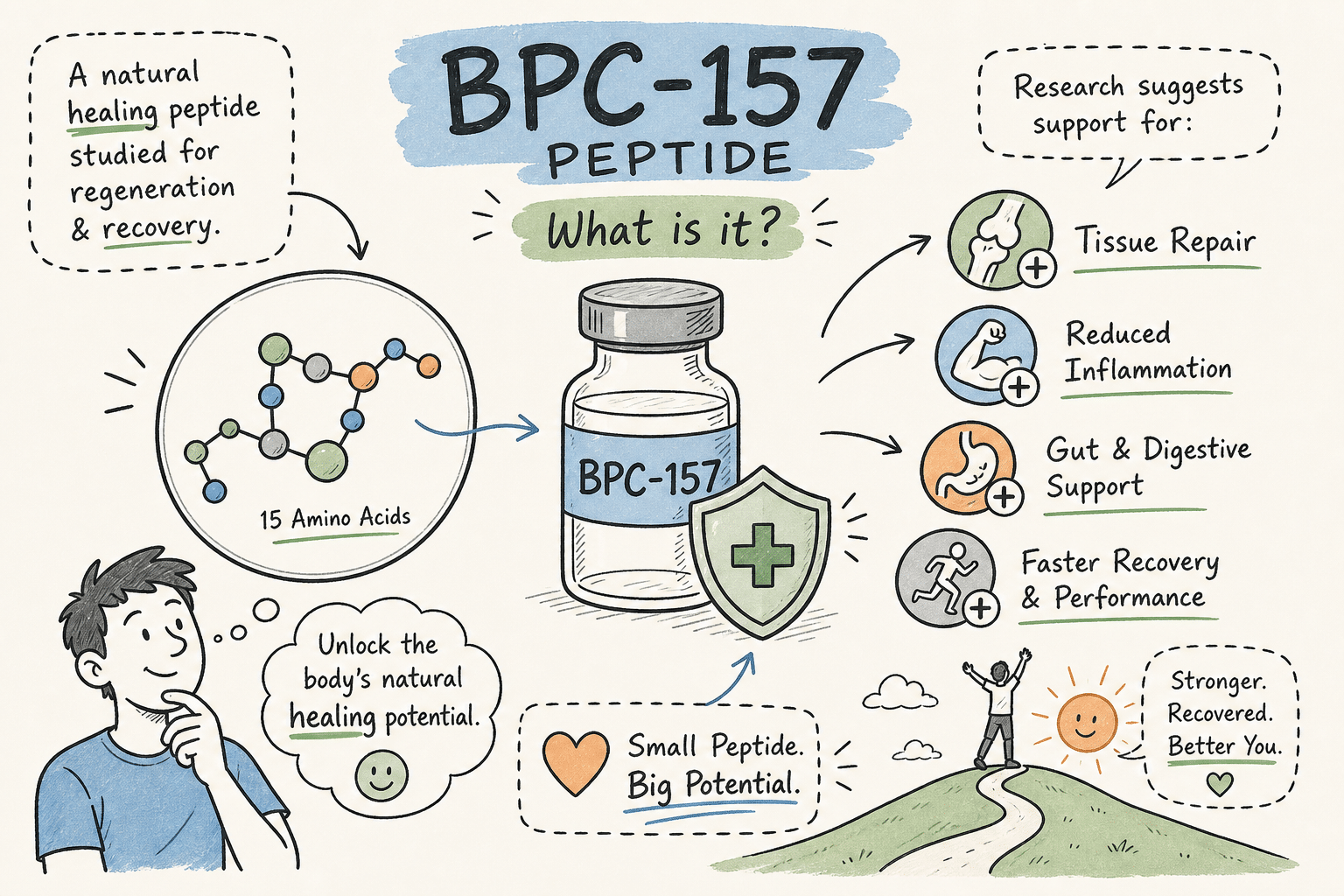
BPC 157 peptide (also written as bpc 157 peptide in research databases) is a synthetic pentadecapeptide derived from a partial sequence of a protective protein isolated from human gastric juice.
It consists of 15 amino acids (GEPPPGKPADDAGLV), carries a molecular weight of approximately 1,419 Da, and has been studied almost exclusively in pre-clinical settings since the early 1990s. This is a research overview, not a treatment guide. Every claim made here reflects the current state of the scientific literature, not clinical advice.
Interest in this compound has grown steadily over the past decade. The animal-model evidence base is unusually broad, covering musculoskeletal repair, GI cytoprotection, neurological modulation, and angiogenesis across dozens of studies.
That breadth has attracted labs, independent researchers, and pre-clinical teams who need reliable, traceable material to run reproducible protocols. For any BPC 157 peptide research program, sourcing matters: the RUO classification shapes everything downstream, including handling, labeling, and any claims made about the compound.
This article covers the compound’s molecular identity, mechanisms of action, pre-clinical findings, available human trial data, safety profile, and regulatory status as of mid-2026. Each section stays grounded in what the evidence actually shows.
BPC 157 Peptide: Molecular Identity and Research Classification
BPC 157 peptide is classified as a pentadecapeptide: a short-chain synthetic peptide small enough to demonstrate notable stability across the administration routes studied in animal models.
Its molecular formula is C62H98N16O22, and its sequence was derived from a fragment of Body Protection Compound, a protein naturally present in human gastric juice. Unlike larger biologics, its compact size contributes to gastric acid stability, which is part of why oral bioactivity has been observed in rodent studies.
In research settings, bpc 157 peptide carries a “research use only” (RUO) classification. It is not a pharmaceutical drug, not a dietary supplement, and not an approved biologic in any jurisdiction worldwide.
Labs and suppliers handle it under RUO documentation, meaning its intended use is strictly in-vitro and pre-clinical research. That classification is not administrative formality, it defines the legal and scientific context for every protocol that uses this material.
BPC-157 Peptide, Mechanisms of Action at the Molecular Level
BPC 157 peptide acts quickly at the transcriptional level. Within minutes of administration in rodent models, it upregulates a cluster of healing-associated genes including Akt1, VEGFR2, eNOS, Egr1, Kras, and Src, while simultaneously downregulating pro-inflammatory markers like Nos2 and Nfkb. One of its more consistently replicated mechanisms is growth hormone receptor (GHR) upregulation in tendon fibroblasts.
Studies using cDNA microarray and Western blot analysis show GHR mRNA and protein expression increasing up to sevenfold within days of exposure, sensitizing cells to GH-mediated proliferation without direct GH supplementation.
The nitric oxide system plays a central role in this compound’s documented activity. BPC 157 peptide strongly upregulates endothelial Nos3 and neuronal Nos1, suppresses inducible Nos2, and activates the Src/caveolin-1/eNOS pathway in vascular tissue.
Its pro-migratory and pro-angiogenic effects run through the ERK1/2 pathway; pharmacological ERK inhibition in both cell culture and animal models abolishes these effects entirely, confirming ERK’s centrality rather than incidental involvement. The EGR-1/NAB2 feedback loop adds another layer of control: EGR-1 expression peaks at 15 minutes and its corepressor NAB2 follows at 30 minutes, moderating angiogenic output to prevent excess vascularization.
This multi-pathway activation pattern is why bpc 157 peptide produces effects across different tissue types in pre-clinical models. It is not acting through a single receptor or a narrow signaling channel. Its pharmacokinetics in rodents confirm a short plasma half-life of roughly 15 minutes via IV administration, with rapid metabolism into standard amino acid pools and clearance through urine and bile.
The short half-life means the parent compound is transient, but the downstream gene expression cascades it initiates persist for hours to days. For a recent pharmacokinetics and distribution overview, see the pharmacokinetic literature summarizing distribution and metabolism in laboratory models (pharmacokinetics and distribution study).
What Over 30 Years of Animal Research Actually Shows
A 2024 systematic review covering 36 studies (35 pre-clinical, 1 clinical) spanning 1993 to 2024 provides the most comprehensive picture currently available. In rodent models, bpc 157 peptide consistently accelerates healing in tendons, ligaments, muscle, bone, skin wounds, and corneal tissue.
The GI findings are equally well-documented: cytoprotective activity in the gut lining, reversal of fistula formation, reduced inflammatory markers, and improved anastomosis healing. CNS research adds another dimension, with studies showing neuroprotective effects and modulation of dopamine-NO interactions in brain injury and drug-induced behavioral models. For an accessible review of the pre-clinical evidence base, see the peer-reviewed analysis that synthesizes many of these animal-model findings (systematic review and synthesis).
The breadth of tissue systems affected by a single 15-amino acid compound is what keeps bpc 157 peptide on the radar of serious researchers. At the same time, rodent physiology does not map perfectly onto human biology. Most studies use injury-induced models, chemical burns, surgical transections, toxin administration, that may not reflect the conditions present in typical human research contexts. Pre-clinical data is hypothesis-generating by nature. Every finding from this body of work requires human trial validation before any clinical interpretation is appropriate.
Human Trial Data: What Exists and What It Actually Tells Us
Human data on this compound remains sparse. Four data points stand out from the available literature. A Phase I trial (NCT02637284) testing oral BPC-157 tablets in healthy volunteers was registered on ClinicalTrials.gov but was ultimately canceled; the sponsor recalled the results before quality review, and no published outcomes exist from that study.
Early 2000s Phase II trials conducted in Croatia by Pliva for mild-to-moderate ulcerative colitis reported the compound as “safe and effective” and “free of side effects,” but full peer-reviewed publications from those trials do not appear in major databases, and the detailed methodology and outcome data remain publicly inaccessible. A primary clinical reference for the Pliva-era work is available in older indexed literature (early Pliva Phase II reference), but the public record lacks the full trial datasets needed for modern appraisal.
More recently, a 2025 pilot IV infusion study involving two healthy adults at doses up to 20 mg reported no adverse events and no clinically meaningful changes in vital signs, ECGs, or liver, kidney, thyroid, or metabolic panels. A retrospective intraarticular injection study with 12 patients found that 7 of 12 reported relief lasting more than six months after a single injection.
These data points suggest a favorable short-term safety signal, not efficacy proof. Sample sizes are too small, designs too varied, and follow-up too limited to draw any clinical conclusions. By any standard of evidence-based medicine, the existing human data is preliminary.
Safety Profile: What’s Observed and What Remains Theoretical
Observed Adverse Events
In the available human data, which is limited to small pilot and retrospective studies, BPC-157 produces primarily mild, transient reactions. Nausea and GI discomfort appear most frequently with oral administration. Dizziness, fatigue, headache, and injection site reactions including redness, warmth, and localized swelling show up across user reports and small studies.
No hepatotoxicity, nephrotoxicity, or confirmed cardiac damage appears in any reviewed human dataset. The compound’s derivation from a gastric protein is sometimes cited as a marker of inherent biological compatibility, though that reasoning does not substitute for proper clinical safety data from adequately powered trials.
Theoretical Risks
Theoretical concerns are worth naming clearly. Pathologic angiogenesis in cancer-prone individuals is a legitimate open question, given the compound’s documented pro-vascular mechanisms. Nitric oxide overproduction at high doses carries its own theoretical risks. Neither concern has been confirmed in human studies, nor has either been ruled out given the absence of long-term human data.
A separate risk category involves sourcing quality: contamination and peptide impurities from improperly manufactured material introduce hazards that are independent of the compound’s intrinsic properties. For this reason, researchers are generally advised to use RUO-labeled BPC-157 from suppliers who provide lot-specific HPLC-verified Certificates of Analysis and full chain-of-custody records.
Regulatory Status in 2026: FDA, WADA, and Research Sourcing
As of May 2026, BPC-157 remains unapproved by the FDA for any human use. The agency has placed it in Category 2 on the 503A bulk drug substance list, classifying it as a substance that “may present significant safety risks” due to concerns about immunogenicity, peptide-related impurities, and insufficient safety data across proposed administration routes.
This classification blocks compounding pharmacies from legally using BPC-157 under Section 503A of the Federal Food, Drug, and Cosmetic Act. A Pharmacy Compounding Advisory Committee meeting is scheduled for July 23, 24, 2026 to review bpc 157 peptide potential reclassification, but no formal status change has occurred as of this writing. The FDA’s guidance on certain bulk drug substances and compounding risks provides useful regulatory context (FDA guidance on bulk drug substances).
WADA lists BPC-157 under S0 (Unapproved Substances) on its Prohibited List, with no pathway for Therapeutic Use Exemptions given the absence of any regulatory approval. The US Department of Defense also prohibits it on the DoD Prohibited Dietary Supplement Ingredients List. These classifications reflect the compound’s status as an experimental research peptide, not a condemnation of its scientific interest. For labs and independent researchers conducting pre-clinical work, bpc 157 peptide remains legally obtainable under RUO terms.
Responsible sourcing means choosing suppliers who provide verified COAs with lot numbers, confirmed HPLC purity percentages, and full chain-of-custody documentation. R-Peptide Supply provides COA-verified, lot-traceable bpc 157 peptide in standard research formats with full chain-of-custody documentation; for researchers interested in combination formats, see their offering for BPC 157 Peptide + TB‑500, Research Peptides Supply.
What This Means for Researchers Working with BPC 157 Peptide
BPC-157 is a synthetic pentadecapeptide with well-characterized molecular mechanisms, an animal-model evidence base spanning more than three decades and 35-plus pre-clinical studies, and a thin but consistently favorable short-term human safety record. The gap between pre-clinical findings and clinical proof is real. The animal data is compelling and worth investigating further. The human data is too limited to support efficacy claims of any kind. Both of those statements are true simultaneously, and serious researchers hold both without collapsing one into the other.
The regulatory context is equally clear: unapproved by the FDA, prohibited by WADA, restricted by the DoD, and under active advisory review as of mid-2026. Researchers working with this compound operate within institutional protocols and RUO frameworks, not therapeutic ones. That distinction defines the legal and scientific boundaries for every protocol that uses this material.
For researchers evaluating the bpc 157 peptide, the purity and traceability of the material used directly shape the quality of every downstream result. Vials with verified COAs, confirmed purity percentages, and traceable lot numbers are not optional for reproducible lab work. R-Peptide Supply offers research-grade, COA-verified BPC-157 in multi-vial formats; full catalog details and documentation specifications are available on their website in their BPC-157 (5mg / 10mg) (10 Vail), Research Peptides Supply BPC 157 Peptide listing and related product pages (BPC-157 (5mg / 10mg) (10 Vail), Research Peptides Supply BPC-157 Peptide).
One thought on “What Is BPC-157 Peptide? A Complete Research Overview”